
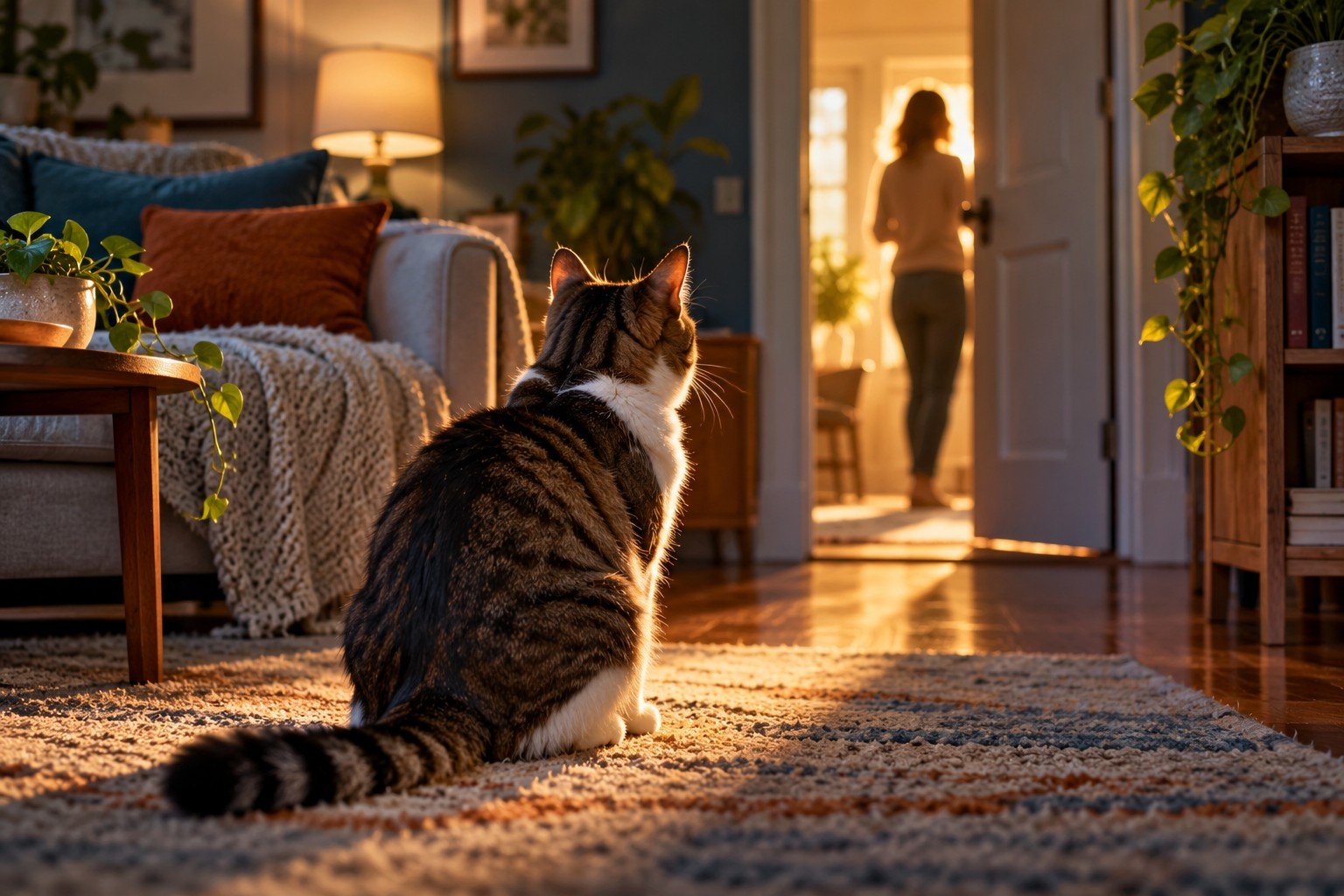
Can Cats Track Your Location by Voice? Inside the Hidden-Owner Experiment
Key takeaways
- The test crossed voice identity with speaker location rather than measuring a cat’s ability to follow a hidden person.
- Fifty cats participated in the owner-voice experiment; eighty-two video clips remained after trial exclusions.
- Surprise was rated from behavior by blinded observers, not reported by the cat.
- There was no stranger-voice habituation condition, limiting conclusions about owner specificity.
Your cat hears you in the hallway and looks toward a doorway. The response seems ordinary, yet it contains several possible questions. Did the animal detect a sound, identify the speaker or connect that person with a location it could no longer see?
Research on whether cats track an owner’s location uses recordings to separate those possibilities. A hidden person is difficult to control: footsteps, movement and timing can all provide information. Playback makes it possible to move an apparent voice while leaving the actual person out of the immediate scene.
The resulting evidence concerns expectations about an unseen social partner. It is more specific than a claim that cats always know where their people are, and more interesting than simply noting that an animal turned toward a loudspeaker.
How researchers test whether cats track your location
If one person speaks from one place and almost immediately seems to speak from a distant place, the sequence violates an ordinary spatial expectation. Researchers can ask whether an animal responds differently when the apparent speaker stays the same or changes.
The 2021 study by Takagi and colleagues placed one speaker outside a familiar room and another inside it. A cat heard its owner calling its name five times from the first location. A later playback varied both voice identity and speaker location.
The crucial comparison was not simply sound here versus sound there. It crossed two factors: the same or a different voice, from the same or a different location. This allowed the researchers to investigate whether the response depended on the relationship between identity and place.
Calling the scenario teleportation is a shorthand for the experimental violation. It does not mean the cat understood teleportation as a concept. The prediction is that a familiar individual apparently changing place too abruptly would produce a different behavioral response.
What the fifty-cat experiment measured when cats track your location
The owner-voice experiment included fifty domestic cats: twenty-three house cats and twenty-seven café cats. An additional five cats were excluded because of recording or sound problems. Each included cat experienced two location conditions within its assigned sound condition; eighteen unusable trials left eighty-two clips for ratings.
Eight blinded raters scored reactions on a five-point surprise scale. Test sounds were replaced with tones in the clips to conceal the experimental condition. The owner’s voice appearing from a different location produced the strongest ratings, supporting the predicted identity–location link.
The fifty cats supplied repeated observations, so the eighty-two clips were not eighty-two independent animals. The researchers used models that accounted for repeated ratings and cat identity. Blinding the raters also reduced the chance that knowing the expected result would shape their scores.
The method supplies a measurable behavioral pattern. It does not supply the cat’s verbal account of what was unexpected. Surprise is the researchers’ operational interpretation of visible reactions, which must remain connected to the rating procedure.
Why voice identity matters when cats track your location
A sound that appears in a new position may attract attention simply because something changed. If that were the whole explanation, changing place should be similarly important regardless of which voice was played. The crossed design makes that alternative testable.
Conversely, a new voice could attract attention because it is unfamiliar. That is why the different-voice conditions matter. An interpretation based on a particular owner being somewhere needs evidence beyond a general reaction to novelty.
The study’s pattern supports the proposal that the cats linked the familiar voice with an unseen individual’s position. It does not show that the animal constructed a detailed floor plan or represented every route the person could take.
A useful way to phrase the result is expectation about location. That wording preserves the cognitive question without turning an inferred representation into a literal picture inside the animal’s head. A mental representation need not resemble a human map.
What the controls did not test about how cats track your location
The researchers did not include a condition in which a stranger’s voice served as the repeated habituation voice. This limits conclusions about whether the effect is unique to owners rather than to familiarization with the first voice under the test conditions.
The paper also included experiments using cat vocalizations and nonsocial sounds. Those did not reproduce the same owner-voice pattern. The results narrow the interpretation, but differences in the stimuli and social relevance remain part of comparing the experiments.
It would therefore be too strong to conclude that cats map people but never other cats, or that only an owner can create a spatial expectation. The experiments tested particular recordings and histories, not every possible auditory relationship.
The strongest conclusion concerns a familiar voice apparently moving between two places during a brief playback sequence. Whether cats hold similar expectations for a newly encountered person, or retain them over a longer interval, remains open.
Knowing a voice is separate from how cats track your location
An earlier 2013 playback study tested twenty cats on recognizing their owners’ voices. That question concerns identity information in sound. It provides context for a later location experiment, but it does not itself demonstrate an expectation about where the owner is.
Likewise, detecting your own name and identifying the person saying it are distinct tasks. A familiar name can be spoken by several people. A familiar person can say many words. An experiment must decide which of those dimensions it is changing.
Our article on how dogs read human faces examines another form of social information. Comparing the work is useful when the sensory channel and outcome remain clear. A gaze response, an auditory reaction and a brain-scan signal are not interchangeable measures.
Together, such studies ask how animals extract useful information from their human environment. They do not establish that a cat or dog interprets every cue through the same concepts a person would use.
Speech style adds another layer to how cats track your location
A 2022 study of sixteen companion cats compared speech directed toward cats with speech directed toward adult humans. It found evidence of discrimination when the owner spoke, without the same pattern for a stranger’s speech.
That result concerns register and speaker context rather than location. It suggests that a recording is not just a package of words: the manner of speaking and the relationship with the speaker can be relevant to the task.
The location study should not be retroactively described as proving all of these abilities at once. Each design isolates different comparisons. Combining their conclusions responsibly means identifying what each contributes and where the connecting experiment is still missing.
For an owner, this is a reason to describe communication concretely. The same word said in a different tone or context may be a different learning situation. The studies do not provide a universal translation of every meow or glance.
Compare detection, identity and spatial expectation
| Question | Relevant experimental change | What the response cannot establish alone |
|---|---|---|
| Was a sound detected? | Sound versus an appropriate baseline | Who produced it |
| Was a speaker recognized? | Familiar versus unfamiliar voices | Where that person currently is |
| Was location expected? | Same voice switching place | A detailed map of the whole home |
| Was speech style discriminated? | Cat-directed versus adult-directed speech | Understanding every sentence |
This framework keeps related abilities from collapsing into a single claim that the animal understands us. The scientific contribution lies in identifying which information changes behavior, then testing what that information allows the animal to predict.
What a home observation can show about whether cats track your location
During everyday life, notice what other cues accompany a response to your voice. The cat may also hear footsteps, see a shadow or recognize the time of a routine. Those are meaningful parts of its environment, even though a playback experiment tries to control them.
If you describe an observation, keep the action and context together. The cat looked toward the hall after I spoke is a stronger starting description than the cat knew my exact position. The latter may be a hypothesis, but it adds information the observation has not isolated.
There is no need to surprise a pet with repeated recordings to test its intelligence. A home setup lacks the study’s counterbalancing, blinded ratings and controlled sound histories. A dramatic reaction might tell you more about the unfamiliar setup than about the targeted cognitive ability.
For an owner, the appealing possibility is that a familiar voice carries information about both a person and a place. That is a richer explanation than sound detection alone, even though the experiment cannot tell us exactly what a cat experiences when it hears someone elsewhere in the home.
Common questions about cats tracking owners
Does my cat always know where I am?
The study does not establish continuous tracking. It tests expectations after a defined sequence of voice playbacks in a familiar environment.
Did researchers prove a mental map?
They found behavior consistent with a representation linking the owner’s voice and location. A detailed, map-like model of the home is a stronger claim than the experiment tested.
Was surprise measured directly?
Raters evaluated visible behavior using a specified scale, and the researchers also examined orientation timing. The cat did not report a subjective feeling. The operational measure and its interpretation should stay distinct.
Does the experiment explain every time a cat searches for someone?
No. Everyday searching can use multiple cues and learning histories. The value of the controlled task is to isolate one possible contribution, not to replace the full context of a pet’s behavior.
Sources and further reading
- Takagi et al., 2021: socio-spatial cognition from owner voice
- Saito and Shinozuka, 2013: recognition of owner voice
- de Mouzon et al., 2022: cat-directed versus adult-directed speech