
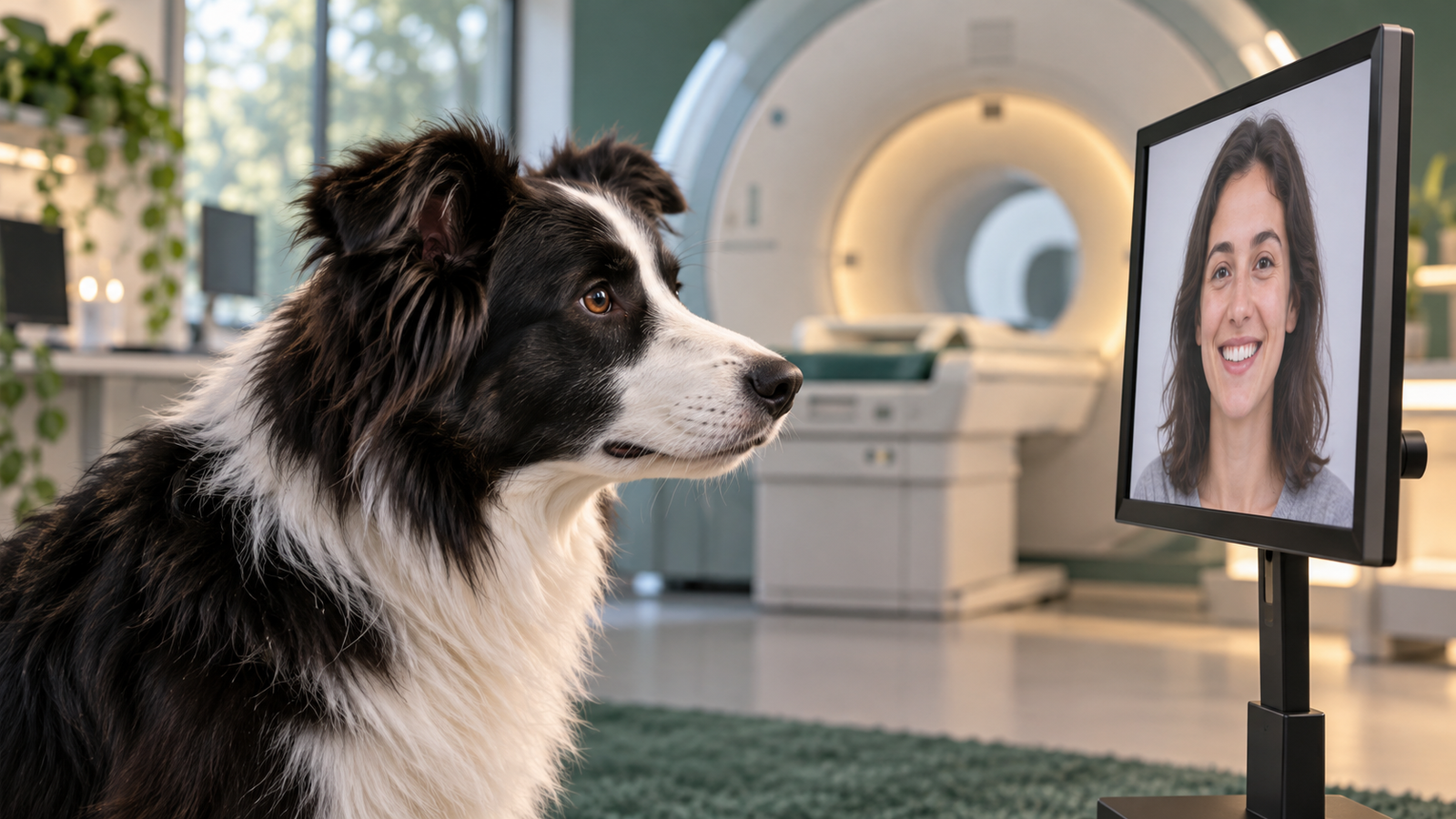
How Dogs Read Human Faces: What the 2026 Vienna Brain-Scan Study Showed
A University of Vienna study published in iScience in August 2026 scanned the brains of pet dogs shown photos of human faces. Happy faces activated reward and higher-processing regions, and whole-brain patterns separated fearful faces from angry and sad ones. The sample was small and mostly border collies, so the result is a first step, not a general rule.
Key points
- Dogs lay awake and still in an fMRI scanner while viewing photos of strangers’ faces.
- Two brain regions linked to reward and higher processing, the temporal cortex and caudate nucleus, responded only to happy faces.
- Looking at activity across the whole brain, researchers could tell fearful faces apart from angry and sad ones. They found no evidence that angry and sad faces were told apart.
- The authors describe this as the first direct evidence that dog brains separate specific negative human expressions, with clear limits on how far it generalizes.
What the researchers did
The team, led by Laura Cuaya with first author Raúl Hernández-Pérez, trained dogs to stay still in a functional magnetic resonance imaging (fMRI) scanner. Participation was voluntary, and dogs could leave at any time. The study ran as two experiments.
| Experiment | Dogs | Images shown | Question asked |
|---|---|---|---|
| 1 | 8 | Strangers with happy or neutral faces | Do any brain regions respond more to happy faces? |
| 2 | 12 | Strangers with happy, angry, fearful or sad faces | Can machine learning tell the expressions apart from brain activity? |
What they found
In the first experiment, regions tied to higher cognitive processing and reward, including the temporal cortex and caudate nucleus, were active for happy faces. In the second, those regions did not respond to anger, fear or sadness. Whole-brain analysis still found distinct activity patterns, and fear stood out from the other negative expressions. The paper reports no evidence that dogs separated angry faces from sad ones.
Press coverage of the paper’s figures reports that a classifier told happy faces from sad, fearful and angry faces at roughly 61 to 70 percent accuracy, above the 50 percent chance level, while pairs of negative expressions stayed near chance.
The authors interpret the happy-face response as possible positive emotional processing, while noting that a dog’s subjective experience cannot be accessed directly.
For a separate human-imaging example, our explainer on neural synchrony in couples examines why shared signals are not a compatibility score.
What the study cannot tell you
- Small sample. Twelve dogs is enough for a first signal, not for a population claim.
- Breed. Most dogs were border collies, a breed known for following social cues. In the first experiment, six of the eight dogs were border collies, with one Labrador and one golden retriever. Results may differ in other breeds.
- Background. All dogs were pets from loving homes and had to be healthy, medium-sized and trained for the scanner. Dogs living in other conditions may respond differently, as the authors caution.
- Still photos of strangers. Real expressions come with body language, voice and scent, which this design did not test.
- Brain pattern is not understanding. A distinct activity pattern shows the brain separates two inputs. It does not show the dog knows what the person feels.
How it fits earlier dog brain research
fMRI work in dogs is not new. A 2016 Science study from Eötvös Loránd University in Budapest used the same scanning approach to show that dogs process the meaning and the intonation of spoken words. The 2026 study extends that line from sound to faces.
What happens next
The researchers plan to test how dogs combine facial expressions with body language, voice and scent, and to compare how dog and human brains process the same emotional signals.
Frequently asked questions
Can dogs tell when I am happy?
This study suggests dog brains respond differently to happy faces than to angry, fearful or sad ones, at least for photos of strangers. It supports the idea that dogs notice happy expressions, but it was a small scan study, so it does not predict how any single dog behaves at home.
Do dogs understand when I am sad or angry?
Not in the sense of knowing why you feel that way. The study found no evidence that dogs separated angry from sad faces, though fear did stand out. Brain activity patterns show the dog’s brain treats the images differently, which is not the same as understanding emotion.
Does this prove dogs have emotions?
No. The authors say they cannot access a dog’s subjective experience directly. They suggest the happy-face response may involve positive emotional processing, which is an interpretation of brain activity and not a measurement of feeling.
For a different animal-behavior example, our cleaner-fish study explainer distinguishes observed choices from claims about intentions.
Sources
- Hernández-Pérez R, Cuaya LV, et al. “Dog brain representations of human facial expressions: Encoding happiness and differentiating specific negative expressions.” iScience, 2026. DOI 10.1016/j.isci.2026.116900 and full text at Cell Press.
- Cell Press news release on the study, August 2026. EurekAlert.
- Andics A, et al. “Neural mechanisms for lexical processing in dogs.” Science, 2016.