
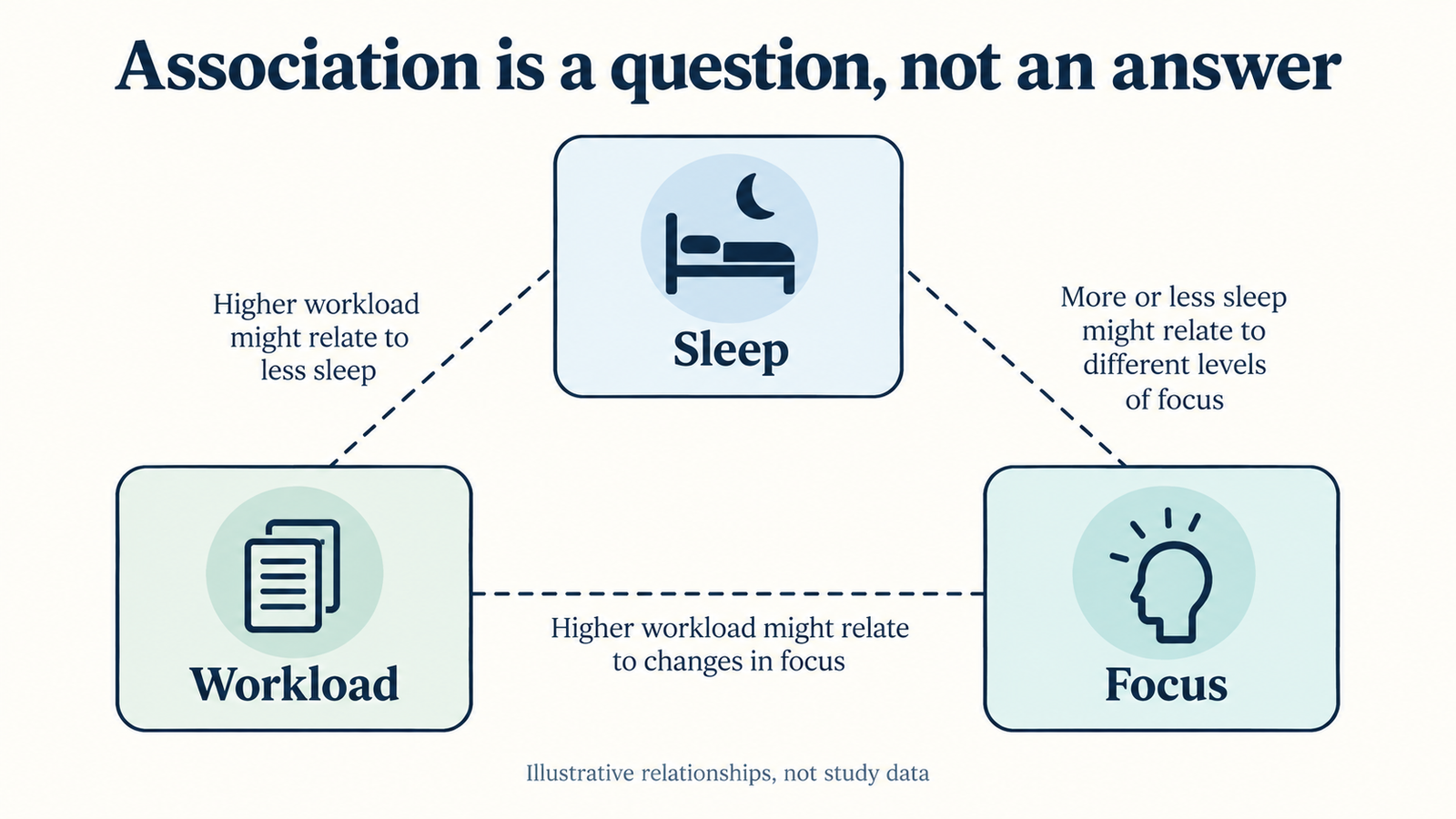
Correlation and Causation in Behavior Research: Read Beyond the Relationship
Key Points:
- An association does not by itself establish what caused an outcome.
- Consider reverse direction and other variables before selecting a preferred explanation.
- Read how participants, conditions and outcomes were defined; random sampling and random assignment differ.
- Match the headline to the actual design and measurement, including practical importance and uncertainty.
People who use a planning app report better concentration. Does the app improve concentration, do people who already concentrate well choose the app, or does another factor help explain both? A relationship is worth investigating, but it does not answer every causal question. This article offers an original reading framework for behavioral research, using hypothetical examples rather than reporting a new study. The goal is to keep the question, research design and conclusion aligned when reading a science headline.
Describe the relationship before explaining it
OpenStax Psychology's discussion of analyzing findings distinguishes correlation from a cause-and-effect conclusion and explains why alternative variables can matter. A useful first step is to state the observation without adding an explanation. In our hypothetical example, app use and reported concentration occur together in the information collected. The sentence that the app caused better concentration goes further. Identifying that extra step helps a reader ask what evidence would be needed to support it.
This does not make a relationship unimportant. An association can help researchers ask better questions, describe patterns or develop predictions. The limitation concerns what the observation establishes by itself. Avoid treating correlation as a synonym for useless research. Equally, avoid treating a strong or appealing relationship as permission to skip questions about how the data were collected and which alternative explanations remain plausible. Both mistakes replace an evaluation of the actual study with an overly broad slogan.
Keep several explanations available
For an original scenario, imagine a survey finding that people who keep a daily planner also report completing more tasks. One possibility is that using a planner helps. Another is that people who already organize their work are more likely to choose planners. A third is that differences in workload, support or working conditions influence both planning and task completion. The survey might contain information relevant to some of these possibilities, but the headline relationship alone does not distinguish them.
Write the alternatives before deciding which story you prefer. This is especially useful when the claim agrees with your own experience or supports a purchase you already want to make. A plausible mechanism can guide research, but it is not a substitute for the appropriate evidence. The table below is our own interpretation worksheet. It contains invented scenarios, not study results, and the alternatives are examples to investigate rather than established explanations.
| Observed relationship | One possible explanation | Another possibility to examine |
|---|---|---|
| Planner users report more completed tasks | Planning helps task completion | Already organized people choose planners |
| Longer study sessions accompany higher scores | Additional study contributes to learning | Prior preparation or support differs |
| App use accompanies reported focus | The app supports focused work | Work conditions affect both app use and focus |
| A habit score rises over several weeks | A routine becomes more automatic | Reporting or circumstances change during the period |
Ask what the variables actually mean
Words such as focus, success and wellbeing can refer to different measurements. Read the methods to find out whether the study used a questionnaire, a task, a behavioral record or another measure. A headline may use a broader everyday word than the researchers’ operational definition. Keep the measured outcome visible. A change in reported concentration should not quietly become a demonstrated improvement in every kind of attention, work performance or long-term learning.
The same applies to the exposure or intervention. App use might mean opening an app once, using a particular feature regularly or being assigned to a defined program. Those descriptions are not interchangeable. If the study does not define the variable clearly enough for the reader to understand what was compared, record that uncertainty. A familiar product category or behavior label should not create the impression that the research evaluated every version of that activity.
Read the design before the conclusion
Ask whether researchers observed existing differences or assigned participants to conditions. In an experiment, a planned comparison can help address alternative explanations when its design and execution are appropriate. Random assignment and random sampling answer different questions: how participants enter conditions differs from how people enter the study. OpenStax discusses those distinctions. Do not assume that the presence of the word random establishes that the participants represent every intended user or that all other limitations disappear.
A comparison group also needs a description. Comparing a program with no activity can answer a different question from comparing it with another credible activity. Ask what participants were told, what outcomes were measured and whether expectations or other differences could influence the result. This framework does not claim that a single design feature settles validity. It helps identify which part of the study supports the conclusion and which questions require a closer reading of methods and limitations.
Time order matters, but does not settle everything
If an outcome is claimed to result from an activity, the order of events matters. A measurement taken only once may leave that order uncertain. Following people over time can provide useful information, but a sequence alone does not eliminate every competing explanation. Other changes may occur during the same period. Ask what the study recorded, what comparisons were made and whether the analysis addresses the alternative factors relevant to the claim.
Consider a hypothetical person who begins using a focus app during a quieter work month. Their task completion improves afterward. The record shows a before-and-after difference, but it does not isolate the app’s contribution from the changed workload. This example is deliberately simple. It illustrates why personal experience can generate a useful question without proving the answer. A responsible article can describe the experience accurately while avoiding a causal conclusion that the information cannot separate from alternatives.
A large relationship is not a complete explanation
A statistical association needs context: the variables, participants, uncertainty and analytical choices. Its apparent strength does not automatically identify a mechanism or prove that an intervention would reproduce the observed difference. Ask how the result was estimated and whether important limitations were reported. Avoid interpreting a single summary number as a complete account of a complex behavior, particularly when the proposed use extends beyond the people or conditions studied.
Also distinguish statistical results from practical importance. A reported difference should be described in terms readers can understand, including the outcome and comparison. A claim can be statistically framed yet still leave open whether the size or nature of the difference matters for daily life. If the available article does not provide enough detail to evaluate that question, say so. Do not fill the gap with an invented estimate, an assumed benefit or a product recommendation.
Use a five-question headline check
Before sharing a behavioral-science story, identify what was measured, who was studied, how the comparison was made, which alternative explanations were addressed and how far the conclusion extends. These are reading prompts, not a validated quality score. A study can have genuine value while answering a narrower question than its press coverage suggests. Preserving that narrower contribution usually makes the reporting more informative, because readers can see what additional research would change the interpretation.
Try rewriting an overconfident headline as a precise observation. Instead of saying that a planner makes everyone productive, describe the actual relationship, population and design. If an experiment supports a causal interpretation under specified conditions, describe those conditions as well. Precision does not require stripping a story of interest. It gives the reader a clearer reason to care, because the evidence and its limits are visible rather than hidden behind a universal promise.
Apply the same standard to claims you like
The hardest claims to examine can be the ones that fit our preferences. A study supporting a favored routine may feel more convincing than a similar study challenging it. Use the same questions in both cases. Keep notes about what evidence would strengthen, weaken or change your interpretation. That makes curiosity more productive than simply collecting supportive headlines and allows a conclusion to improve when better information becomes available.
Correlation is a starting relationship, while a causal explanation asks what produces a change. Responsible behavioral-science reading keeps those questions connected without treating them as identical. Name the measurement, inspect the design, consider alternatives and match the conclusion to the evidence. That habit is useful for research news, personal experiments and commercial claims alike, especially when an appealing story is about to become a recommendation to spend time or money.