
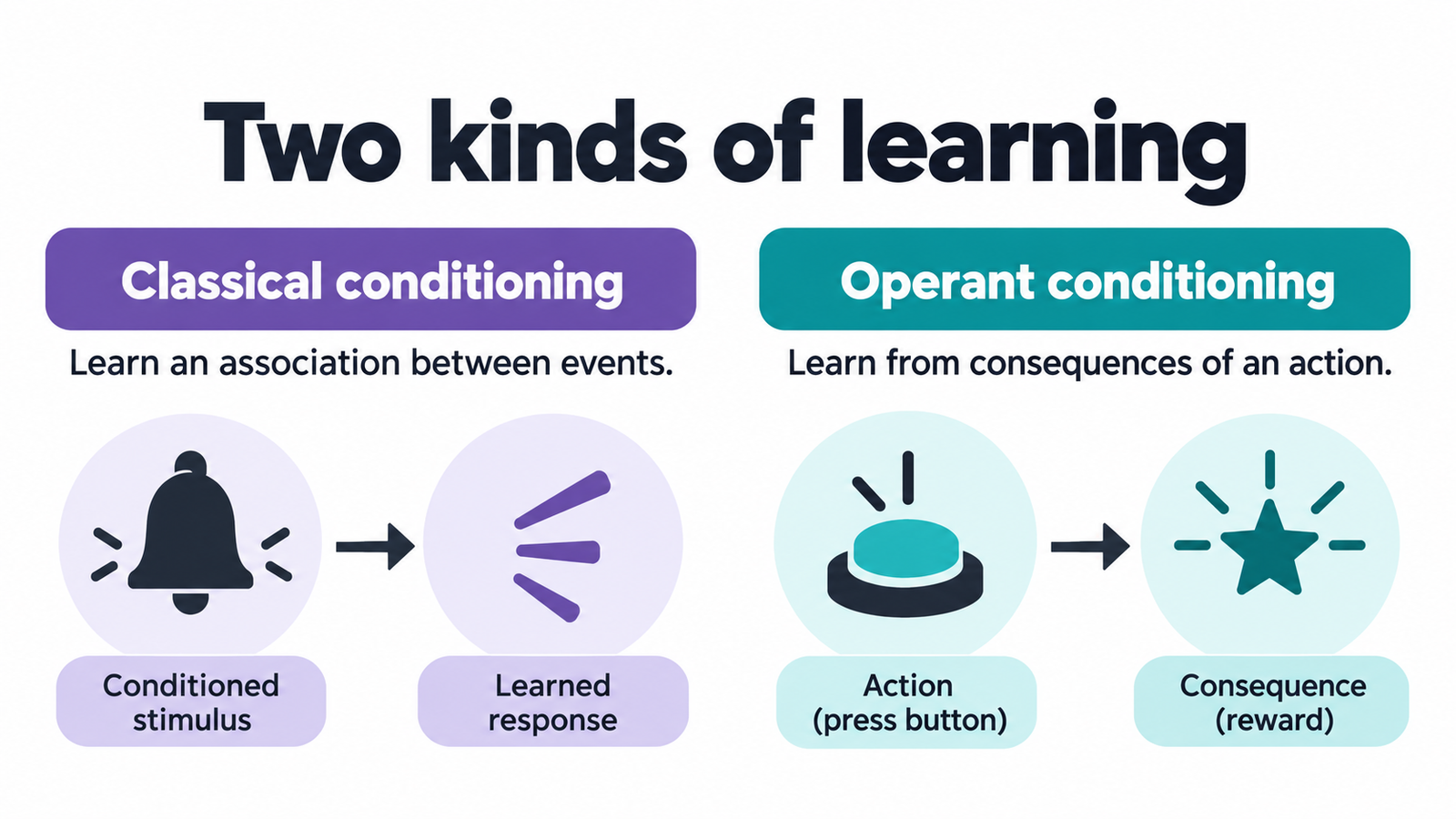
Classical and Operant Conditioning: Two Different Ways Associations Are Learned
Key Points:
- Classical conditioning concerns learned associations between stimuli.
- Operant conditioning concerns relationships between behavior and consequences.
- Positive and negative refer to adding or removing something, not moral judgments.
- Use concrete observations and humane examples rather than assuming a label fully explains a person.
The word conditioning is often used loosely to explain habits, advertisements, learning apps and everyday routines. In psychology, two important forms of associative learning have different structures. Classical conditioning concerns learning an association between events that can come to elicit a response. Operant conditioning concerns learning a relationship between an action and its consequences. Recognizing the distinction helps you explain examples more precisely without reducing all human behavior to one simple mechanism.
Start with the relationship being learned
OpenStax Psychology 2e's classical-conditioning chapter describes how a previously neutral stimulus can become associated with an event that already elicits a response. Its operant-conditioning chapter focuses on how consequences influence the likelihood of an action. These are university textbook explanations, not a diagnosis of any individual’s behavior. Real situations can involve several processes together, so use the categories to analyze a specific relationship rather than label an entire person or activity.
For a conceptual example, imagine a distinctive sound repeatedly occurring just before an event that produces a response. Learning that association illustrates the classical pattern. Now imagine an action followed by feedback that changes how often the action occurs. That illustrates the operant pattern. The important difference is not whether the example includes a bell or a reward. It is which events are related and whether the explanation centers on an elicited response or an action’s consequence.
| Question | Classical conditioning | Operant conditioning |
|---|---|---|
| What relationship is central? | An association between stimuli or events | An association between an action and its consequence |
| What should an example identify? | The original eliciting event, cue and learned response | The action, consequence and later change in behavior |
| What is a common mistake? | Calling every repeated routine classical conditioning | Calling every unpleasant consequence negative reinforcement |
| What remains important? | Timing, context and evidence of learning | Timing, context and what actually happens to the behavior |
Classical conditioning is more than a familiar story
The OpenStax chapter uses Pavlov’s work to explain unconditioned and conditioned stimuli and responses. An unconditioned response occurs without the particular association being learned. A conditioned response develops in relation to a previously neutral cue. When reading an example, identify each part explicitly. If the example does not specify the original response or how the cue became associated with it, calling the process classical conditioning may simply be a label attached after the fact.
An original study exercise is to draw three boxes: before the association, during repeated pairing, and after learning. Write the cue and response in each box. If you cannot keep the roles consistent, return to the textbook definitions rather than force the example to fit. This is an educational exercise, not an experiment to perform on another person or animal. You do not need to create distressing situations or manipulate someone to understand the structure of the concept.
Operant conditioning requires looking at consequences
In operant conditioning, an action is followed by a consequence, and the action’s future likelihood is central to the analysis. A consequence that someone intends as a reward is not automatically a reinforcer in the technical sense. You need to know whether the behavior increases. Likewise, an intended punishment is not defined only by how stern or unpleasant it seems. The terminology concerns the relationship between the consequence and the behavior, not merely the provider’s intention.
Consider a hypothetical learning app that displays a badge after a completed exercise. The badge’s existence does not establish that it improves learning or increases future practice. Those are outcomes that would need to be measured. A product description may call the feature reinforcement as a design idea, but a tested effectiveness claim requires evidence. This distinction prevents a psychological term from becoming a substitute for evaluating whether a particular feature has the intended effect.
Positive and negative do not mean good and bad
OpenStax explains that positive refers to adding something and negative refers to removing something. Reinforcement concerns increasing a behavior, while punishment concerns decreasing it. Combining these dimensions produces four categories. The terminology can feel counterintuitive because everyday language uses positive and negative as judgments. Keep the two questions separate: was something added or removed, and did the target behavior become more or less likely?
| Term | Consequence operation | Behavioral direction |
|---|---|---|
| Positive reinforcement | Something is added | Behavior increases |
| Negative reinforcement | Something is removed | Behavior increases |
| Positive punishment | Something is added | Behavior decreases |
| Negative punishment | Something is removed | Behavior decreases |
The table is a terminology guide, not a recommendation to use punishment. Ethical, developmental and practical considerations matter when working with people or animals. A conceptual category does not establish that an intervention is appropriate, safe or effective in a real situation. For concerns involving a child’s development, distress or behavior, seek suitable professional guidance rather than treat a short textbook summary as an individualized behavior-management plan.
One situation can contain several learning processes
A phone notification can be a cue, a reminder and part of an action-feedback loop. Its role depends on the relationship you are examining. Hearing the sound, opening the app and receiving a response are not one undifferentiated event. Break the sequence into steps before choosing terminology. You may find that an example involves more than one process, or that there is not enough information to identify the learning mechanism confidently.
This matters when claims about persuasive technology become overly sweeping. Saying an app uses conditioning does not quantify its effect, explain every user’s experience or prove a particular mental-health outcome. A careful analysis would identify the feature, the behavior being measured, the comparison and the duration. The concepts help formulate questions, but they do not remove the need for evidence about the actual product and population being discussed.
Repetition alone does not settle the explanation
An action can recur because someone deliberately chooses it, because the situation makes it convenient, because it serves a goal, or because learning processes contribute. Observing repetition does not uniquely identify the cause. If a person reads after dinner, the schedule alone does not tell you whether automaticity, enjoyment, social expectations or a planned learning goal is most important. Be cautious about turning a descriptive pattern into a complete psychological explanation.
For an original analysis worksheet, record the observable sequence first without interpretive labels. Then write the proposed association and what evidence would distinguish it from alternatives. Finally, identify what remains unknown. This method makes it easier to discuss behavior respectfully, because it focuses on specific events rather than claiming to know hidden motives. It also creates a useful boundary between an educational example and a research conclusion about how learning occurred.
Apply the distinction to buying guides
If a learning product advertises rewards, streaks or adaptive feedback, ask what outcome the feature supports. More time in the app is not the same as better understanding outside it. A badge may encourage completing activities without establishing transfer to a different task. A responsible review should distinguish engagement metrics, demonstrated learning and longer-term usefulness. It should not treat familiar psychological vocabulary as independent proof that a product’s design is effective.
The most useful skill is to describe the relationship accurately before judging it. Classical and operant conditioning provide different explanatory tools, and the positive-negative distinction prevents a common vocabulary error. Keep the textbook definitions available, use original low-stakes examples, and resist the urge to make one mechanism explain everything. Clear language improves the questions you ask; careful evidence is still needed to answer them in a particular real-world setting.
Sources and further reading
- 6.2 Classical Conditioning – Psychology 2e | OpenStax.
- 6.3 Operant Conditioning – Psychology 2e | OpenStax.