
The Human Pangenome Reference: More Paths Through Genetic Variation
Key Points:
- The initial 2023 human pangenome reference incorporated data from 47 people.
- A reference with more paths can represent genetic variation differently from one linear sequence.
- A research reference is not an individual diagnosis or a complete representation of everyone.
- Expansion targets in the original announcement are plans, not proof that later goals were achieved.
Educational reporting, not individual diagnosis, treatment or dietary advice. Dated milestone reports describe the original event; current clinical decisions require current guidance and a qualified healthcare professional.
In May 2023, researchers released a draft human pangenome reference designed to represent more genetic diversity than a single linear reference sequence could capture. The milestone was about improving a shared research resource, not discovering a separate genome for every group or producing a complete map of all human variation. This retrospective explains what the initial release contained, why reference design matters and what the word draft leaves open. It does not claim to describe the latest release or a personal genetic test result.
A reference is a tool for comparison
The National Human Genome Research Institute's 2023 pangenome overview describes a collection of high-quality reference sequences from 47 people of diverse ancestries. A reference helps researchers compare and analyze genomic information. It is not a definition of a normal person or a complete template against which every difference should be judged as disease. The distinction is important because the language of reference can sound more biologically prescriptive than the research tool actually is.
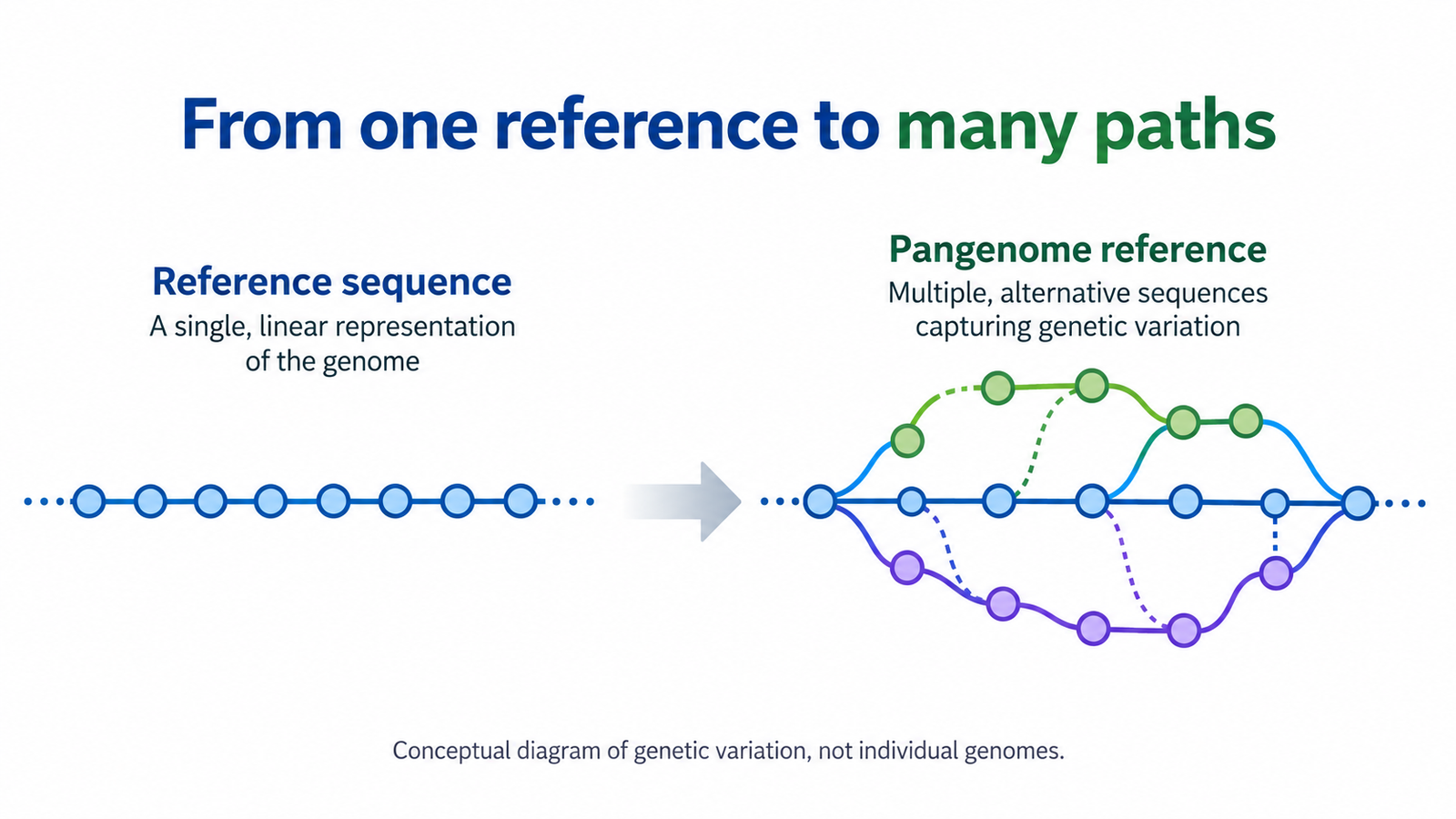
A linear reference provides one representation of a genome sequence. A pangenome resource can represent alternative sequence paths and variation across the included genomes. Our diagram illustrates that concept schematically; it does not display actual participants’ genomes or a complete pangenome graph. A simplified visual can help explain multiple paths, but it should not suggest that a few colored branches capture every type of human genetic variation or correspond neatly to fixed racial categories.
| Item | 2023 account | What not to infer |
|---|---|---|
| Initial resource | Draft human pangenome reference | A final representation of all human variation |
| People represented | 47 | That every population or rare variant was captured |
| Release context | May 10, 2023 announcement and linked research | A new 2026 release |
| Expansion target mentioned | 350 people by mid-2024 | That the target was achieved, without checking a later source |
| Scientific purpose | Broader reference representation | An individual diagnosis or ancestry identity rule |
Why one reference cannot contain every alternative
People share much of their DNA, while genetic variation includes differences that a single linear representation cannot display simultaneously in every position. A broader reference approach can help represent alternatives rather than requiring every sequence to be interpreted against only one path. The practical scientific question concerns how comparison and analysis work. It should not be transformed into a claim that humanity can be divided into a small set of separate, uniform genomes.
For a limited analogy, a transport map with alternative routes can represent more possibilities than a single itinerary. The analogy explains the idea of multiple paths, not the mathematical or biological details of a pangenome graph. Actual genomic resources involve methods and structures far more complex than a road map. Use the analogy to understand the comparison problem, then return to the source for claims about what the resource contains and how researchers evaluate it.
Representation can affect what researchers see
The NHGRI overview emphasizes broader population diversity compared with the previous reference sequence. A reference that represents more variation can improve the foundation for investigating genomic differences. However, the existence of a broader resource does not automatically establish a specific improvement in every clinical test or research pipeline. Those applications need their own evaluations. A science article should distinguish the resource’s design goal from measured benefits in a particular downstream use.
Imagine a hypothetical analysis method that struggles with a sequence poorly represented in its reference. Adding a relevant alternative might help the method, but the improvement would need to be tested. This example illustrates a plausible research question rather than reporting an unverified performance number. Avoid turning a general statement about inclusiveness into a precise diagnostic accuracy claim unless the source actually evaluates that outcome in the relevant population and workflow.
A draft is a substantial result with remaining work
Calling the release a draft does not mean it was insignificant. It identifies a stage in building a resource that can be expanded and refined. NHGRI’s 2023 page linked the underlying research and described a planned increase in representation. A responsible historical account records the initial 47 people and labels the expansion target as a plan at that time. It does not silently assume a later goal was achieved or present the initial resource as the current final version.
This is a useful pattern for reading science infrastructure news. A release can be both usable and incomplete. The relevant questions include what is included, what is omitted, how quality was assessed and how updates will be documented. Those questions are more informative than treating draft as either a flaw that invalidates the work or a word to remove because it complicates a celebratory headline. Scientific resources often improve through openly described stages.
A reference difference is not automatically a harmful mutation
Finding a difference from a reference sequence does not by itself establish that the difference causes disease. Interpretation requires evidence about the variant and the question being investigated. The NHGRI genome-editing educational material also helps distinguish changing DNA for a defined purpose from merely identifying variation. Sequencing, comparing, interpreting and editing are different activities, even when they appear together in a broad story about genomics.
For an original reading exercise, separate four verbs in a news report: detected, associated, explained and treated. A study may detect a variant without explaining its biological effect; a later study may investigate an association; a treatment claim requires additional evidence. This separation prevents a reference-resource milestone from being presented as if it immediately solved the medical meaning of every newly represented difference or established a treatment for everyone carrying one.
Diversity should not be reduced to simplistic labels
The resource’s emphasis on diverse ancestries concerns representation in genomic research. It should not be used to imply that broad social categories each have one uniform sequence or that genetics alone defines identity, behavior or opportunity. A reference is an analytical resource, not a hierarchy of people. Clear reporting can explain why broader representation matters while avoiding deterministic stories about individuals or groups that the data do not support.
When a summary uses a population label, ask how the original research defined it and why it was relevant. Do not substitute a more familiar social label if it changes the meaning. Also distinguish an included participant’s genome from every person sharing some aspect of ancestry. A sample can improve representation without standing for an entire population. Preserving that distinction is part of communicating the scientific value accurately rather than flattening it into a simple diversity slogan.
Privacy and consent remain important
Genomic information can be sensitive, and research participation involves consent and data-governance questions. This article does not review the complete consent arrangements of the consortium or promise that all genomic datasets have the same protections. If discussing a particular resource’s data access, use its actual documentation. Avoid assuming that a public research announcement authorizes reuse of identifiable information or that an individual’s genetic result should be posted publicly to help interpret an article.
For readers, the practical boundary is straightforward: do not upload or share personal genetic data merely because a broad reference-resource story is interesting. Questions about an individual’s test require appropriate professional interpretation and an understanding of the service’s current privacy terms. The pangenome milestone is valuable to explain at a general level without soliciting private results or pretending that a science-news publication can perform a personal genomic assessment.
How to read later pangenome updates
Check the release version, date, included genomes and the outcome being evaluated. Is the story about adding representation, improving assembly, changing analysis methods or demonstrating an application? These are related advances but not identical claims. A later release should be assessed using its own documentation, not by simply changing the date on a 2023 article. Historical context is useful when it remains clearly distinguished from current release information.
The initial human pangenome release mattered because it broadened the way researchers could represent genetic variation in a shared reference. Its significance does not require pretending it captured everyone or immediately solved clinical interpretation. A clear explanation preserves the initial scale, the draft status and the difference between a research resource and an individual result. Those boundaries make the advance more understandable and give readers better questions for following the field.


