
Does Naming a Feeling Change It? What Emotion Research Shows
Key Points:
- Putting a feeling into words is called affect labeling, and experiments suggest it can change some emotional responses.
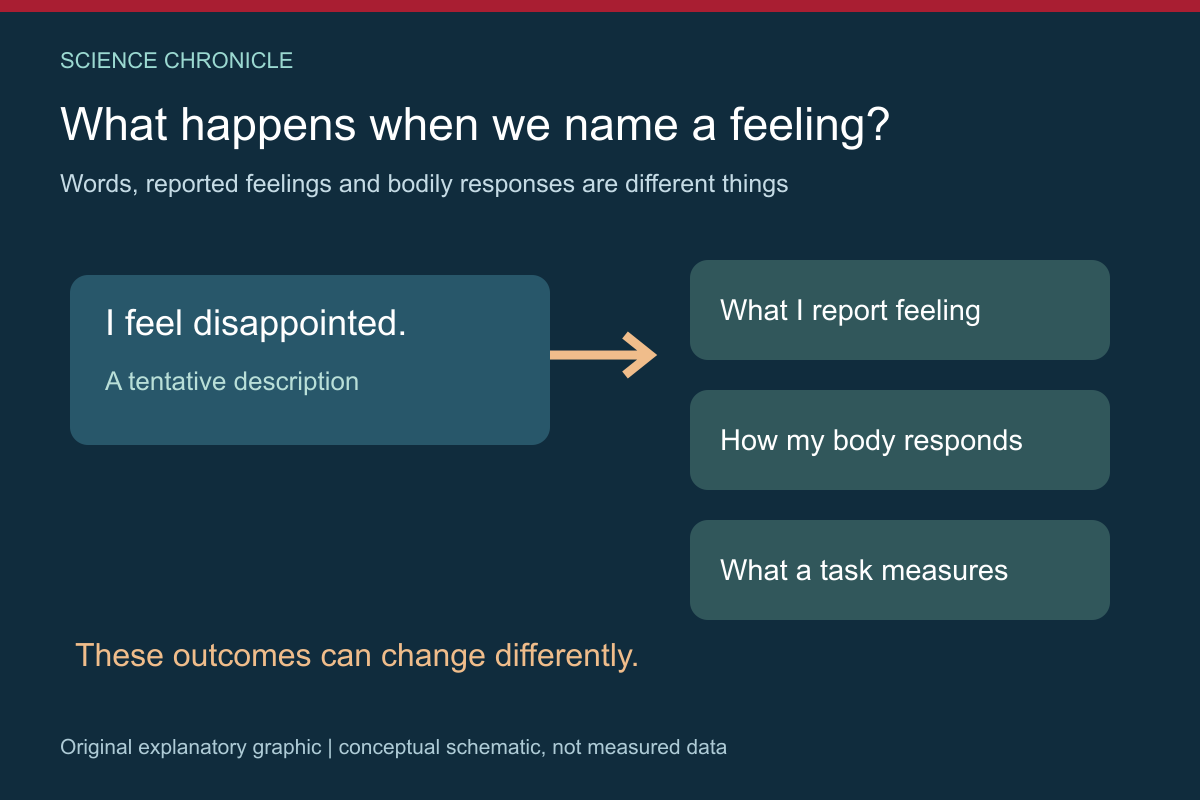
- A brain signal, a bodily response and a report of feeling better are different outcomes.
- The effects depend on the task and context; naming a feeling does not always reduce distress.
- A useful everyday starting point is a tentative description, rather than a judgment about yourself or someone else.
After an awkward conversation, “I feel bad” may be the first description that comes to mind. A moment later, you might realize that you feel embarrassed, disappointed or worried about what happens next. Does putting that experience into words actually change it? Researchers have tested versions of this question. The answer is more interesting than the promise that naming a feeling makes it disappear.
What does naming a feeling mean?
Psychologists call it affect labeling: using language to identify an emotional experience or the emotion shown in a stimulus. That is different from explaining why the experience happened, distracting yourself or deliberately trying to see the situation differently. These activities can overlap in conversation, but experiments separate them so their effects can be compared.
For an everyday example, “I feel disappointed” names an experience. “They never respect me” adds an interpretation of another person’s behavior. “Perhaps they were distracted” offers a different interpretation. None is the same mental task, even though all three might follow the same event.
What the brain study found
In a functional MRI experiment by Matthew Lieberman and colleagues, labeling negative emotional images was associated with a smaller response in the amygdala and other regions than comparison tasks. Activity increased in a part of the right prefrontal cortex. The amygdala is involved in processing emotionally important information; it is not a single fear button.
This study provides evidence about a particular task and measured brain responses. It does not show that saying one word switches off a feeling. A change in a scan is also not, by itself, a report that a person feels better or proof of a lasting benefit.
Feeling better and reacting differently can come apart
In an experiment involving 88 people with high spider fear, Katharina Kircanski and colleagues compared labeling, changing interpretations, distraction and exposure without those additions. At a follow-up one week later, the labeling group showed a smaller skin-conductance response than the other groups. Skin conductance reflects changes in sweating associated with bodily arousal. The groups did not differ in self-reported fear.
That mismatch is informative. A result can be real for one outcome without applying to every aspect of emotion. The study does not provide instructions for attempting exposure therapy alone, and a spider-related experiment cannot establish that the same approach helps every stressful experience.
| Outcome | What it can tell researchers | What it does not directly establish |
|---|---|---|
| Brain activity during a task | How the measured response differs between conditions | Whether daily life improves |
| Skin conductance | One aspect of bodily arousal | Exactly what someone feels |
| A person’s own rating | How they describe their experience | Every underlying bodily process |
Why the context matters
Four experiments on emotional pictures examined self-reported experience. Labeling was associated with less distress for negative pictures, but also less pleasure for positive pictures. The pattern was not simply a general increase in happiness.
A later study by Einat Levy-Gigi and Simone Shamay-Tsoory adds another boundary. In its second experiment, involving 79 participants, labeling reduced reported distress for high-intensity negative pictures but increased it for lower-intensity negative pictures. These laboratory findings argue against a rule that naming every feeling always helps. They also do not mean that someone has failed if a label leaves them feeling the same or worse.
A description can be useful without being a cure
For ordinary self-reflection, a tentative sentence can leave room for uncertainty: “I think I feel disappointed, and perhaps a little worried.” This is an example of describing an experience, not a treatment protocol or a requirement to analyze every passing mood. You can revise the description as you understand the situation better.
It also helps to keep the feeling separate from the next action. Feeling angry does not decide whether to send a message immediately; feeling embarrassed does not prove that everyone noticed. Naming an experience can be one part of a conversation with yourself or someone you trust, while the practical problem may still need attention.
There is no need to force a label or continue an exercise that increases distress. Persistent or overwhelming difficulties deserve appropriate professional support. The research offers a more modest insight: language can influence emotional processing, but the effect depends on what is being measured and on the circumstances in which the words are used.
Sources and further reading
- Lieberman and colleagues. Putting feelings into words: affect labeling disrupts amygdala activity in response to affective stimuli. Psychological Science.
- Kircanski, Lieberman and Craske. Feelings into words: contributions of language to exposure therapy. Psychological Science.
- Lieberman and colleagues. Subjective responses to emotional stimuli during labeling, reappraisal, and distraction. Emotion.
- Levy-Gigi and Shamay-Tsoory. Affect labeling: The role of timing and intensity. PLOS ONE.