
The Adult Fruit-Fly Connectome: A Wiring Map Is a Starting Point
Key Points:
- The reported adult fruit-fly brain map included 139,255 neurons and roughly 50 million synapses.
- The work combined computational reconstruction with human checking.
- A wiring map is a foundation for functional questions, not a transcript of thoughts or behavior.
- A fruit-fly connectome does not constitute a complete map of a human brain.
In October 2024, a Princeton-led collaboration reported a detailed wiring map of an adult fruit-fly brain. The work represented a major advance in connectomics, the study of neural connections. It did not amount to reading a fly’s thoughts or completing a human brain map. Understanding the achievement requires separating structure, activity, behavior and interpretation. This retrospective explains the resource described in the 2024 institutional report and why a map can transform research while leaving many functional questions open.
What the map contained
Princeton University's October 2, 2024 account described the FlyWire collaboration’s map of 139,255 neurons and about 50 million synaptic connections in an adult fruit-fly brain. It linked a suite of research papers in Nature. Those figures describe the mapped resource, not the number of neurons in a human brain or a universal count for every fruit fly. A responsible summary identifies the organism and the particular kind of map rather than allowing a broad phrase such as complete brain to carry an unintended meaning.
The term connectome emphasizes connections among neurons. A structural map supplies information about which cells connect and how the reconstructed network is organized. It does not directly supply every pattern of activity, every influence on behavior or every physiological property. The achievement is important precisely because those further questions can be investigated using a more detailed structural foundation, not because the map makes all other kinds of neuroscience unnecessary.
| Feature | Reported information | Interpretive boundary |
|---|---|---|
| Organism | Adult fruit fly, Drosophila melanogaster | Not a human connectome |
| Neurons mapped | 139,255 | Count for the reconstructed resource |
| Connections | About 50 million synapses | Structural connections, not a record of every activity state |
| Image foundation | 21 million images described in the account | Raw images required reconstruction and checking |
| Human contribution | Proofreading and annotation across a large collaboration | Not an entirely automatic AI result |
Why an adult fruit fly is scientifically useful
Princeton’s account contrasts the scale of the adult fly map with earlier maps of simpler nervous systems and a larval fly brain. The adult fly offers a complex network that researchers can investigate in an organism widely used in neuroscience. That does not mean its brain is a miniature human brain in every relevant respect. Similarities can motivate research questions, while differences limit what can be inferred about human function or disease from one structural resource.
When a headline connects an animal result to human health, ask whether the connection is a demonstrated finding or a motivation for future research. A map can help scientists study principles of organization without immediately establishing a human treatment. This is not a reason to dismiss model-organism work. It is a reason to explain the evidentiary step accurately, so readers can recognize the value of foundational research without mistaking it for a completed clinical application.
Images became a reconstruction through substantial work
The Princeton report describes a large image dataset, computational reconstruction and extensive human proofreading and annotation. The raw images did not arrive as a ready-to-use list of neurons and connections. Turning them into a resource required methods for tracing structures, checking errors and labeling cell types. This sequence matters when crediting the achievement and when evaluating broad claims that artificial intelligence mapped a brain entirely on its own.
The collaboration illustrates a useful division of labor: computational tools can help process scale, while people inspect and refine results within a scientific workflow. The NIST AI Risk Management Framework provides a general context for thinking about evaluation and oversight, although it does not certify this project or serve as its scientific validation. The relevant evidence for the connectome remains the project methods, checks and linked research, not the mere presence of AI in the workflow.
Structure is not the same as activity
A road network can show possible routes without recording every journey. As a limited analogy, a connectome can show structural relationships without recording every neural event. The analogy should not be treated as a complete model of brain function. It simply helps distinguish a wiring map from a movie of activity. A headline that claims the map explains every decision would need much more evidence than a structural reconstruction alone provides.
For an original hypothetical example, a researcher might use the map to identify a pathway that could contribute to a behavior, then investigate its activity or alter it under appropriate research conditions. The map helps formulate a testable question. It does not prove the functional interpretation by appearance alone. This distinction is especially important when colorful network images are shared as if a visually prominent connection automatically establishes what the animal is thinking or experiencing.
A map can reveal questions as well as answers
Detailed resources can help researchers notice patterns, compare cell types and formulate hypotheses about information flow. Their usefulness is not limited to confirming what was already expected. However, a pattern in a map should be separated from an explanation of its function. A science article can describe an interesting structural finding while clearly identifying which functional claims remain hypotheses and what kinds of experiments would help investigate them.
An original reading worksheet can have four columns: structural observation, proposed interpretation, supporting functional evidence and remaining question. This prevents the interpretation from absorbing the status of the observation simply because both appear in the same paragraph. It also helps a reader follow later research. A new experiment may refine the functional explanation without invalidating the usefulness of the original structural resource, because the two kinds of evidence address different parts of the question.
Completeness always has a scope
The phrase complete map needs a defined object and method. Here it concerns the reconstructed adult fly brain resource described by the collaboration, not all brains, every individual difference or every kind of biological information. A resource can be unusually comprehensive within its scope while still having limitations and an ongoing correction process. The right reading question is complete with respect to what, rather than assuming the word means that no relevant uncertainty remains.
Similarly, do not infer that one mapped brain captures every individual, developmental state or condition. Comparisons across organisms and circumstances require additional evidence. This article does not estimate how much variation exists among flies or claim that the resource settles that question. It explains why preserving the sampled organism and resource scope is necessary before generalizing. A precise description makes an impressive achievement stronger, not weaker, because readers can understand what was actually accomplished.
Scientific images need clear provenance
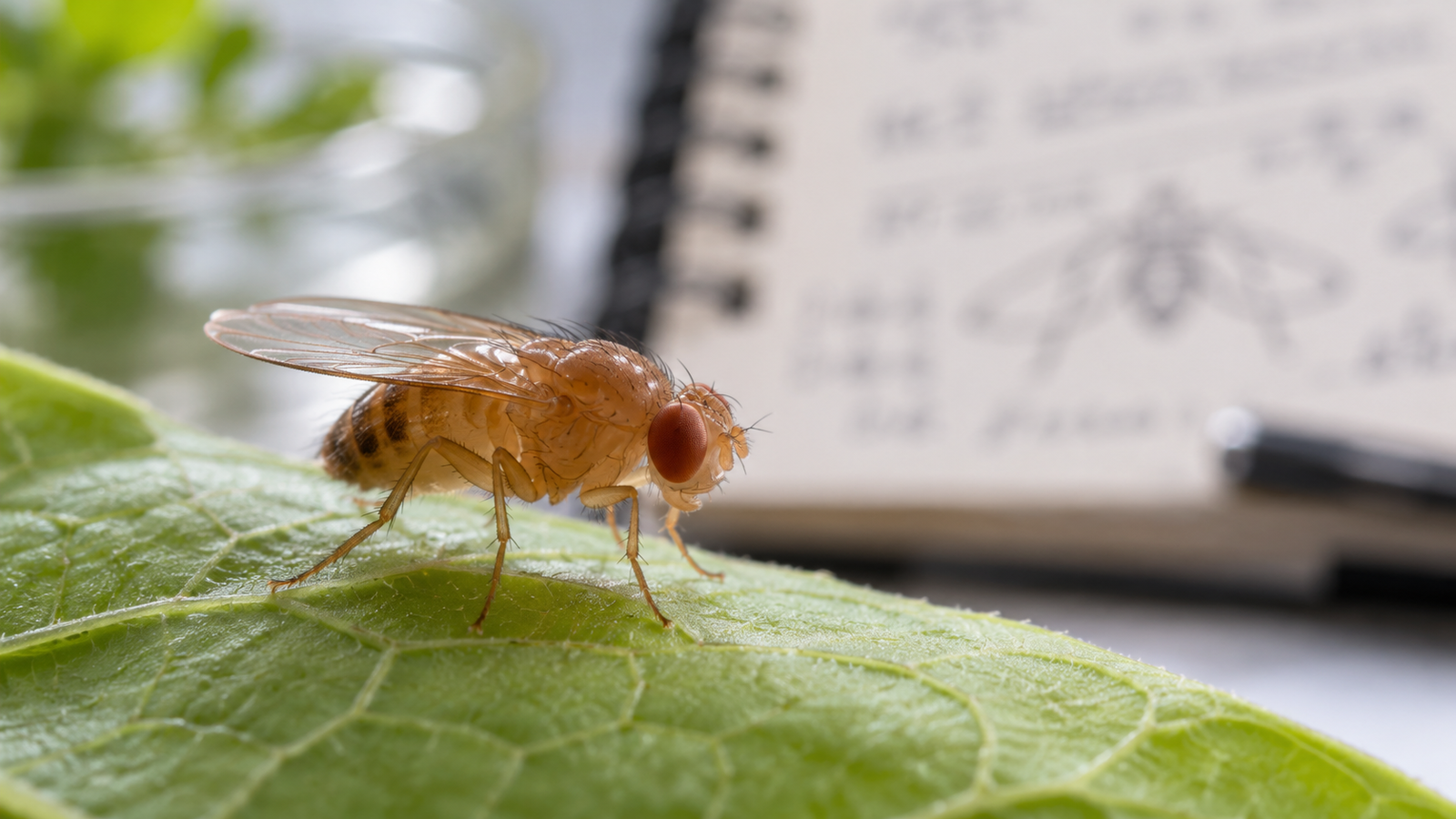
A research network rendering, a microscope image and an editorial illustration serve different purposes. The cover accompanying this article is an illustration of the subject, not an image from the FlyWire dataset. We do not reproduce the source’s photographs or research graphics without a documented basis for doing so. Linking to the institutional report allows readers to inspect the actual visual evidence and its credits while keeping our explanatory image separate from the scientific record.
When sharing a research figure, preserve its source, method and caption, and check reuse rights. Attribution is necessary but does not automatically grant permission. Avoid cropping away a legend or uncertainty statement that changes the interpretation. A simplified original diagram may be useful for education, but it should not introduce fictional connections and label them as actual data. Visual clarity is valuable only when the image’s evidentiary status remains clear.
How this milestone connects to future research
The map creates opportunities for more detailed investigations of neural circuits. A later study might examine a particular pathway, combine structure with activity or compare another resource. Each advance needs its own methods and evidence. The 2024 report is not a current leaderboard of connectome projects, nor a guarantee of a timetable for mapping a human brain. Historical significance should not become an unsupported forecast of when every larger problem will be solved.
For the next connectome headline, identify the organism, tissue, scale, measurement and type of result. Ask how automated reconstruction was checked and whether the conclusion concerns structure or function. These questions let you appreciate the scale of the work without accepting a thought-reading narrative. The adult fly connectome mattered because it made a complex network accessible in a new way. Its greatest value is as a foundation for better questions and experiments, not as a claim that a wiring diagram alone explains an entire mind.
Sources and further reading
- Mapping an entire (fly) brain: A step toward understanding diseases of the human brain.
- AI Risk Management Framework | NIST.


