Myelin and Nerve Signaling: Why the Insulation Analogy Has Limits
Key Points:
- Myelin forms a sheath around axons and contributes to communication between neurons.
- The insulation analogy is useful but does not fully describe living nervous tissue.
- A structural change, a measurement and a practical benefit require different evidence.
- A biological mechanism does not establish that a commercial product repairs myelin or treats a disease.
Myelin is often introduced as insulation around a nerve fiber. That comparison can help a beginner picture one part of nervous-system organization, but it is a model, not a complete account of living tissue. A household cable does not capture the biological complexity of a nerve cell or the effects of a neurological disorder. This explainer uses myelin to show how to learn from an analogy without letting it become a misleading explanation or a promise about a treatment.
Start with the biological terms
The National Institute of Neurological Disorders and Stroke overview of multiple sclerosis describes myelin as a protein-and-fatty-acid mixture forming a protective sheath around axons. Axons are nerve fibers. Myelin contributes to communication between neurons, and its appearance contributes to the pale color associated with white matter. The central nervous system includes the brain and spinal cord. These basic terms are enough to begin reading, without assuming that every detail of nervous-system function can be inferred from the appearance of a sheath.
The word insulation provides a familiar starting image. Its usefulness depends on remembering what the comparison is intended to illustrate and where it stops. A real biological system contains cells, structures and processes that an electrical cord does not. If an explanation moves from a cable analogy to a claim about symptoms, recovery or a product, ask what biological evidence supports that additional step. A familiar picture should reduce confusion, not conceal the need for evidence.
Use an analogy as a map with a legend
A good scientific analogy states both the useful similarity and the important limitation. In this case, imagining a covering around a fiber can help a reader distinguish the sheath from the fiber itself. It does not establish that damage can be assessed or repaired like damage to a household cable. Our original table is a reading aid. It does not describe a diagnostic method, show anatomical proportions or provide a prediction about an individual’s nervous system.
| Teaching comparison | Useful idea | Boundary to retain |
|---|---|---|
| A covering around a fiber | The sheath and axon are distinguishable structures | A living nerve fiber is not a manufactured wire |
| A communication pathway | Structure matters to communication | One simplified pathway does not explain every function |
| Damage in a network | Location can matter to consequences | A diagram cannot predict an individual’s symptoms |
| Repair as a research goal | Restoring function is a meaningful scientific question | A plausible mechanism does not establish an effective treatment |
Why a disease example needs careful boundaries
NINDS explains that multiple sclerosis involves immune-system attacks on myelin in the central nervous system, and that damage can also affect axons and nerve cell bodies. The source also emphasizes differences between people and the importance of lesion location and severity. That makes MS a useful example of why a simple covering analogy is incomplete. This article is not a symptom checklist, an assessment of a reader’s health or a guide to selecting treatment.
Do not reverse the explanation into a personal diagnosis. Learning that a disease can affect myelin does not mean that an everyday difficulty identifies that disease or proves myelin damage. Many clinical questions require information that a general article cannot provide. If a reader has a health concern, the useful next action is an appropriate professional conversation. Searching for a match between a diagram and an experience is not equivalent to a clinical evaluation.
Distinguish structure, measurement and function
A study may examine a structure, a measurement related to it or a functional outcome. Those are connected questions, but they are not interchangeable. Before interpreting a headline, identify which one the researchers measured. Did they observe tissue in a particular experimental setting? Did they report an imaging result? Did they assess a change in performance or symptoms? The article should keep the measured result visible rather than quietly replacing it with a broader claim about brain health.
For an original hypothetical example, imagine a laboratory study reporting a change in a marker associated with a biological process. That result may support further investigation. It does not, by itself, establish that a consumer product improves memory or treats a disease. The gap is not filled by repeating the word myelin. Ask what additional evidence connects the marker to the intended benefit, in the relevant population, under the conditions in which the intervention would actually be used.
Read repair headlines in stages
Research on biological repair can be important before a practical treatment exists. Separate the model studied, the intervention tested, the outcome measured and the uncertainty. A result in a cell system addresses a different question from a result in an animal study or a human clinical trial. The point is not to dismiss early research. It is to describe its contribution at the stage reached, so readers can understand both the promise and the work that remains.
A headline that says scientists may help repair myelin should therefore lead to specific questions. What did repair mean in the study? How was it measured? Was function assessed? Were adverse effects considered? How closely did the experimental setting resemble the proposed use? This is an original reading framework, not a claim that any named study has answered or failed those questions. Apply it to the actual methods and results rather than assuming that a hopeful phrase supplies the missing evidence.
Be cautious with products borrowing the vocabulary
A supplement, app or training program may use neuroscience terms in its marketing. A biological explanation of myelin does not validate that product. Ask for evidence about the actual intervention and claimed benefit. If the claim concerns improved cognition, look for an appropriate cognitive outcome. If it concerns disease treatment, that is a clinical claim requiring evidence and professional context beyond an attractive diagram. We have not tested or endorsed a product in this article.
Also distinguish a general statement about a nutrient or process from a demonstrated benefit of taking an additional product. A substance’s role in biology does not establish that more of it produces the advertised outcome for a particular person. The practical question is what evidence supports the proposed action, including its limitations and risks. An explanation can be scientifically recognizable while the commercial conclusion attached to it remains unsupported or insufficiently specified.
Label illustrations honestly
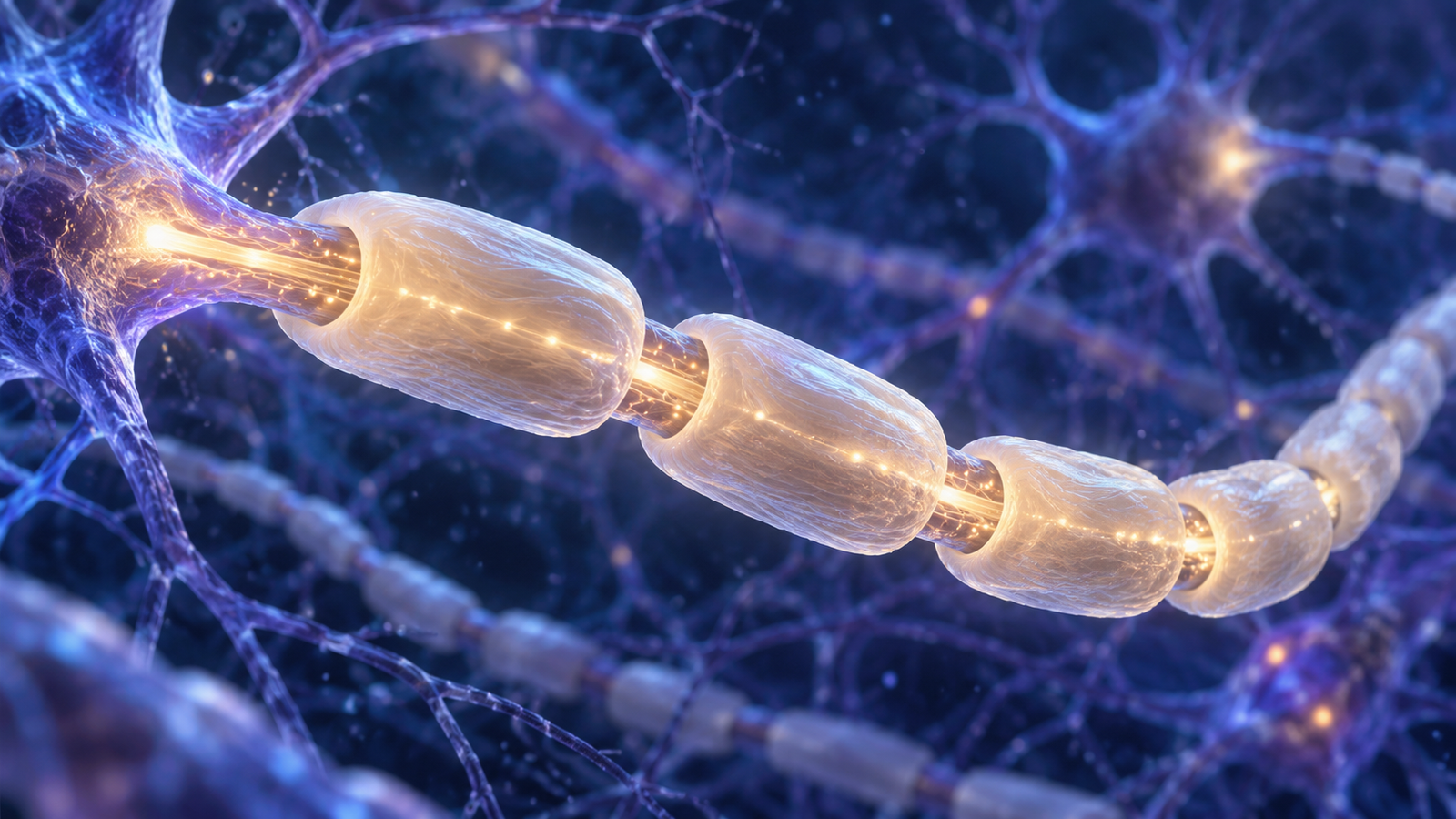
An editorial image can make a complicated topic easier to approach, but it should not be mistaken for a microscope image or a validated anatomical diagram. The illustration accompanying this article is conceptual. It does not provide scale, show a patient’s tissue or document a research finding. When reading any scientific picture, check its caption and origin. Ask whether it is an artist’s interpretation, a schematic, a measured image or a visualization generated from data.
Different image types serve different purposes. A schematic may simplify structure, while a research image requires methods and context to interpret. A realistic texture does not transform an artistic image into evidence. Keep the explanation anchored to the cited institutional source and the question being discussed. That habit is particularly useful online, where a visually convincing illustration may circulate separately from the caption that originally explained its limitations.
A practical way to remember the concept
Write three short notes after reading: what myelin is, what the covering analogy helps you picture and what it cannot establish. Then try explaining the distinction between the sheath and the axon without making a treatment claim. If the explanation needs a phrase such as exactly like a wire, revise it to identify the limited similarity. That small exercise checks understanding more effectively than memorizing an image while overlooking the boundary of the comparison.
The useful conclusion is modest and durable. Myelin is part of living nervous-system organization, and its relationship with nerve communication matters. Understanding it requires more than a cable metaphor, especially when discussing disease, research or commercial claims. Keep structure, measurement and practical benefit separate until evidence connects them. That approach supports curiosity about neurobiology while preserving the uncertainty that responsible science reporting should make visible.