
What EEG Measures, and What It Cannot Tell You
Key Points:
- EEG records electrical activity; a trace does not interpret itself.
- Separate the recording, software processing, label and decision made from the output.
- Clinical uses of EEG do not validate every consumer claim about focus or brain performance.
- MedlinePlus notes that EEG cannot measure intelligence and a normal recording does not prove a seizure never occurred.
An electroencephalogram, usually shortened to EEG, records electrical activity associated with the brain. The resulting traces can be clinically useful, but a wave on a screen is not a direct transcript of a person’s thoughts. Understanding the distinction between a signal, an interpretation and a decision helps readers evaluate both medical explanations and consumer technology claims. This article explains that reading framework. It does not interpret an individual’s recording, recommend a test or compare products we have used.
A recording is the beginning of an interpretation
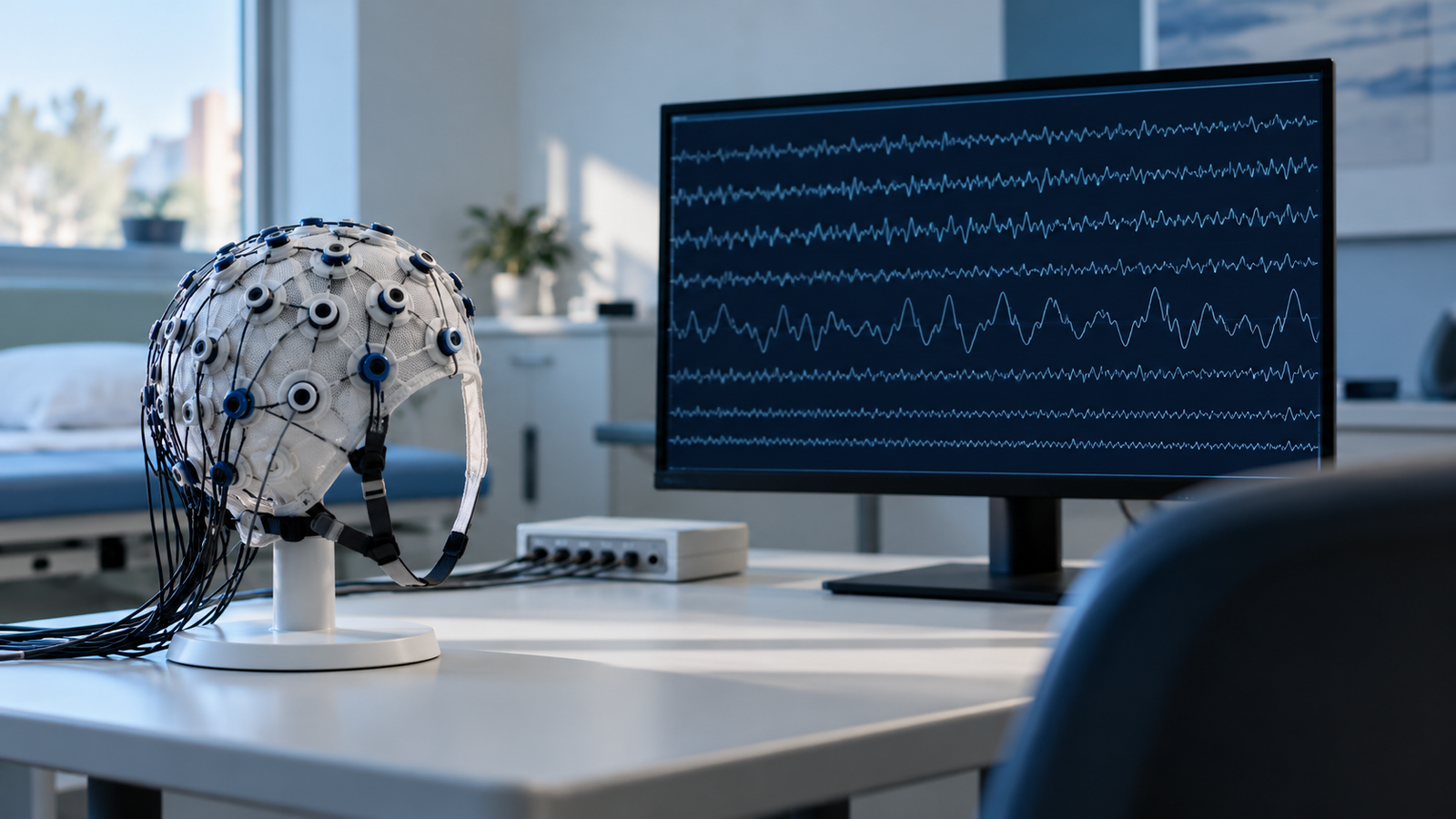
The MedlinePlus explanation of EEG describes electrodes positioned on the scalp and connected to a recording system. The signals appear as changing wave patterns. Movement can affect the recording, and the procedure may involve different conditions chosen by the clinical team. The important distinction for a general reader is between obtaining a trace and determining what that trace means in the context of a clinical question. A graphic that looks scientific does not interpret itself.
Imagine a hypothetical article displaying a colorful set of waves beside a claim about concentration. Before accepting the claim, ask what was actually recorded, what processing turned the recording into the display and how the claimed interpretation was checked. Those are separate questions. The presence of electrodes supports the narrow observation that a recording method was used. It does not establish every label attached to the output, especially when the label concerns a complex experience such as focus, creativity or emotional state.
Separate the signal from the label
A useful reading sequence has three stages. First identify the recorded signal. Next identify the method used to summarize or classify it. Finally identify the decision or claim made from that summary. Our original table below organizes those stages without suggesting that a reader can diagnose a condition from a screenshot. In a medical setting, interpretation belongs with an appropriately qualified professional who can consider the reason for testing and other relevant information.
| Stage | Question to ask | What it does not establish alone |
|---|---|---|
| Recording | What signal and recording conditions are described? | The meaning of a pattern for an individual |
| Processing | How was the raw recording transformed into a score or image? | Whether that score measures the advertised concept |
| Interpretation | What evidence supports the label applied to the result? | Whether a different device or setting works equally well |
| Decision | Who interprets the result, and for which purpose? | That one measurement settles every relevant question |
Clinical use does not validate every consumer claim
MedlinePlus describes EEG use in evaluating or monitoring several neurological circumstances, including seizure-related questions. It also states that EEG cannot measure intelligence and that a normal recording does not establish that a seizure never occurred. These boundaries are useful examples of why the test must be interpreted for a particular question. This article does not provide a complete account of indications or tell a reader whether a test is appropriate for their symptoms.
A consumer advertisement may borrow the vocabulary of a clinical procedure while making a different claim with different equipment. Ask whether the evidence concerns the actual product, its intended users and its proposed use. Evidence that a measurement technique has legitimate applications is not evidence that every device using related terminology accurately measures concentration or improves daily performance. The supporting study should match the claim closely enough that a reader can understand what was evaluated and what remained uncertain.
Ask what a score is compared with
If a system presents a concentration score, the number needs an explanation. What reference defines a high or low value? Is the score compared with the same person’s previous recordings, a group of users or an externally defined task? Does the evidence assess agreement with a suitable reference, repeatability, practical usefulness or something else? These questions do not imply that any particular product fails. They identify information needed before a score can be treated as a meaningful measure.
For an original example, suppose an app reports a higher score during one session than another. That difference could be described accurately as a change in the app’s output. Calling it a proven improvement in attention requires additional support. The recording conditions, processing and relevant comparison matter. Avoid turning a proprietary score into a universal unit of brain performance merely because the display uses a percentage sign or a polished chart. The interface should not supply certainty that the evidence does not provide.
Read a study beyond its headline result
Look for the participants, task, comparison and outcome. A small laboratory demonstration may answer a useful research question while leaving daily use uncertain. A result in one task should be described at that level unless the researchers tested transfer to other situations. If the article claims improved studying, ask whether studying was measured. If it claims a health benefit, ask what clinical evidence addresses that benefit rather than relying on a visually impressive trace.
Keep association and intervention separate as well. A pattern associated with an activity does not automatically establish that changing the pattern through a device will improve that activity. The first question concerns a relationship; the second concerns an effect of an intervention. A responsible report identifies which question the evidence addresses. If methods are unavailable, the appropriate conclusion is that the claim could not be fully assessed from the accessible material, not that the missing methods must have been adequate.
Prepare questions for a clinical conversation
If a healthcare professional has recommended an EEG, ask what question the test is intended to help answer, how preparation should be handled and how the result will be explained. Follow the instructions from the treating team rather than improvising from an online article. Do not stop or change medication because a general description mentions preparation. The details of a person’s care are outside this educational article and require the professional who knows the relevant circumstances.
It can help to write down the questions you want answered after the test. What did the recording show? What limitations affect the interpretation? Is more information needed? What follow-up was recommended? These are communication prompts, not a checklist that determines a diagnosis. Keep the written report and the clinician’s explanation together when possible, because a remembered phrase or a cropped image may omit the uncertainty that matters most to understanding the result.
Protect the information around the recording
A shared screenshot may include a name, date, clinic details or other identifying information. Before posting a recording to a public forum, consider what it reveals and whether public interpretation is appropriate. A discussion board cannot replace the professional responsible for a clinical result. For a consumer service, inspect its privacy documentation, account requirements and options for exporting or deleting information. A striking visualization is still information generated in a particular context, not a reason to ignore ordinary privacy questions.
The practical lesson is to resist collapsing several steps into one. EEG records signals; people and software apply methods to interpret them for particular purposes. A useful article names those purposes, explains the comparison and preserves the limitations. That approach allows readers to appreciate a valuable scientific and clinical method while asking proportionate questions about claims that extend beyond the evidence. The best next question is usually what supports this interpretation, rather than whether the waves simply look convincing.