
Do Cats Recognize Their Names? What Playback Experiments Actually Show
Key takeaways
- An ear turn or head movement can be a response even when a cat stays in place.
- The first name-discrimination analysis involved eleven habituated cats, not every tested cat.
- Experiments with unfamiliar speakers and other cats’ names tested different questions.
- Recognizing a sound, identifying an individual and following a request are distinct abilities.
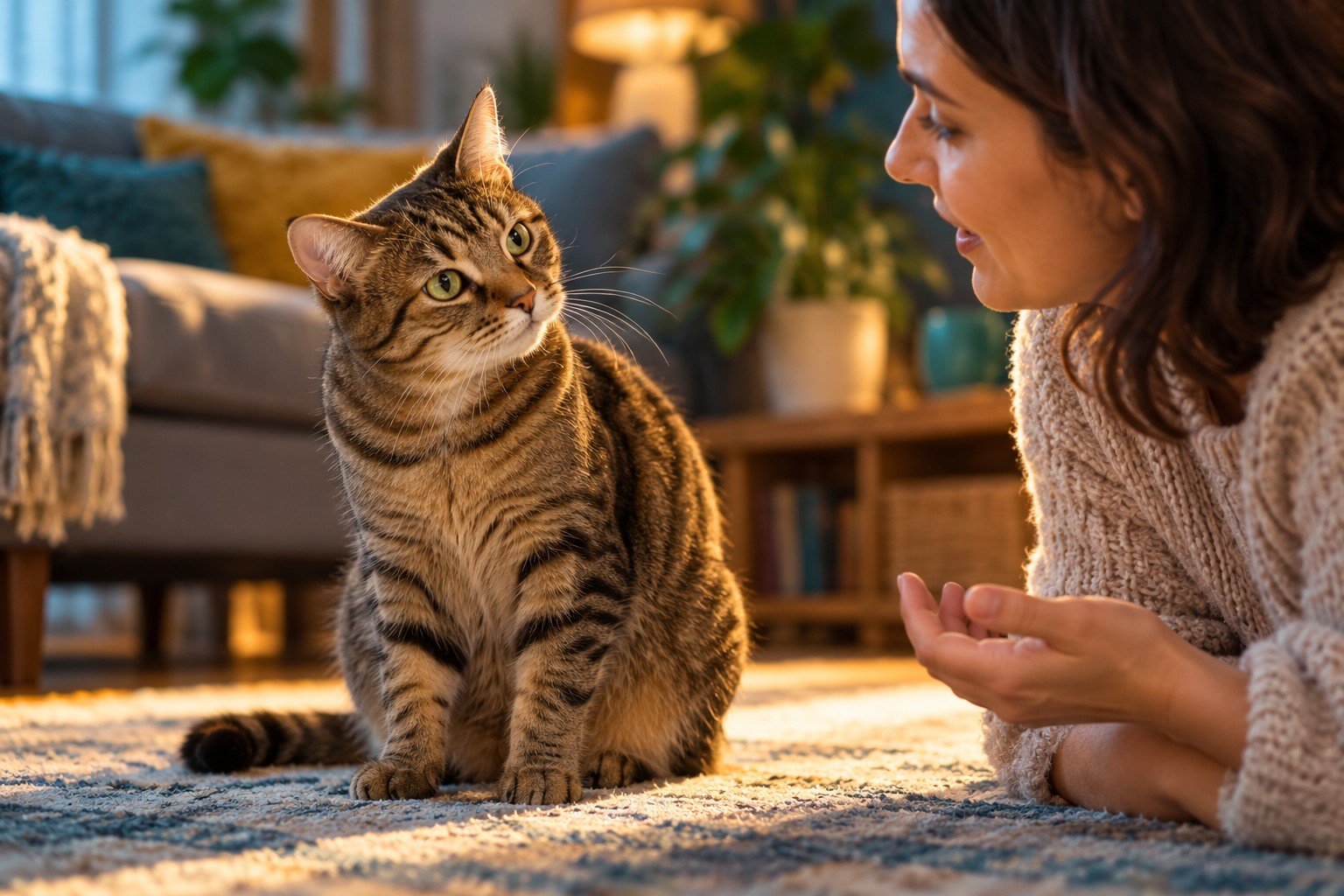
You say your cat’s name. An ear rotates, the eyes briefly shift and the cat stays exactly where it was. It is tempting to interpret the scene as a choice between understanding and ignoring you. A cognition experiment separates the questions: did the sound produce a detectable response, and what information did the animal discriminate?
Research asking whether cats recognize their names does not require the animal to walk toward a person. Instead, playback methods measure changes in attention to recorded words. That makes small responses scientifically useful, while leaving obedience and everyday motivation as separate issues.
The evidence is strongest when the name is compared with other sounds under controlled conditions. A single response at home could involve your posture, a food container or a familiar routine. The laboratory question is whether differences remain when researchers arrange the spoken stimuli more systematically.
How a playback experiment tests a name
In the 2019 study by Saito and colleagues, researchers used habituation and dishabituation. Cats first heard a sequence of comparison words. A reduction in response across those presentations established habituation; a renewed response to the cat’s name was evidence of discrimination.
In the first experiment, eleven of sixteen cats habituated to the comparison nouns. Nine of those eleven increased their response to their own name. The statistical comparison concerned the habituated group, so the result is not a population estimate that nine in eleven ordinary cats always recognize a call.
This design asks whether a change in the spoken stimulus changes behavior after attention has declined. It avoids requiring extensive training to retrieve an object or perform a command. That is particularly useful when an animal may notice a sound without approaching the person who produced it.
The comparison words had the same length and accent pattern as each cat’s name. Matching these features helped rule out a response caused simply by a longer word or a different stress pattern. The experiment still allowed familiarity with the name to contribute to the response.
Why ears and heads mattered more than walking
Across the experiments, the study commonly recorded orienting movements of the ears and head. Vocalizing, moving the tail or changing position were less frequent. Restricting recognition to coming across the room would therefore miss much of the measured response.
An orienting response is still not a sentence in the cat’s mind. It establishes that the animal’s behavior changed when the stimulus changed. The interpretation depends on the comparison words, their presentation and the animal’s experience with its name.
This distinction is useful at home. If you are describing an interaction to another person, report what happened: one ear moved, the head turned or the cat approached. Each is clearer than saying the cat definitely understood everything or deliberately refused to cooperate.
Likewise, absence of walking is not evidence of deafness, stubbornness or dislike. The experiment did not validate those diagnoses. Recognition of a familiar signal and motivation to leave a comfortable location need not produce the same observable outcome.
What unfamiliar speakers add
If only the owner speaks, the animal could be responding to a familiar combination of voice, pronunciation and word. Testing another speaker asks whether discrimination extends beyond that exact presentation.
In the paper’s fourth experiment, twenty of thirty-three tested cats habituated to unfamiliar speakers’ comparison words. Thirteen of those twenty increased their response to their own name. The group-level result supported discrimination beyond the owner’s voice, with the same limitation that analysis depended on habituation.
The finding does not show that any pronunciation or nickname will work equally well. Generalization has a defined range: the tested speakers, recordings and words. A recording that is unfamiliar in one respect can still retain acoustic features that the animal has learned.
Hearing the name in another voice matters because everyday calls rarely sound identical. The result suggests some flexibility in recognizing its sound pattern, while leaving open how much a changed pronunciation, noisy room or competing activity would affect the response.
A familiar name is not a human identity concept
A name can be a well-learned sound associated with relevant events. That possibility is compatible with the discrimination finding. The experiment does not require a cat to understand naming conventions, spelling or the social meaning that a person attaches to a name.
Our guide to how memory works distinguishes learning, retention and later retrieval. The cat study targets a response to familiar auditory information; it does not supply one general score for all of those processes.
A useful question for follow-up would be whether a name predicts an individual across changed contexts and modalities. That requires a different experimental comparison from simply detecting that the name sounds unlike a series of nouns.
Why household and café results differed
The paper also compared cats’ own names with cohabiting cats’ names. In that experiment, six of twenty-four household cats and nine of ten café cats habituated. All six habituated household cats increased their response to their own name, compared with three of the nine café cats. The household result therefore rests on a particularly small analyzed group.
In a multi-cat setting, several names may occur close together and precede similar events. That is one possible way to think about the learning problem, not proof of the mechanism behind the observed group difference. The study cannot assign one explanation to every household or café.
What matters for interpretation is that a comparison against general nouns is different from a comparison against other frequently heard names. The second can be harder to explain through familiarity alone, but it also brings different histories of exposure.
Avoid ranking pets by comparing their responses without accounting for that history. An animal’s experience is part of the task it faces. A lively reaction in one home and a subtle reaction in another do not create a standardized intelligence test.
Names of other cats raise a separate question
A 2022 study by Takagi and colleagues paired spoken names with pictures of familiar cats or family members. This design investigated whether a name creates an expectation about whose face will appear, rather than only whether the sound stands out.
The study reported evidence that household cats can associate at least one companion cat’s name with that individual; results involving human family members were more conditional. It should not be simplified into all cats know everyone’s name.
The distinction between the studies is valuable. Detecting your own familiar name and linking another individual’s name to a face may draw on overlapping learning processes, but neither task automatically demonstrates the other.
A separate 2013 owner-voice study tested twenty domestic cats with recorded voices. Its recognition question concerned who was speaking. Keeping speaker identity and word identity separate prevents several related findings from turning into an unsupported claim of human-like language comprehension.
Compare the claims before interpreting your pet
| Question | Relevant observation | What remains a separate issue |
|---|---|---|
| Does the sound stand out? | Response rebounds after comparison words | Whether the cat will approach |
| Does discrimination extend across speakers? | Response to a name spoken by someone unfamiliar | Every nickname or pronunciation |
| Does a name predict an individual? | Different looking when name and face mismatch | Understanding human naming conventions |
| Does the cat follow a request? | A defined action after a cue | Recognition from a small orienting response alone |
These questions can coexist in one relationship. An animal could recognize a word without acting on it, or perform an action because a situation is familiar without relying on the word alone. The table is an interpretation guide rather than a scoring system.
A useful way to observe without overtesting
During ordinary interactions, notice the setting as well as the response. Was the cat resting, already watching you or attending to something else? Did a familiar gesture accompany the name? A short description of context is more informative than a label such as ignores me.
Keep an observation separate from an experiment. Repeating a name until a cat responds changes its exposure and may change attention. It also gives you many chances to count an unrelated movement as success. That does not reproduce a controlled comparison.
For a cat owner, the most useful shift is to notice attention as well as action. A cat can register a familiar call while remaining on the sofa. The studies make that small moment easier to appreciate without treating it as proof of obedience or indifference.
Common questions about cats recognizing names
Does turning an ear count as recognition?
It can be part of the measured orienting response. A single ear turn outside a controlled comparison cannot, by itself, establish which information caused it.
Does staying still mean the cat is ignoring me?
That interpretation adds intention to an observation. The cat may have detected the sound without approaching. The playback studies do not establish the motive behind an individual pet’s stillness.
Can cats recognize names spoken by strangers?
The 2019 study found group-level discrimination in its unfamiliar-speaker experiment among cats that habituated. That is narrower than a guarantee for every cat or every voice.
Does this mean cats understand full sentences?
No. Distinguishing a familiar word does not establish grammar or comprehension of every word around it. Each broader language claim needs its own test.
Sources and further reading
- Saito et al., 2019: cats discriminate their names from other words
- Saito and Shinozuka, 2013: vocal recognition of owners
- Takagi et al., 2022: names of companion cats and family members