
Synaptic Pruning and Microglia: How Brain Connections Change, Without the Detox Myth
Key takeaways
- Pruning means selective remodeling, not indiscriminate destruction.
- Activity and complement signaling can influence microglial engulfment in developing circuits.
- Microglia have roles beyond removal, including interactions relevant to learning.
- Animal sleep experiments do not establish that a poor night makes a human brain eat itself.
A young nervous system forms and refines many connections. The familiar gardening metaphor calls some of this refinement “pruning.” It is useful up to a point: a living brain has no gardener deciding which memories deserve to survive.
Microglia contribute to this changing cellular environment. They can interact with synaptic material, respond to signals and participate in processes that depend on age, location and circumstances. Reducing them to either helpful cleaners or destructive invaders misses that range.
The same caution matters when the concept becomes a sales pitch. “Optimize brain cleanup” sounds attractive, but it does not identify a measured problem or establish that a product changes a relevant human outcome.
What is being pruned?
A synapse is a specialized contact through which one neuron influences another. Some structural studies examine dendritic spines, small protrusions associated with many excitatory contacts. A change in a spine is not the same as the death of an entire neuron.
Formation, stabilization, weakening and elimination all contribute to changing circuits. The number of connections alone is not a direct measure of intelligence or health. Useful organization depends on which cells communicate, under what conditions and with what effects.
Developmental refinement is also different from pathological synapse loss. Both may involve some overlapping molecules, but that does not make them the same process or suggest that maximizing removal would be beneficial.
What microglia do in a developing circuit
In a 2012 study of the developing mouse visual system, microglia engulfed presynaptic material during circuit refinement. Neural activity and complement-related signaling influenced the process; disrupting the pathway altered connectivity.
Complement is part of immune signaling, and the experiment linked particular components to a defined developmental setting. It did not establish that every weak connection throughout the adult human brain receives the same label or follows the same fate.
The important insight is that refinement can involve interactions between neurons and immune cells. The limitation is equally important: a specific circuit in a developing mouse cannot stand in for all learning, aging or disease.
Microglia are not just cellular rubbish collectors
Parkhurst and colleagues studied microglia and learning-related synapse formation in mice. Their experiments implicated microglial BDNF signaling in some structural and behavioral changes associated with learning.
This complicates the idea that the goal should always be to suppress microglia. Their effects depend on context, and a cell population can participate in more than one process. “Activation” is not a complete explanation of whether its behavior is beneficial or harmful.
It also does not follow that taking a supplement marketed around BDNF reproduces the experimental effect. A molecular role in an animal model is different from evidence that a product reaches the relevant site and improves a human outcome.
What sleep research actually tells us
A 2017 mouse study of sleep loss examined astrocytic engulfment and microglial changes under different sleep conditions. Chronic restriction and acute sleep deprivation did not produce identical microglial findings.
These observations are often compressed into the alarming phrase that the brain “eats itself.” That phrase erases the species, protocol and cellular distinctions. The experiment did not demonstrate that an ordinary bad night causes comparable human brain damage.
Other work has examined REM sleep and selective changes in new dendritic spines in mice. Sleep-related plasticity is a set of research questions, not one universal cleanup cycle with a consumer-accessible dial.
Pruning is different from glymphatic clearance
Synaptic remodeling concerns cellular contacts and their organization. Glymphatic research examines movement and exchange of fluids and solutes in the brain. Both can be discussed in relation to sleep, but they are not interchangeable forms of a single “detox” process.
Our article on cognitive reserve and aging makes a related distinction: functioning despite brain change is not the same as preventing every biological change. Keeping the mechanism separate from the desired outcome prevents misleading shortcuts.
A claim that a cooling mattress, probiotic or supplement clears toxins therefore cannot be used as evidence that it improves microglial pruning. Each proposed mechanism and clinical outcome needs its own test.
How to read a brain-cleanup claim
| Question | Why it matters |
|---|---|
| Was this studied in people, animals or cells? | Each setting supports different conclusions. |
| What was measured? | A protein marker, image and memory test are different outcomes. |
| Was the exact product tested? | A general mechanism does not validate a formulation or device. |
| What benefit and harm were assessed? | More pruning is not automatically a desirable result. |
Be especially cautious when a product turns a normal biological process into an assumed deficiency. Without a validated personal measurement, a promise to restore the “right amount” can be impossible for a buyer to check.
Practical priorities that do not require a pruning score
Protect a workable opportunity for sleep
Keep a reasonably consistent schedule where circumstances allow and allow time to rest. This supports ordinary health without promising to select particular synapses for preservation. One disrupted night is not a reason to begin an expensive recovery protocol.
Seek help for persistent problems
Ongoing insomnia, marked daytime sleepiness or changes in thinking deserve appropriate assessment. A consumer sleep score cannot determine whether microglia are functioning normally. Treat symptoms as a reason to ask a clinical question, not as proof of a cellular explanation.
Choose learning for its practical value
Practice a skill, keep meaningful activities accessible and assess what you can do over time. You do not need to estimate the number of eliminated connections. The aim is useful function and wellbeing, not maximum synapse count.
Evaluate purchases on demonstrated benefits
A comfortable sleep environment may be worth improving for comfort. Compare cost, trial terms and alternatives on that basis. Comfort improvements do not establish treatment of pruning dysfunction or prevention of neurodegeneration.
Developmental pruning and disease-related loss should stay separate
The same word can describe changes with very different implications. During development, a circuit may be refined as patterns of connectivity become more organized. In disease research, scientists may investigate excessive or inappropriate loss of connections. Neither description makes “more pruning” a general wellness target.
A useful comparison is editing a document. Removing repetition can improve clarity, while deleting essential information can make the document worse. The number of deleted words does not decide which happened. The analogy has limits, but it illustrates why counting eliminated synapses would not by itself establish a benefit.
Researchers therefore need context: the circuit, developmental stage, cell behavior, timing and functional outcome. A change in an immune-related molecule may help explain an experiment without becoming a standalone diagnosis. Routine symptoms such as tiredness cannot identify a specific pruning pathway.
Read an animal-study headline in four steps
First, identify the organism and conditions. “Sleep loss” could refer to a carefully controlled protocol that differs substantially from a person waking once during the night. Record the actual comparison rather than assuming that the most dramatic headline describes everyday life.
Second, identify the measurement. Microscopy may reveal cellular structures, while another experiment measures a protein or behavior. A change in one is not interchangeable with a clinical outcome such as a diagnosed memory disorder. Ask what the study directly observed and what the authors proposed as a possible explanation.
Third, separate the result from the forecast. An observed change can justify further investigation without establishing permanent damage or future disease. A phrase such as “may increase susceptibility” expresses a hypothesis or uncertainty. Repeating it as “causes dementia” changes the claim.
Fourth, check the proposed action. Even if the biological finding is reliable, it does not automatically validate a product attached to the story. A seller needs evidence that the specific intervention produces a worthwhile benefit in an appropriate population, together with information about limitations and harms.
This approach also prevents the opposite mistake of dismissing animal work as irrelevant. Controlled experiments can reveal mechanisms that are difficult to examine directly in people. Their value depends on asking the next question carefully, rather than treating them as either a ready-made human prescription or a curiosity with no implications.
For a broader example of this reasoning, see our guide to chronic stress and brain structure. It explains why cellular findings, human imaging and everyday symptoms should be interpreted at their own level. Keeping those levels distinct makes a health explanation more useful and less alarming.
Frequently asked questions
Does pruning mean forgetting everything I do not practice?
No. Forgetting has multiple explanations, and a memory is not a single isolated synapse that disappears on a nightly schedule.
Should I try to stop microglial activation?
There is no general self-care goal of turning microglia off. They have normal roles, and a medical intervention would require a specific condition and evidence.
Can a sleep tracker tell me how much pruning occurred?
No ordinary consumer sleep score directly measures microglial engulfment or the fate of individual synapses.
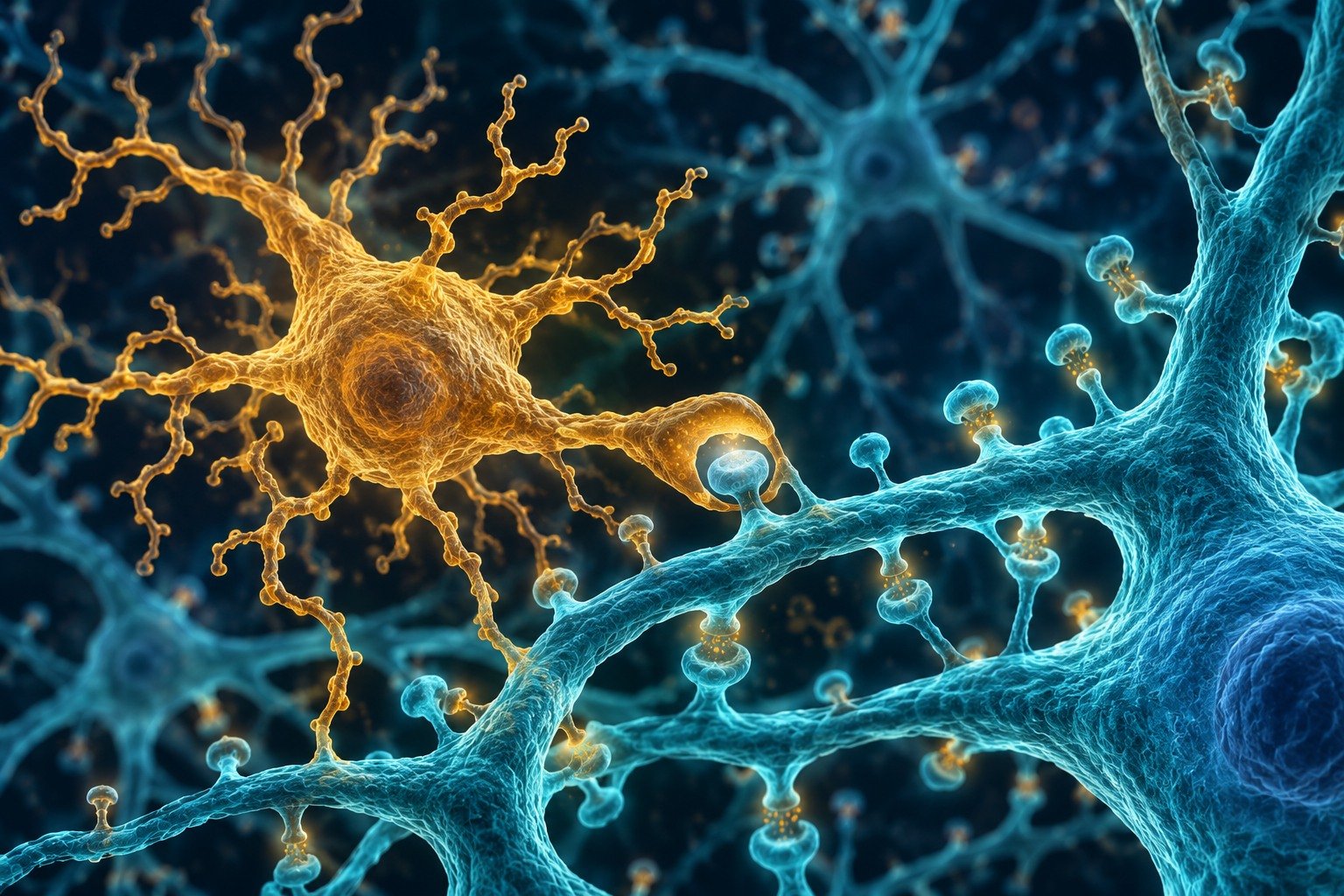
The featured illustration is conceptual artwork, not a brain scan or a measurement of individual brain function.
Sources and further reading
- Schafer et al. (2012). Microglia sculpt postnatal neural circuits.
- Parkhurst et al. (2013). Microglia promote learning-dependent synapse formation through BDNF.
- Bellesi et al. (2017). Sleep loss promotes astrocytic phagocytosis and microglial activation in mouse cerebral cortex.
- Li et al. (2017). REM sleep selectively prunes and maintains new synapses.
Continue reading
- Neuroplasticity in Adulthood: 5 Evidence-Based Ways to Rewire Your Neural Pathways
- Does Sleep Clean the Brain? What the Glymphatic Evidence Shows and Where Scientists Disagree
- Neural Oscillations and Learning: Why Timing Matters More Than a Brain-Wave Score
- Neuroinflammation and Brain Fog: Evidence, Symptoms and Testing Limits