Neural Oscillations and Learning: Why Timing Matters More Than a Brain-Wave Score
Key takeaways
- Frequency, timing and recording location matter together.
- Theta–gamma coupling describes a relationship between signals, not a fixed memory-storage capacity.
- Intracranial findings cannot be assumed to appear identically in a home EEG headband.
- Practice, feedback and checking later recall are more useful learning targets than chasing a particular rhythm.
A classroom, a musical ensemble and a conversation all depend on timing. The brain also coordinates activity over time, although its signals are not a literal orchestra with a single conductor. Neural oscillations give scientists one way to study that coordination.
Popular descriptions often go further, assigning a mental ability to each frequency band. That makes a memorable chart, but it hides the importance of recording location, task and the relationship between different signals. Learning is not a process of turning every “good” wave upward.
The useful question is what a particular rhythm predicts in a particular experiment, and whether changing it improves an outcome that matters outside the experiment.
What an oscillation actually measures
Electrical recordings reflect changing activity from neural populations. A rhythmic component repeats over time, and its frequency describes how quickly that repetition occurs. Power describes the strength of a component in a recording; phase describes a position within its cycle.
These quantities answer different questions. Two signals can have similar power yet differ in timing. A brief coordinated event can matter even when an average over a long recording makes it hard to see.
Band names such as theta and gamma group frequencies for analysis. Their boundaries vary across studies, brain regions and species. A study reporting slower hippocampal theta in humans should not be forced into a universal chart derived from another experimental setting.
Theta–gamma coupling, explained without the hype
In phase–amplitude coupling, the strength of faster activity varies with the phase of a slower rhythm. A useful analogy is a recurring window during which another signal becomes more prominent. The analogy does not mean the brain stores exactly one item in every wave.
In intracranial recordings during a word-memory task, researchers found hippocampal coupling between slow theta and gamma activity related to encoding. The participants were neurosurgical patients, and electrodes recorded from particular locations.
This provides evidence about coordination during that task. It does not establish a personal memory score for the general population, a universal optimal frequency or a consumer intervention. Sampling, recording methods and the patient setting all affect how broadly the result can be interpreted.
Formation and retrieval are different experiments
Encoding is the initial processing that can support a memory; retrieval is accessing it later. A signal related to one stage need not behave the same way during the other. Working memory, spatial navigation and remembering a word list also make different demands.
A human intracranial study of spatial memory retrieval examined theta activity and its relationship with gamma. It adds a task-specific piece of evidence rather than a rule that more theta always means better memory.
When reading a headline, identify both the behavior and the time point. An immediate improvement on a practiced task is different from remembering material a week later or applying it in an unfamiliar setting.
Why a home headband is not an implanted electrode
Scalp EEG and intracranial recordings access activity in different ways. The scalp signal is influenced by the distance and tissue between sources and sensors, as well as by non-neural activity. A consumer device may use a small set of sites and summarize the result through a proprietary algorithm.
That can support an engaging feedback experience without making it a direct readout of hippocampal coupling. Eye and facial muscle activity are especially relevant when interpreting signals recorded near the forehead.
See our explanation of what EEG can and cannot tell you. Before accepting a memory claim, ask what the sensor measures and whether the claimed learning improvement was actually tested.
What would demonstrate a learning benefit?
| Claim | Evidence to look for | Remaining question |
|---|---|---|
| A rhythm changes | A reliable recording and appropriate analysis | Does performance improve? |
| A trained task improves | A controlled comparison using that task | Does it transfer beyond practice? |
| Everyday learning improves | Relevant outcomes and follow-up | How large and lasting is the benefit? |
A sound mechanism is a reason to investigate an intervention, not a substitute for testing it. Placebo expectations, extra practice and coaching can influence results. The comparison should make it possible to separate those influences from the intervention being advertised.
Build a learning routine around outcomes you can check
Choose material and a retrieval task
After studying a short section, close it and explain the main point. For a skill, perform the relevant step rather than only watching a demonstration. This gives you a practical check on what you can currently do.
Return later
Check the same idea after a delay. If it has become difficult, use that information to guide the next practice session. A feeling of familiarity while rereading is less informative than an attempt to retrieve the answer.
Keep feedback specific
Identify the missing detail or recurring mistake. “Improve gamma” does not tell you whether you confused two concepts or skipped a step. Feedback should help you decide what to change in the next attempt.
Make the routine sustainable
Protect opportunities for rest and choose a workload you can repeat. These are sensible learning conditions, not a guarantee that a particular electrical pattern will occur. If a tool adds more monitoring than useful practice, simplify the setup.
How to assess paid brain-training tools
A product may offer structure, reminders or enjoyable exercises. Judge those features on their own merits. Do not assume that an exercise associated with a neural mechanism has demonstrated broad improvement in memory or prevention of disease.
Ask for evidence for the exact version, users and outcome. Our guide to brain-training transfer explains why getting better at an exercise is different from a general cognitive benefit. Compare price, accessibility and cancellation with lower-cost ways of practicing the skill you actually need.
Neural oscillations, synchrony and entrainment are different ideas
An oscillation is a recurring pattern. Synchrony concerns a relationship in timing between signals. Entrainment describes alignment with a repeating influence. These terms can appear together, but observing one does not automatically establish the others or demonstrate improved learning.
Imagine two musicians playing at the same average tempo. They can still be out of time with each other. Similarly, naming a frequency says little about the relationship between recordings. Scientists need an analysis suited to the specific timing question, with checks that the result is not produced by an artifact or by the mathematical properties of the signal.
Consumer advertising may compress this chain into “play a frequency, synchronize the brain, remember more.” Each step needs separate evidence. A measurable response to sound does not by itself demonstrate stronger memory, and better performance during one session does not establish lasting retention.
Follow a memory claim from signal to everyday outcome
Consider a hypothetical app study in which users complete an exercise while a device records activity. The first question is whether the recording and analysis reliably detect the proposed signal. The second is whether that signal relates to performance within the study. The third is whether the app causes an improvement compared with a suitable alternative.
A fourth question concerns transfer. If users become better at the app’s own exercise, can they also remember names, learn course material or perform another relevant task? A fifth concerns time: does the improvement remain after practice ends? These are different outcomes, so a compelling chart for the first cannot answer all five.
Look for the size of the behavioral difference as well as whether it was statistically detectable. A result may be interesting for research while offering little practical advantage at a particular price. Also ask whether the study included people with needs similar to yours and whether the comparison involved an equally engaging activity.
For your own learning, select a small, meaningful test before changing the routine. A student could attempt an explanation without notes today and again after a delay. A learner of a practical skill could repeat the task in a new example. This keeps the evaluation connected to the goal while leaving questions about neural mechanisms to methods designed to measure them.
Our overview of cognitive reserve and cognitive health also separates a targeted training effect from broad claims about resilience or disease prevention. Those distinctions matter even when a product uses sophisticated neuroscience terminology.
Frequently asked questions
Is gamma the best frequency for learning?
There is no single best brain-wave band for all learning. Relevant activity depends on the task, location, timing and method used to record it.
Can music directly copy hippocampal theta–gamma coupling?
Hearing a rhythmic stimulus is different from demonstrating a particular relationship in hippocampal recordings. A commercial claim needs direct evidence for its proposed mechanism and behavioral benefit.
Should I buy a device to check whether I am learning?
You can check learning directly through later recall and task performance. A consumer physiological score is not a replacement for those outcomes.
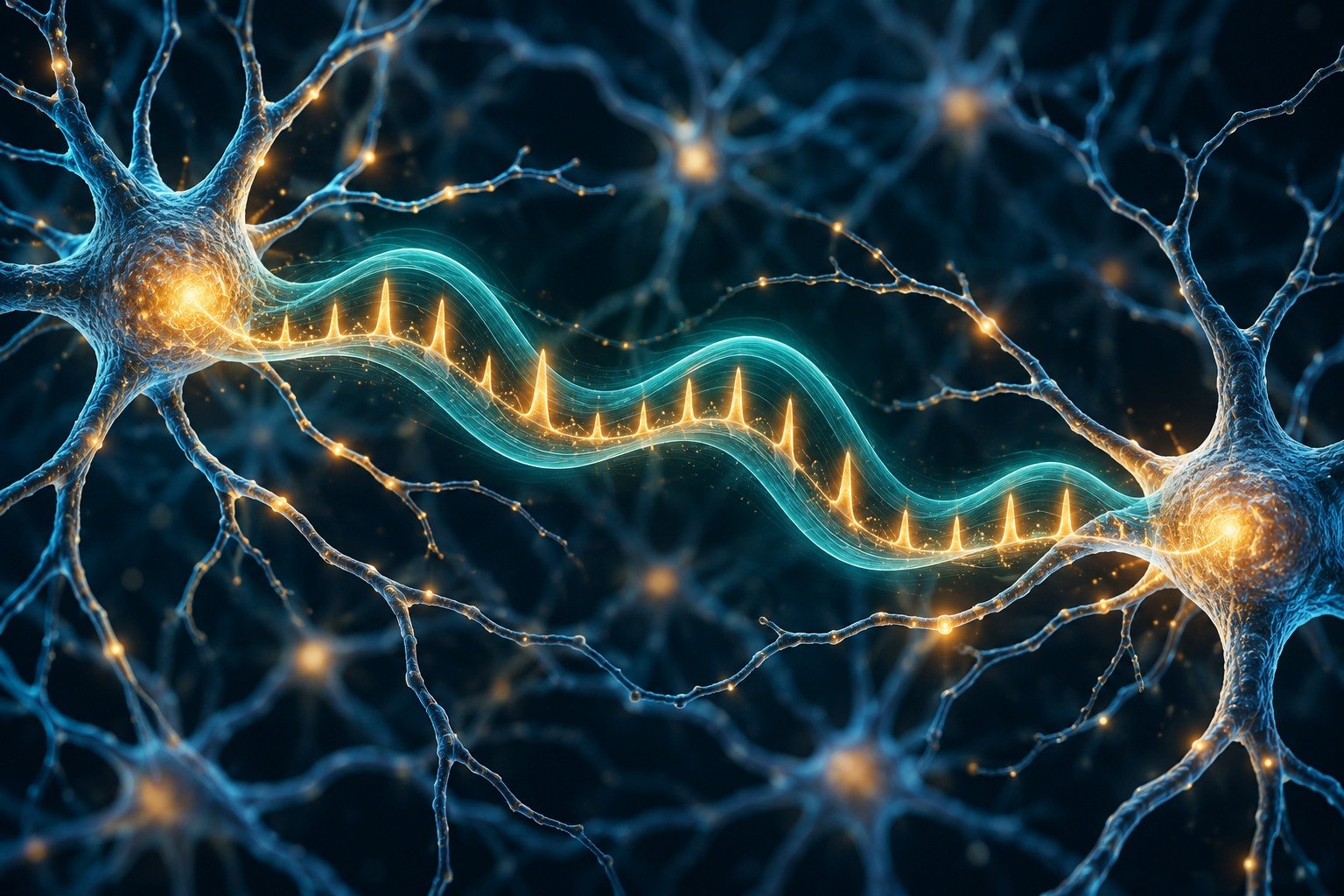
The featured illustration is conceptual artwork, not a brain scan or a measurement of individual brain function.
Sources and further reading
- Lega, Burke, Jacobs, and Kahana (2016). Slow-theta-to-gamma phase-amplitude coupling in human hippocampus supports the formation of new episodic memories. Cerebral Cortex, 26, 268-278.
- Vivekananda et al. (2021). Theta power and theta-gamma coupling support long-term spatial memory retrieval. Hippocampus, 31, 213-220.
- Tort, Komorowski, Manns, Kopell, and Eichenbaum (2009). Theta-gamma coupling increases during the learning of item-context associations. PNAS, 106, 20942-20947.