Bumblebee Social Learning: What a Two-Step Puzzle Reveals About Insect Cognition
Key takeaways
- Five of fifteen observers passed the learning test; only two met the stricter proficiency criterion.
- The first puzzle action did not directly deliver the final food reward.
- Learning from another animal does not necessarily require human-style imitation or teaching.
- Laboratory transmission and cumulative culture in the wild are separate research questions.
A small animal solves a complicated puzzle after spending time with an experienced partner. It is an appealing scene, but the interesting scientific question is more precise than whether the animal is clever. Did the partner provide information that changed what the learner could accomplish?
Bumblebee social learning research approaches that question through artificial foraging tasks. Researchers can control the reward, the available movements and the learner’s experience. That makes it possible to ask what social exposure adds beyond an opportunity to explore.
A two-step puzzle described in 2024 is particularly useful because the first action does not immediately pay off. Understanding the design explains why the finding matters, and why describing it as proof that bees think exactly like people goes beyond the result.
Why a two-step puzzle is informative for bumblebee social learning
Consider a latch that must move before a lid can open. Pushing the lid gives no result until the latch is cleared. Learning the sequence requires connecting an apparently unproductive action with access to a later reward.
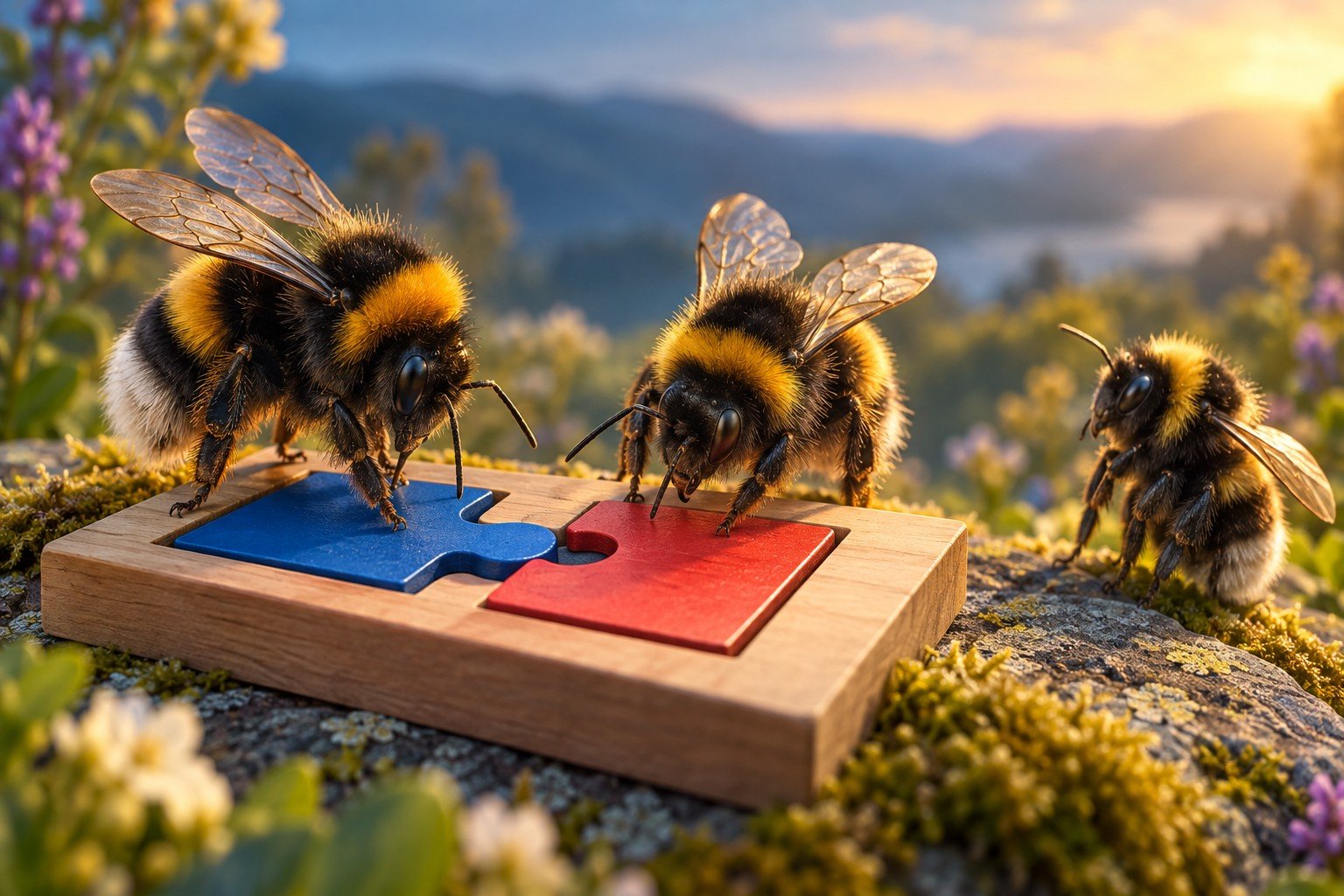
In the 2024 experiment by Bridges and colleagues, bees faced blue and red tabs on a food puzzle. Moving the blue tab cleared the red tab, which could then be pushed to expose sucrose. The apparatus created a dependency between actions rather than simply offering two equivalent buttons.
That dependency makes the task a useful test of acquiring a sequence. It does not automatically show that a successful animal represents the mechanism as a person would. Learning which movements work and understanding why they work are related possibilities, but they require different evidence.
For a reader, the crucial question is what experience was available before the successful attempt. An animal trained separately on every component has a different learning problem from one encountering the whole sequence with an experienced partner.
What the observers learned in bumblebee social learning
The authors tested fifteen naive observers paired with trained demonstrators. Observers received thirty to forty joint sessions, with individual unrewarded tests after specified sessions. Five passed and later repeated the sequence alone; only two reached the separate proficiency threshold of at least ten box openings. Passing and proficiency should not be merged into one outcome.
Three control colonies lacked trained demonstrators. Two had twelve days of exposure and one had twenty-four, with no completed openings. These were colony-level opportunities to discover the task, not fifteen individually matched control learners. The absence of success applies to the tested conditions.
The author-hosted full text also describes the substantial training required to prepare demonstrators. A temporary reward was needed for the initial action and was later removed. Observers acquired the sequence without receiving that same separate reward for its first component.
Keep the two training histories distinct. Otherwise, a report could incorrectly suggest that the experienced bees spontaneously invented the entire procedure or that observers followed precisely the same training schedule as demonstrators.
Five successes out of fifteen needs context
The result contains both successful transmission and substantial variation. A headline that says bees can learn the task is defensible as a statement about demonstrated capacity. A claim that all bees readily learn it is incompatible with the reported denominator.
The number of observer animals is also different from the number of sessions, box openings or demonstrations. Many observations from the same learner help describe that learner’s progress. They cannot be counted as many independent learners.
Likewise, a trained demonstrator’s performance is not a fresh test of how a naive animal discovers the solution. Combining trained and untrained animals into a single success percentage would obscure the study’s central comparison.
A useful account therefore reports who learned, what counted as passing and what happened when social guidance was absent. Those details reveal more than an isolated statement that an insect solved a puzzle designed by scientists.
Bumblebee social learning is broader than imitation
An animal may benefit from another’s behavior in several ways. Its attention could be directed to a useful object or location. It could follow a route, encounter a reward or acquire a movement sequence through its own subsequent practice. These are alternative explanatory possibilities, not additional findings from the experiment.
Imitation is a specific claim about copying an action. Teaching is a separate question about whether the demonstrator modifies its behavior in a way that facilitates another’s learning. Animal teaching can be defined functionally without assuming a conscious intention to instruct. This experiment does not establish that the demonstrators met teaching criteria.
The 2024 paper discusses close following and different opening techniques. These observations help generate explanations of transmission. They do not turn the demonstrator into a human instructor with a stated intention to educate another individual.
Avoid treating an associative explanation as an insult to the animal. A sequence acquired through attention, reward and experience can be an effective cognitive solution. The scientific goal is to identify the mechanism accurately, rather than select whichever label sounds most impressive.
How earlier experiments fit bumblebee social learning
An earlier string-pulling study investigated bees obtaining otherwise inaccessible food by manipulating a string. It showed that a non-natural behavior could be learned and socially transmitted, while examining associative processes that could support that transmission.
A 2023 puzzle-box study used two alternative ways of opening a box and followed the spread of behavior through groups. Bees exposed to demonstrators favored demonstrated variants. Some control bees also discovered how to open those simpler boxes.
These studies address related questions, but the tasks are not interchangeable. A behavior that some individuals can discover independently is a different case from a difficult sequence that no control colony solved during the tested period. This difference helps explain the specific contribution of the later experiment.
The progression also illustrates why science advances through comparisons among designs. Each new task can isolate a condition left uncertain by an earlier one. It need not erase the earlier result or support a grander description of every insect behavior.
What would count as cumulative culture?
Learning something from a companion is one part of a possible cultural process. A stronger cumulative claim asks whether innovations are retained, transmitted and built upon across successive learners. A single demonstration of acquiring a fixed solution cannot establish the entire process.
The two-step experiment makes a useful contribution by testing social acquisition of a sequence that was difficult to discover alone. It does not follow generations of wild colonies accumulating ever more elaborate solutions. Keeping those scales separate protects the finding from an unnecessarily inflated headline.
| Question | Evidence to look for | What should remain open |
|---|---|---|
| Did an observer learn? | Performance without the demonstrator | Whether every observer can learn |
| Did social exposure matter? | Appropriate comparison without a demonstrator | Whether discovery is universally impossible |
| Was a tradition maintained? | Behavior persisting across a group over time | Long-term persistence from a brief test |
| Was complexity accumulated? | Successive retained modifications | Human-like cumulative culture from one sequence |
This table describes standards for evaluating claims. It does not imply that every listed condition has already been demonstrated by the same experiment. The distinction between a finding and its next test is essential in comparative cognition.
What the study says about insect brains
The behavior shows that the relevant capacity should not be dismissed merely because the animal is an insect. It does not identify the neurons that encoded the sequence or establish that the bee used the same computational strategy as a person.
To connect learning to a neural mechanism, a study would need evidence linking measured or manipulated nervous-system activity to the behavior. Behavioral controls would still matter, since an intervention could affect movement, motivation or sensory access rather than the learning process alone.
Our fruit-fly connectome explainer considers a complementary issue: a wiring map does not explain an animal’s complete behavioral repertoire by itself. Structure and behavior are different kinds of evidence, and connecting them is a research task.
For human comparisons, use the experiment to formulate a question rather than declare equivalence. The broad problem of acquiring useful information from others is shared across many settings. A shared problem does not guarantee a shared experience, circuit or educational implication.
Common questions about bumblebee social learning
Did the bees understand the puzzle’s mechanics?
They acquired a behavior that solved the task. A separate test would be needed to distinguish flexible causal understanding from a learned sequence that works in the familiar arrangement. Successful performance alone cannot settle that distinction.
Were the demonstrators teaching deliberately?
The study tested learning through exposure to a demonstrator, not deliberate instruction. Calling the animals demonstrators and observers describes their experimental roles without making a claim about teaching or intention.
Does failure in the controls mean bees can never invent it?
No. It means the tested controls did not solve the puzzle within the study conditions and exposure. Universal impossibility is a much stronger claim than an observed absence of success.
Should I recreate the task with wild bees?
The findings describe controlled research, not a home-testing protocol. Observing foraging without manipulating or trapping animals is a different activity from reproducing an experiment. A short garden observation cannot supply the controls or training histories needed to evaluate the scientific claim.
Sources and further reading
- Bridges et al., 2024: two-step puzzle experiment
- Author-hosted full text of the 2024 experiment
- Alem et al., 2016: social transmission of string pulling
- Bridges et al., 2023: alternative puzzle-box solutions