
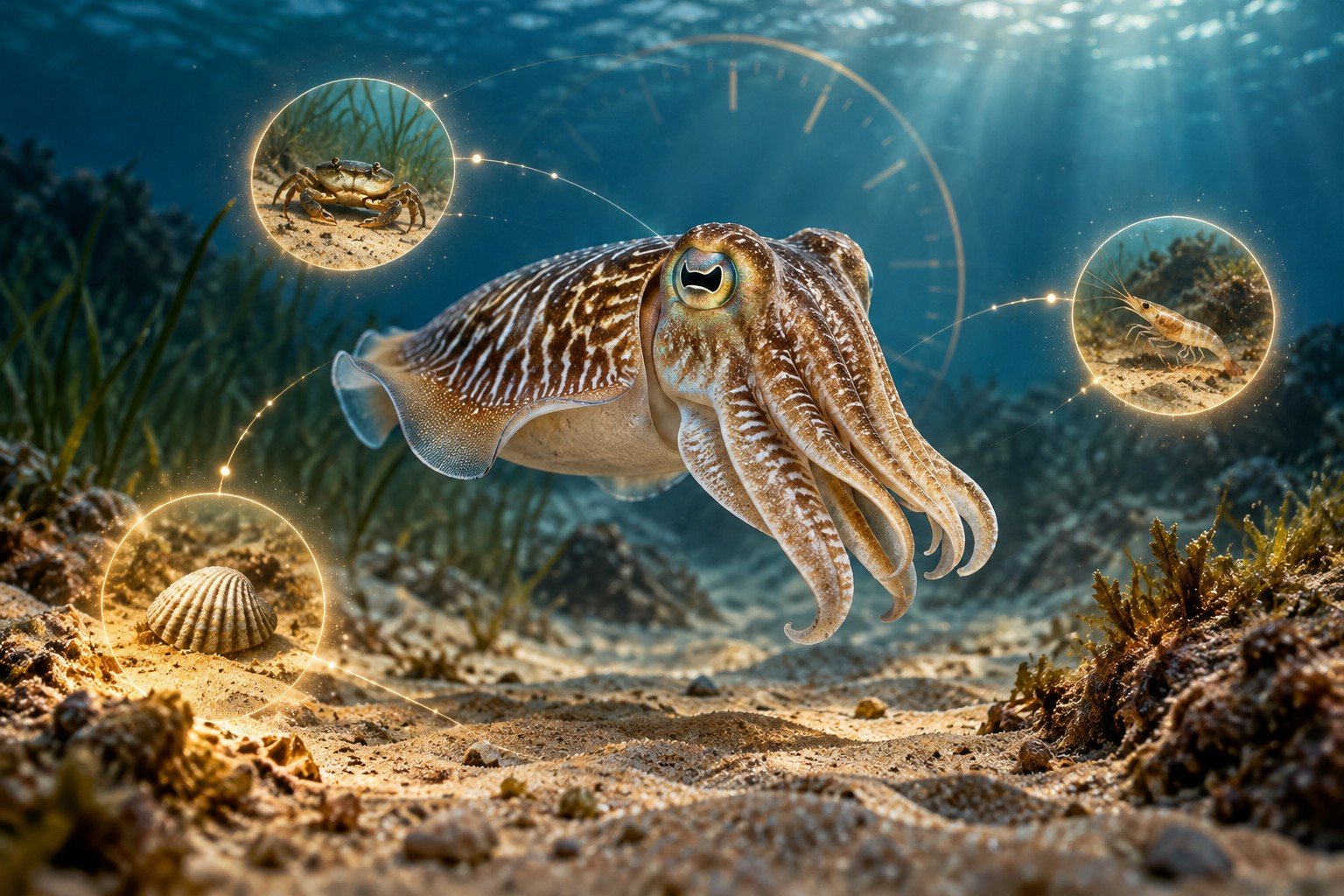
Cuttlefish Memory: What Aging and Food-Choice Experiments Actually Show
Key takeaways
- Episodic-like describes a tested pattern of behavior, rather than a report of conscious recollection.
- The aging experiment compared small groups at defined life stages, not every age throughout life.
- Waiting for food and remembering an event are distinct abilities tested with different procedures.
- Comparative research can reveal alternative solutions to a cognitive problem without establishing a human treatment.
A cuttlefish choosing where to search for a meal presents a deceptively simple problem. The animal may need information about which food appeared, where it appeared and how long ago it was available. Success can look like remembering an episode. Explaining what the experiment actually establishes requires a more careful vocabulary.
Cuttlefish memory research is valuable because it asks a familiar question in an animal whose evolutionary history is very different from ours. What information can a nervous system retain, and how can an experiment distinguish that information from a simple preference? The answer depends on the task rather than the appeal of the animal.
Two widely discussed 2021 papers address different parts of this problem. One tested memory across age groups. The other tested willingness to wait for preferred food. Reading them together helps clarify both the abilities and the boundaries of the evidence.
What episodic-like cuttlefish memory means
In everyday language, remembering an event can include a feeling of returning to a particular experience. A person can describe yesterday’s meal, place it in context and say whether it feels remembered or merely known. A cuttlefish cannot provide that kind of verbal account.
Researchers therefore use the term episodic-like for behavior that meets specified criteria. In a what–where–when task, the question is whether an animal’s choices depend on a combination of the food involved, its location and timing. The label keeps the behavioral finding separate from an assumption about subjective experience.
This distinction is useful rather than dismissive. An experiment does not become uninteresting because it cannot establish everything implied by the everyday word memory. Its strength comes from identifying which information is needed to solve the particular problem.
Here, food locations changed each test day. Preferred prey was available again after three hours but not after one hour. Food was presented only after the animal chose a location, reducing the opportunity to follow its immediate sight or smell. The correct choice therefore depended on that day’s event and the elapsed delay.
How the cuttlefish memory aging experiment was organized
The 2021 memory study used twenty-four common cuttlefish, Sepia officinalis, overall. Each of its two tasks had six younger and six older animals. The episodic-like task tested animals at ten and twenty-two months; the separate semantic-like task tested twelve- and twenty-four-month-old animals. Thus, twelve is the sample for each task, not the whole paper.
The age groups made comparable proportions of correct episodic-like choices; older animals reached the test criterion faster. That finding concerns this task, not an absence of cognitive aging. The authors acknowledged the six-animal cohorts and discussed earlier evidence of impaired memory retention in aged cuttlefish.
The research team’s Cambridge account places the result within the species’ short life cycle. The relevant comparison is between particular life stages, including animals approaching the end of life. Twenty-two months in this context is not equivalent to being twenty-two years old in a human.
Why twelve animals are not twelve trials
An animal can make many choices over repeated sessions. Those observations help establish consistency and reveal how performance changes with practice. They do not create a fresh independent animal every time a choice is recorded.
The reported success criterion was at least eight correct choices in ten consecutive trials. Reaching that criterion describes performance across choices; the six animals in an age group remain the independent subjects. Keeping both counts visible prevents a run of successful trials from appearing to be a much larger animal sample.
The same principle applies when comparing age groups. Repeated testing may improve estimates of each animal’s behavior, while the small number of animals still limits confidence about the wider population. A dramatic difference in trial counts does not erase that limitation.
Readers should also distinguish a failure to detect decline from proof that decline is impossible. Stronger confidence would come from additional cohorts, different tasks and evidence that the result is robust to reasonable changes in the protocol. That is a proposed standard for follow-up, not a claim that those studies have already settled every question.
Waiting for food tests another ability
In a separate delay-of-gratification experiment, six sub-adult cuttlefish completed training and testing. They could forgo immediately available food for a preferred item delivered later. Individual maximum delays ranged from fifty to one hundred and thirty seconds.
The apparatus distinguished immediately accessible, delayed accessible and inaccessible food. That comparison matters: simply remaining still beside food would not, on its own, show that the animal adjusted its behavior to whether waiting could pay off.
This study concerns maintaining a delay under a particular reward arrangement. It does not show that cuttlefish make human financial plans or exercise the same kind of restraint as a child in every situation. The popular marshmallow-test comparison is an analogy between experimental problems, not evidence that the underlying experience is identical.
Nor should the longest waiting time become a species-wide score. Fifty seconds and one hundred and thirty seconds describe individual performances in this setup. They are not a calibrated ranking of cuttlefish against children, birds or other animals tested under different conditions.
Keep cuttlefish memory, preference and inhibition separate
Food tasks inevitably involve more than memory. An animal must detect the options, find the reward worthwhile and be able to perform the required response. These demands are part of interpreting the experiment, even when memory is the main question.
| Observed behavior | Question it helps address | Conclusion requiring more evidence |
|---|---|---|
| Choosing using food, location and time | Does behavior depend on event information? | Does the animal consciously relive the event? |
| Waiting for a preferred reward | Can the animal maintain a delay in this task? | Is it generally more self-controlled than another species? |
| Stable older-group performance | Was decline detected in the tested comparison? | Is every memory process protected throughout life? |
| Repeated successful choices | Is the response consistent within individuals? | Would the same proportion succeed in the wild? |
The table is a guide to separating questions rather than a new set of study results. One behavior can be compatible with several mechanisms. Experiments become more informative when they arrange conditions that make those explanations predict different outcomes.
For example, a preference for one food cannot by itself explain accurate changes in choice when relevant information changes. Conversely, a task that never changes its reward arrangement may be easier to solve through a learned routine. Ask what would happen under each explanation before deciding which one the evidence supports.
What cuttlefish memory research offers comparative neuroscience
The central comparative question is how different nervous systems solve related information problems. Similar performance can suggest a useful research direction, but it does not identify the same circuit, molecule or developmental pathway in both species.
A behavioral experiment and a neural mechanism study answer different questions. To connect them, researchers would need appropriate recordings, anatomical evidence or interventions, together with controls showing what the intervention changed. A successful food choice alone cannot reveal the complete circuit that produced it.
Our explanation of the adult fruit-fly connectome approaches the problem from the other direction. A detailed wiring map supplies structural information, but structure still needs to be linked to function. Behavioral ability and anatomical detail become stronger together when the connection is tested.
The important lesson is that an animal need not resemble a human to pose a useful neuroscience question. At the same time, a striking ability in another species does not eliminate the work needed to establish whether a proposed explanation applies to people.
What cuttlefish memory results do not offer for human aging
These experiments do not test a supplement, training app, dietary program or treatment for human memory loss. A claim that a product preserves memory because cuttlefish retain episodic-like performance would skip the essential human evidence.
The research can motivate questions about how memory changes across species. It cannot tell an individual whether their forgetfulness is normal or recommend a clinical intervention. A scientific analogy becomes a medical claim only after additional evidence, not after adding a brain illustration to an advertisement.
When evaluating coverage, check whether the article clearly names the species, life stage, task and outcome. Phrases such as never forget or defeat aging should prompt a closer look at what was actually measured. Those phrases often promise a broader conclusion than a defined task can supply.
Common questions about cuttlefish memory
Do cuttlefish remember the way humans do?
The evidence supports specific forms of information use. It does not establish that their recollections have the same conscious qualities as human autobiographical memories. Episodic-like is the appropriately limited term for the task-based claim.
Does the aging result mean cuttlefish never lose memory?
No. It concerns the tested abilities, groups and conditions. A wider statement about every memory system at every age would require a much broader body of evidence.
Can I compare waiting times across species?
Only cautiously. Reward value, training, opportunity to abandon the task and the cost of waiting may differ. A stopwatch supplies a number; it does not automatically make the experiments equivalent.
What should I look for in the next study?
Look for a clear prediction, an explicit number of animals, controls for alternative strategies and a distinction between behavior and experience. Those details will tell you more than a headline that simply awards the animal another human-like trait.
Sources and further reading
- Schnell et al., 2021: episodic-like memory and aging
- Schnell et al., 2021: delayed gratification
- Cambridge research team: memory and aging study context


