Motor Cortex Plasticity: How Practice Changes a Skill, and What Brain Studies Show
Key takeaways
- Motor learning involves networks, including motor cortex, cerebellum and basal ganglia.
- Human imaging and animal microscopy provide different kinds of evidence.
- Improvement is often specific to the movement and conditions practiced.
- A clear task, useful feedback and manageable repetition are practical priorities.
The first attempt at a new keyboard pattern can feel like a negotiation with each finger. After practice, the same sequence becomes easier to organize. The fingers have not acquired a separate memory system: the nervous system has become better at controlling the task.
Motor plasticity is part of that story. Yet phrases such as “rewire instantly” or “master-code movement” can make the process sound more direct than the evidence allows. Practice can change performance without providing a visible count of new connections in your own brain.
Separating what researchers observe from what a training product promises makes the science more useful for anyone learning an instrument, improving a sport or adapting an everyday movement.
The motor cortex is one part of a movement system
Primary motor cortex, often called M1, contributes to controlling voluntary movements through interactions with other cortical and subcortical systems. It is not a keyboard with one isolated key for each muscle or skill.
Planning, sensory feedback, timing, motivation and error correction all influence movement. The cerebellum, basal ganglia, sensory systems and spinal circuits participate in different aspects of control. The exact contribution depends on the task.
A pianist learning a sequence and a person adjusting balance after a stumble therefore need overlapping but different computations. Improvement should be described in relation to the movement being learned, rather than as a global upgrade to the motor cortex.
What human imaging has shown
In a 1995 finger-sequence experiment, daily practice over weeks improved performance and changed the extent of M1 activation associated with the trained sequence. Benefits did not simply generalize to a matched untrained sequence or the other hand.
The study illustrates experience-dependent change in adults and the specificity of learning. Its functional MRI signal reflected blood oxygenation changes associated with activity. It did not directly image new neurons or count synapses.
More activation is not a universal definition of better performance. Interpretation depends on the stage of learning and what the task requires. A scan should be understood alongside behavior, not used as a simple brighter-is-better score.
What a mouse experiment can reveal about synapses
Xu and colleagues tracked dendritic spines during motor learning in mice. New skill training was associated with rapid formation of spines in motor cortex, and some newly formed spines were selectively stabilized.
Dendritic spines are small protrusions that host many excitatory synapses. Observing them over time provides a structural view that ordinary human functional imaging does not. It also shows why learning should not be reduced to adding connections indiscriminately.
A mouse trained on a specific task is not evidence that your next workout will produce an identical structural change. Species, age, brain region and training conditions matter. The experiment establishes a mechanism worth investigating, not a personal forecast.
Why repetition and learning are not identical
Repeating a movement can improve consistency, but the relevant practice depends on the goal. Rehearsing an error without useful feedback can leave the central problem unresolved. Increasing speed before control is established may change what you practice rather than accelerate the same lesson.
Break a difficult task into an observable component. For a musical passage, that might mean coordinating two transitions at a comfortable tempo. For a household skill, it might mean arranging the workspace so you can perform the movement without unnecessary strain.
Use a measure that reflects success: accurate notes, a stable movement or a task completed with less difficulty. Wearable activity totals are useful for some purposes, but they do not establish that a specific motor representation has changed.
Four practical ways to organize skill practice
1. Make the target specific
Choose a movement or short sequence you can attempt and evaluate. A broad intention such as “increase neuroplasticity” offers no feedback about whether the session helped. Define a task that fits your current ability and circumstances.
2. Use feedback you can act on
A teacher, coach, recording or simple task result may reveal a recurring mistake. Select one adjustment at a time so you can tell whether it helps. Feedback should clarify the next attempt rather than create a running judgment of your potential.
3. Keep repetitions manageable
Choose sessions that preserve attention and physical comfort. Stop or adjust if pain, dizziness or unusual symptoms occur. Longer practice is not automatically better practice, and fatigue can make it harder to interpret performance.
4. Check retention and transfer
Return later and see what remains. Then test the skill in the setting where you need it, such as a passage within the full piece. Improvement in a drill is encouraging, but useful transfer deserves its own check.
Watching, imagining and doing are different activities
Watching a demonstration can help you understand the goal. Mental rehearsal may also be used in training contexts. Neither is interchangeable with physical practice or a promise that “mirror neurons” will install a skill simply by observation.
If a course relies heavily on demonstrations, look for opportunities to attempt the task and receive feedback. A polished video library is a resource, not proof of learning. Choose a format that matches the skills, access needs and support you require.
Our article on myelin and nerve signaling offers another example of why an appealing biological metaphor should not become a guaranteed training outcome.
Courses and recovery products: what is worth evaluating?
A lesson or structured program may provide progression and feedback. Evaluate instructor expertise, level, accessibility, equipment needs, trial access and total price. The value comes from how well the program supports the task, not from describing it as a brain intervention.
A tracker or massage device measures or supports different things. It should not be presented as demonstrating motor-cortex rewiring. Clinical rehabilitation also has different goals from recreational skill learning. After injury or neurological illness, use an individualized plan from an appropriate professional rather than applying a general practice routine.
Motor learning, temporary performance and rehabilitation
A good session is encouraging, but performance during practice and learning that lasts are different things. A demonstration, extra cue or familiar environment can make a movement easier in the moment. Returning later helps reveal what you can reproduce without that support.
For example, a learner might copy a finger pattern while watching a teacher, then struggle when the visual prompt disappears. That does not make the earlier attempt worthless. It identifies the next goal: gradually reduce the cue while preserving a manageable level of difficulty. The appropriate progression depends on the task and the learner.
Rehabilitation adds clinical considerations such as weakness, altered sensation, fatigue, injury and safety. A program that suits a healthy musician is not automatically appropriate after a stroke. Changes in symptoms or function should be discussed with the clinician overseeing rehabilitation. General neuroscience cannot specify the right intensity or movement for an individual patient.
An example of a useful practice record
Suppose you want to learn a short piano sequence. Write down the sequence, the tempo or comfortable pace, and what counts as an accurate attempt. Note whether you used a visual cue. These details make the next session comparable enough to guide practice without turning a hobby into a laboratory.
After a few attempts, identify one recurring problem. Perhaps the transition between the third and fourth notes is awkward. Slow that transition, obtain feedback if available and then place it back into the sequence. More repetitions of the complete pattern may be less informative than understanding that particular difficulty.
At the next session, try the sequence before reviewing it. Later, test it within a longer passage. Record the outcome in ordinary terms such as “accurate at a comfortable pace” or “needs a cue.” A brain-change label would add certainty that these observations do not provide.
Make room for accessibility. An adapted instrument, different position or assistive tool can change how someone performs the task while preserving its purpose. Effective learning does not require everyone to use the same movement pattern. Ask a qualified instructor or therapist when the task involves pain, disability or a condition requiring specific precautions.
Frequently asked questions
Can adults still learn complex movements?
Yes. Adult learning is possible, although pace, prior experience, health and the task affect progress. A difficult first attempt is not a measure of the brain’s capacity to adapt.
Does every practice session grow new neurons?
That does not follow from motor-plasticity research. Changes can involve activity, strategy, synaptic function and structure; these are different from the birth of neurons.
Can a fitness tracker measure my motor plasticity?
An ordinary consumer activity tracker does not directly measure synaptic changes or motor-cortex reorganization. Use it for the measurements it actually provides.
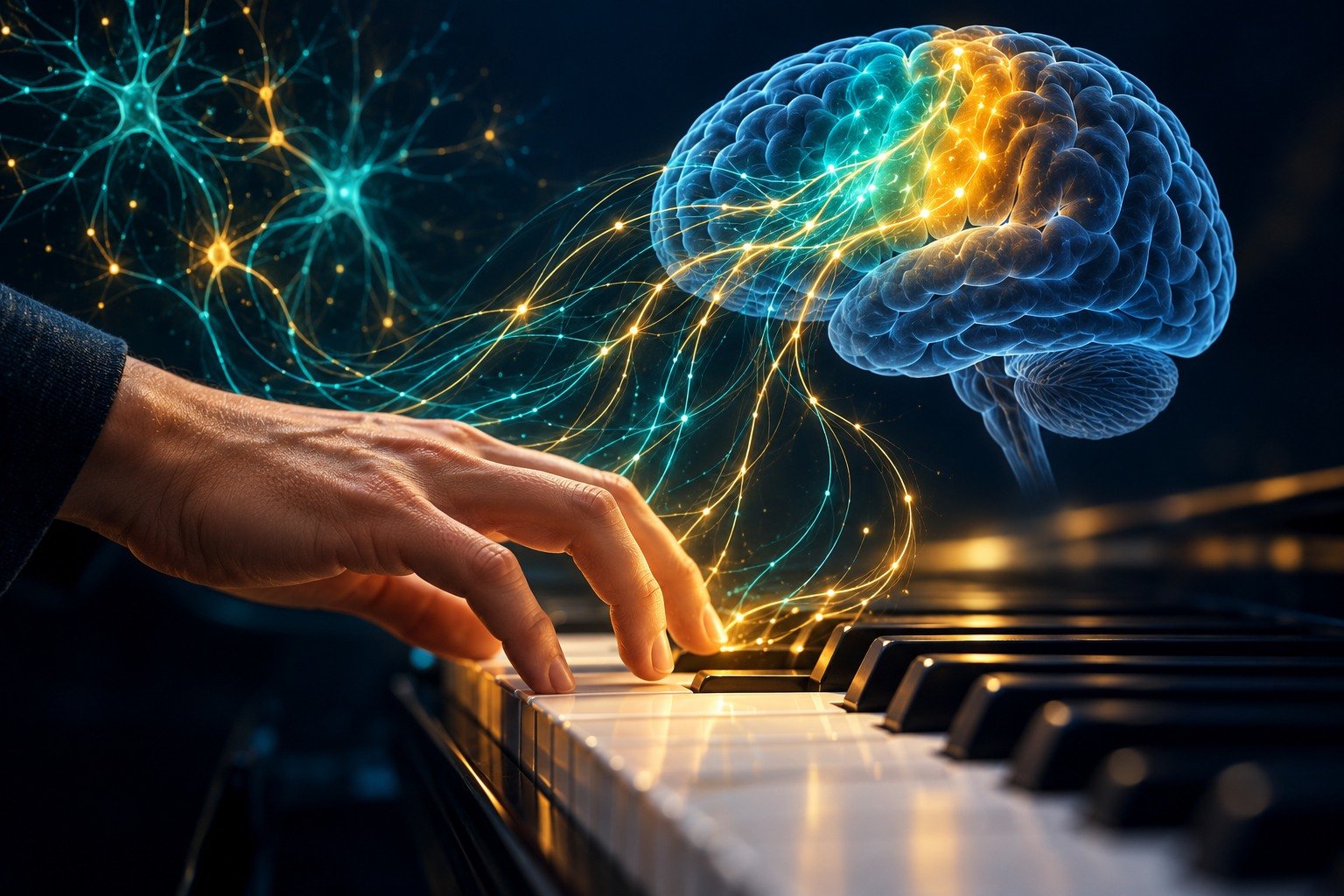
The featured illustration is conceptual artwork, not a brain scan or a measurement of individual brain function.
Sources and further reading
- Karni et al. (1995). Functional MRI evidence for adult motor cortex plasticity during motor skill learning.
- Xu et al. (2009). Rapid formation and selective stabilization of synapses for enduring motor memories.
- Karni et al. (1998). Fast and slow experience-driven changes in primary motor cortex.
Continue reading
- Synaptic Pruning and Microglia: How Brain Connections Change, Without the Detox Myth
- Neuroplasticity in Adulthood: 5 Evidence-Based Ways to Rewire Your Neural Pathways
- Flow State and Brain Waves: What Neuroscience Can Actually Tell Us
- Neural Oscillations and Learning: Why Timing Matters More Than a Brain-Wave Score