
Reward Prediction Error: How Experiments Connect Dopamine With Learning
Key takeaways
- Prediction error concerns an outcome relative to expectation, rather than reward size alone.
- Classic recordings show why a predictive cue and an omitted reward matter.
- Human imaging, neural recordings and optogenetic experiments provide different kinds of evidence.
- A learning model is useful without becoming a personal brain-chemistry score or a habit-app guarantee.
Imagine receiving the same small reward twice. The first time it is an unexpected bonus. The second time you were promised something larger. The physical outcome is the same, but its relationship to your expectation differs.
That comparison is the starting point for reward prediction error. The concept helps researchers describe how experience can update predictions. It becomes especially interesting when a mathematical learning signal resembles the timing of activity in a neural system.
This article focuses on the experiments and their interpretation. For the broader discussion of everyday dopamine language, see our dopamine detox and regulation guide. A detailed account of prediction-error evidence answers a different question from whether a digital break is useful.
A simple example of prediction error
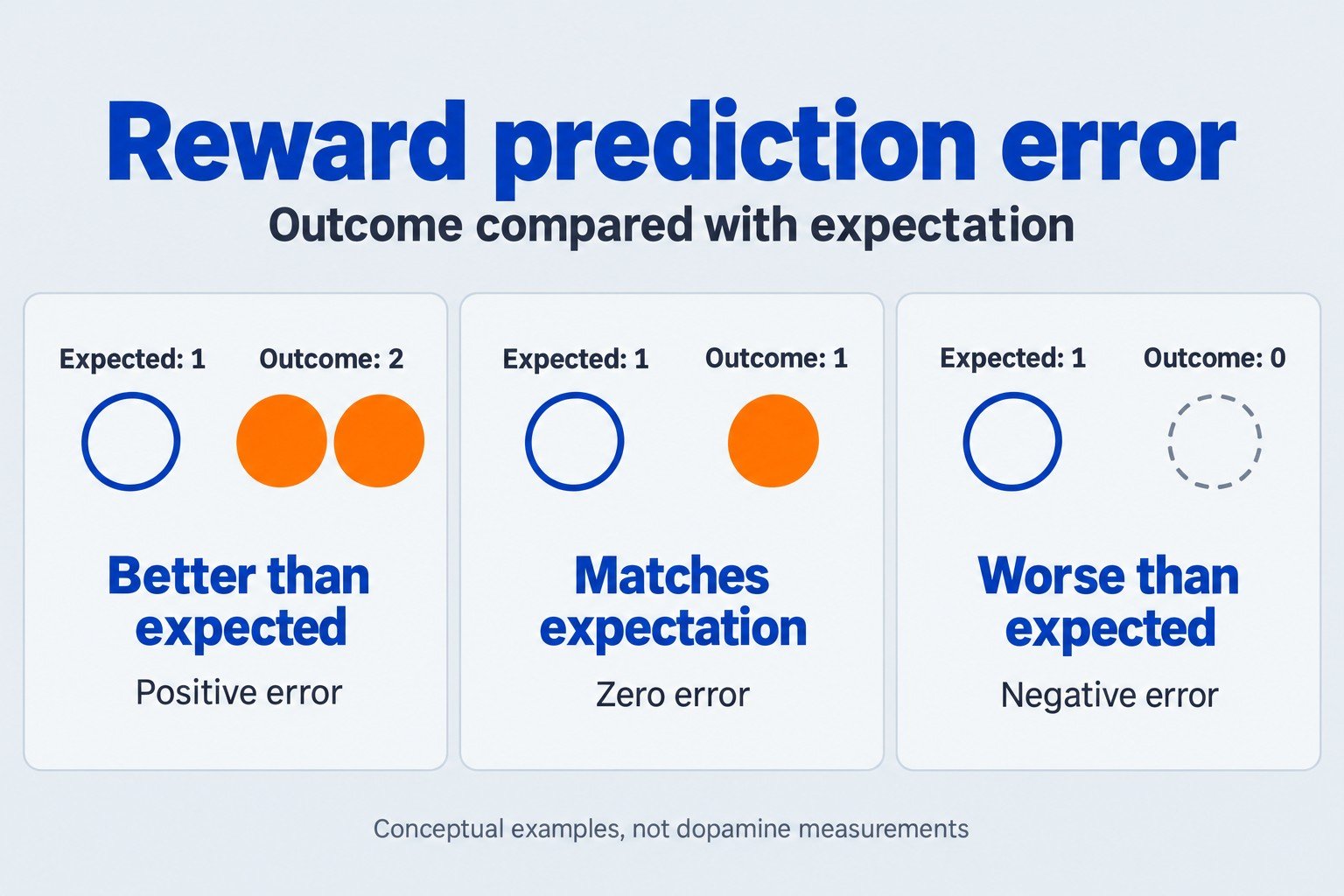
For a basic teaching example, imagine a task in which expected and received outcomes use the same arbitrary value scale. Expect one token and receive two: the outcome is better than expected. Expect one and receive one: there is no discrepancy on that simple scale. Expect one and receive none: the outcome is worse than expected.
These are hypothetical values, not dopamine units. Real experiments must establish how value, timing and expectation are represented in the task. A person’s emotional reaction does not supply those measurements automatically.
The useful idea is that the same reward can have a different learning significance depending on what preceded it. Reward size alone leaves out the prediction against which the outcome is evaluated.
Why the classic recordings mattered
Schultz, Dayan and Montague’s influential 1997 paper connected patterns in dopamine-neuron activity with computational accounts of reward learning. According to its abstract, the paper brings together recordings from dopamine neurons in primates and computational theories of learning. The experimental pattern includes responses to unexpected rewards, responses that shift toward learned predictive cues, and reduced activity when an expected reward fails to arrive.
The omission is particularly informative. If a signal merely announced the presence of something pleasant, the absence of an expected reward would be harder to explain. A prediction-error account considers what should have happened at that time as well as what did happen.
This does not mean every dopamine neuron behaves identically or that one signal explains the whole brain. It identifies a useful relationship in defined circuits and tasks. The experimental setting remains part of the finding.
What it means for a response to move toward a cue
At first, a previously neutral cue may tell the learner little. After repeated pairings, it predicts what follows. Information that was surprising at the reward’s arrival becomes available earlier, when the cue appears.
In a teaching example, a sound might precede an outcome in a stable task. A change in response timing can then reflect learning about the sound. It should not be translated into a claim that every phone notification has the same neural value or effect.
Ask whether the cue actually predicts an outcome, how the learner’s expectation was estimated and what response was measured. Those details are more useful than treating a colorful brain illustration as proof that a particular everyday cue is addictive.
Timing makes formal models more detailed
The simple outcome-minus-expectation example captures an intuition. Temporal-difference models also consider how predictions change over time, including information about future outcomes. They are more detailed than a single comparison made only when a reward arrives.
This matters because waiting and predicting are part of behavior. A cue can change what is expected before the final outcome occurs. A model can describe those updates and generate a signal to compare with measured activity.
The model is still an account to test, not a declaration that the nervous system literally displays its internal spreadsheet. Researchers compare alternative explanations, fit parameters and ask whether the model predicts observations beyond the data used to build it.
Human imaging provides a different measurement
O’Doherty and colleagues’ 2003 human study examined reward-related learning using a temporal-difference model and functional brain imaging. In that study, adult volunteers were scanned with fMRI while learning to predict a pleasant taste reward, and activity in the ventral striatum and orbitofrontal cortex tracked a prediction error signal. It connected modeled prediction-error signals with changes in measured brain activity during the task.
Functional MRI measures blood-oxygen-related signals, not the firing of every dopamine neuron or the amount of dopamine released at a particular synapse. An imaging association can support a computational hypothesis without being identical to direct cellular recording.
When a headline says that a human brain scan found a dopamine response, check the actual method. Was dopamine measured directly, or was the interpretation based on activity in a reward-related region and a model? The distinction changes how precise the conclusion can be.
Causal experiments ask a stronger question
Steinberg and colleagues’ 2013 animal study used optogenetic activation of dopamine neurons timed with reward delivery. In that study, rats received optogenetic stimulation of dopamine neurons at the moment of reward, which increased later cue-driven reward seeking, so it shows a causal link in rats and does not test people. The manipulation, designed to resemble a prediction error, altered later cue-elicited reward seeking. This provided evidence for a causal role in the learning process studied.
Manipulation is a different kind of evidence from observing two signals that vary together. It can help test whether changing the proposed signal changes learning. The inference remains tied to the animal model, targeted cells and task.
It does not establish a consumer technique for creating precisely calibrated dopamine bursts. A habit app awarding a badge has not reproduced optogenetic stimulation, and a user’s satisfaction does not demonstrate that the same experimental mechanism occurred.
Prediction errors can concern more than immediate reward
Sharpe and colleagues’ 2017 experiments investigated learning about associations between events using dopamine-neuron manipulations. The results supported a role for dopamine transients in acquiring model-based information, extending a narrower picture focused only on simple stored reward value.
The broader lesson is that a familiar slogan can become too restrictive. A neural signal may participate in learning about the structure of events, not merely assigning a pleasure score. Research can refine a theory without making the earlier experiments uninformative.
For readers, this is a reason to distinguish the measured signal from the interpretation attached to it. A model explains selected patterns. It should remain open to revision as different tasks reveal additional functions.
Compare the evidence methods
| Method | Useful contribution | Important limit |
|---|---|---|
| Neural recording | Timing of activity in sampled cells | Does not sample every circuit or establish causation alone |
| Computational model | Explicit predictions about learning signals | Depends on assumptions and comparison with alternatives |
| Human functional imaging | Task-related signals across brain regions | Is not a direct dopamine concentration measurement |
| Targeted animal manipulation | Tests a causal contribution under defined conditions | Does not validate a consumer intervention in humans |
No single row supplies every answer. The research becomes stronger when different methods address related questions while their limits remain visible. Combining methods should improve the inference rather than blur what each one measured.
What this means for feedback and everyday learning
A practical implication is to make feedback informative. If you want to learn a skill, define what success means and compare an attempt with a reliable reference. An unexpected result can then identify what needs updating rather than becoming only a judgment about effort.
For example, a learner might predict which step in a calculation will be difficult, attempt it and review the mismatch. This is an ordinary learning exercise, not a way to measure or optimize dopamine. Its value lies in the information the feedback provides.
Do not assume that making rewards more unpredictable always improves a routine. The outcome you want may be consistency, clarity or reduced distraction. A strategy that increases checking can conflict with those goals even if a reward-learning story makes it sound sophisticated.
Evaluate app claims without a dopamine score
Ask what the tool actually does: records practice, supplies feedback, blocks selected interruptions or gives reminders. Evaluate that function using an observable outcome. A proprietary motivation score should not be treated as a direct readout of reward prediction error.
Check privacy, accessibility, export options and recurring cost. This article has not personally tested or ranked products. A simple record of attempts and feedback may be enough if it supports the learning task you have.
Persistent problems with motivation or compulsive behavior deserve appropriate assessment. The prediction-error concept is not an individual diagnosis or a complete explanation of addiction. A mechanism can inform research without replacing a person’s clinical and social context.
Frequently asked questions
Is zero prediction error the same as no enjoyment?
No. In the simple model it means that the outcome matches the prediction. Enjoyment and a learning signal are different concepts, so a predicted reward can still be enjoyable.
Is every surprise a reward prediction error?
No. Surprise can concern many kinds of information. Researchers must specify the prediction, value and task before identifying a reward-related error signal.
Can I calculate dopamine from how disappointed I feel?
No. A feeling does not provide the neural measurement or model parameters needed. The token examples here illustrate a concept rather than biological quantities.
Does a badge in a habit app prove dopamine learning?
No. The feature may provide feedback or encouragement, but a claim about its precise neural mechanism needs relevant evidence. Judge whether it helps the intended behavior without assuming a brain-chemistry effect.
The featured image is an editorial visual. It does not depict experimental data, an identified patient or a clinical outcome.
Sources and further reading
- Schultz, Dayan and Montague (1997). A neural substrate of prediction and reward.
- O’Doherty et al. (2003). Temporal-difference models in human reward learning.
- Steinberg et al. (2013). Causal link between prediction errors, dopamine neurons and learning.
- Sharpe et al. (2017). Dopamine transients and model-based associations.