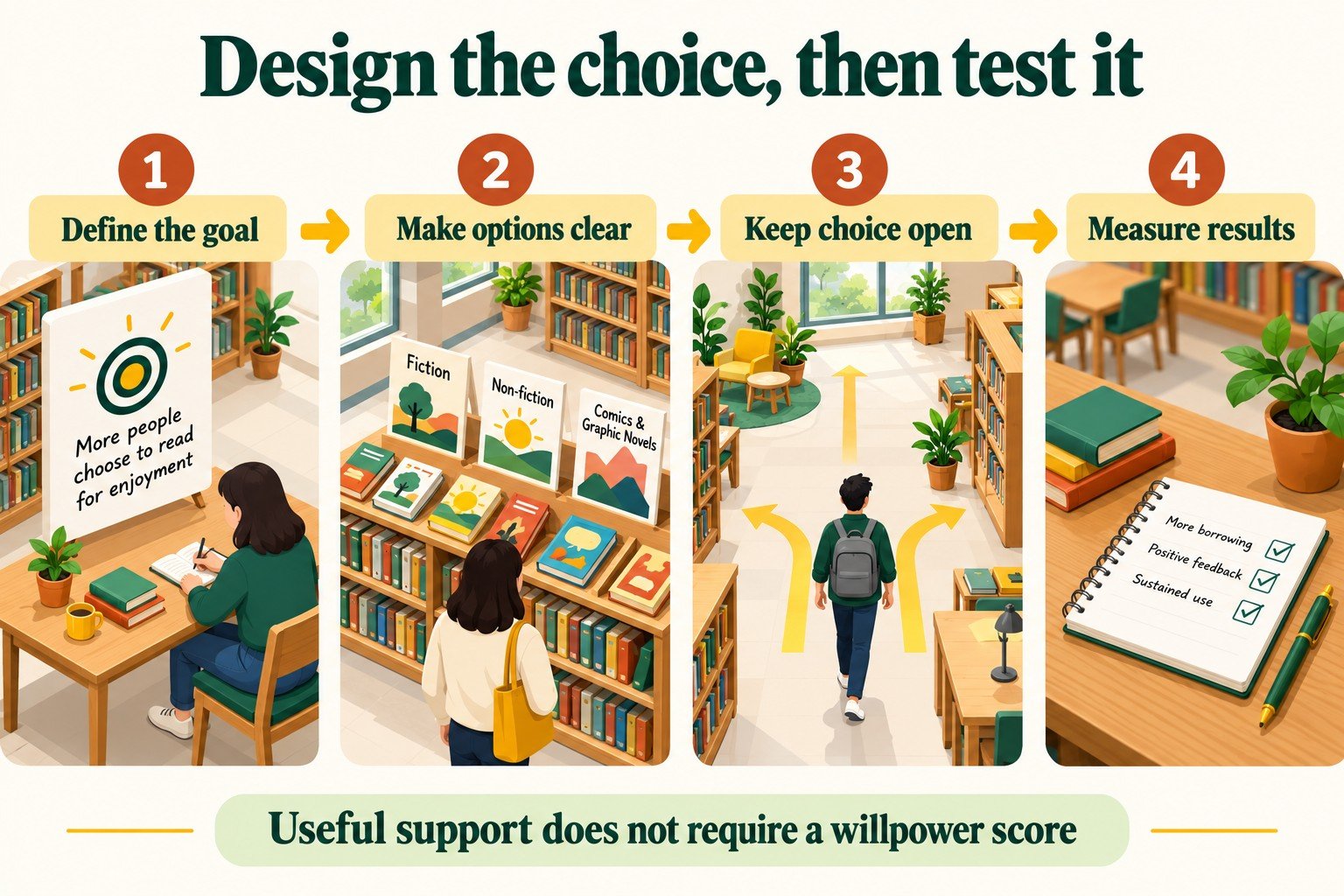
Behavioral Scaffolding: Design Better Choices Without Assuming Willpower Runs Out
Key takeaways
- Define the specific action and outcome before choosing a tool.
- Choice architecture can change how options are presented without removing alternatives.
- A failed ego-depletion replication does not mean tiredness or difficult decisions are imaginary.
- Measure actual benefits, burdens and unintended effects rather than assuming every nudge works.
A confusing sign-up form can prevent an intended action. A timely reminder can make an appointment easier to remember. Neither example requires a diagnosis of weak character or a claim that someone’s mental energy has been used up.
Behavioral scaffolding offers a practical way to discuss those supports. The interesting question is whether a particular arrangement helps a particular person complete a chosen action. The explanation should remain open to testing.
This distinction matters because useful design advice is often packaged with an overly confident story about willpower. A tool may be helpful even when the proposed theory behind its marketing is uncertain.
Our habit-formation and friction guide discusses everyday routine design. Here, the focus is how to evaluate choice architecture and the theory used to explain it.
What behavioral scaffolding means here
In this article, behavioral scaffolding is a descriptive umbrella for external supports that make an intended action more manageable. Examples include a reminder that arrives when a decision is possible, instructions written in plain language and a process that shows what to do next.
The term does not identify a single protocol with one proven effect size. A calendar prompt, an accessible form and a coaching service differ in their mechanisms, costs and evidence. Calling all three scaffolding does not make their results interchangeable.
A useful support should fit the obstacle. If someone cannot understand an instruction, adding more reminders may create annoyance without improving comprehension. If the obstacle is an unaffordable fee, a motivational message cannot remove it.
Start by describing what happens. A person intended to book a class but stopped at the payment screen. That observation is more informative than saying the person lacked discipline. It points toward a specific decision that can be examined.
How choice architecture fits into the picture
Choice architecture concerns the way options are organized and presented. Defaults, ordering, wording and reminders can influence decisions. In ordinary use, a nudge aims to influence behavior while leaving options available rather than requiring one response.
Consider a library offering several reading groups. It might present the meeting time, accessibility information and cancellation process on one page. It could also make a reminder optional during registration. These are different design decisions, each with a different outcome to assess.
Clearer presentation does not guarantee that more people will join. A person may understand every option and reasonably decide that none is suitable. A good design makes that decision easier too. Participation should not be the only acceptable result.
The same principle applies to defaults. A default should be visible, understandable and easy to change. A hidden recurring commitment may increase completion numbers while making the experience worse for the people using it.
Why the willpower battery story needs caution
Ego depletion is the proposal that exerting self-control on one task can impair performance on a subsequent self-control task. Popular explanations often turn this into a literal battery metaphor. The experimental claim and that everyday metaphor should be evaluated separately.
In a 2016 preregistered multilaboratory replication led by Hagger, 23 laboratories tested a standardized procedure with 2,141 participants. The estimated effect was small, and its confidence interval included no effect. The study did not support a substantial depletion effect under that procedure.
That result does not show that demanding work never feels exhausting, that sleep is irrelevant or that every version of the theory has been settled. It tests a defined sequence of tasks. Extending its conclusion to every difficult day would repeat the same overgeneralization in the opposite direction.
For practical design, the implication is modest. You do not need to measure an invisible willpower balance before improving an instruction or offering an optional reminder. Observe the obstacle and test the support directly.
What nudge research can and cannot establish
A 2022 meta-analysis by Mertens and colleagues combined more than 200 studies of choice architecture. It reported an overall positive effect, substantial variation across studies and evidence of publication bias. An average across many interventions is not a guarantee for a new intervention.
Publication bias matters because studies with striking results can be more likely to appear in the published record. If less successful interventions are missing, the visible average can be too optimistic. Statistical adjustments attempt to address this problem, but their assumptions also matter.
Maier and colleagues’ reanalysis argued that correcting for publication bias removed evidence for an overall effect in that dataset. This disagreement is a reason to examine the intervention and context closely. It is not proof that every reminder fails or that any attractive design must work.
Large field experiments can help by testing alternatives against a comparison condition. A megastudy of text-message reminders before medical appointments illustrates this approach. Its value as a model is the direct comparison of actual messages and behavior, rather than reliance on an appealing theory alone.
The practical lesson is to resist universal claims. A message tested in one appointment system does not automatically establish the effect of a different message in a workplace, school or subscription app.
Match the support to an observable obstacle
| Observed problem | Support worth testing | Outcome to examine |
|---|---|---|
| People cannot find the next step | A clearly labeled action and short instructions | Completion and comprehension |
| People intend to return later but forget | An optional reminder at a useful time | Return rate and unwanted notifications |
| People are unsure what enrollment includes | A concise explanation with visible alternatives | Understanding and informed decisions |
| The process excludes some users | Accessible formats and assistance | Successful use across relevant needs |
These are examples for designing a test, not proven prescriptions. The same reminder may help one person and interrupt another. The same simplified page may improve navigation while accidentally omitting a detail people need.
Ask users where they became uncertain before selecting a solution. Their answer may reveal a practical constraint that the designer did not anticipate. More persuasion is a poor substitute for solving the actual problem.
Build a small test with a clear stopping rule
Choose one action that the person or group already wants to support. Define success in plain language. For a voluntary workshop, success might include understanding the schedule and making an informed registration decision, rather than maximizing sign-ups at any cost.
Next, specify the proposed change and comparison. You might compare the existing instructions with a shorter version that retains the same essential information. Change one major feature at a time when possible so that the result remains interpretable.
Record more than the desired action. Track confusion, complaints, mistaken enrollments or repeated reminders. A change that increases a headline number while increasing unwanted commitments may be a poor outcome.
Set a review point before examining the results. A small informal test cannot establish a universal scientific effect, but it can identify obvious problems and inform a local decision. Keep the language proportionate to the quality of the comparison.
If the support is not helping, revise or remove it. People should not be blamed for failing to respond to a design whose effectiveness was never demonstrated.
Preserve autonomy when choosing tools or services
An app can offer reminders and clearer sequences without possessing a special measure of self-control. Evaluate the actual functions: notification settings, accessibility, cancellation, data collection and the ease of changing a default.
Treat a claim about depleted willpower as a separate claim from a demonstration that a feature is convenient. Ask what was measured, against what comparison and in which users. A testimonial cannot answer those questions for everyone.
For teams, make the purpose of a design change explicit. People should know what the process encourages and whether participation is optional. An organization should also be willing to hear that the proposed goal does not fit someone’s circumstances.
Preserving alternatives is especially important when one party has more power. A manager’s apparently optional prompt may feel mandatory to an employee. The wording on a screen alone does not resolve that imbalance.
Common questions about behavioral scaffolding
Is scaffolding the same as removing all difficulty?
No. Some tasks require sustained effort or learning. Support can clarify the next step or remove avoidable confusion while leaving the substantive challenge intact. Making a task understandable is different from promising that it will become effortless.
Does a reminder prove that someone lacked motivation?
No. Forgetting, competing demands and an inconvenient decision point can all affect whether an intention becomes an action. A reminder’s usefulness does not establish a personal deficit, and declining it is not evidence of failure.
Should every choice have a default?
No. Some decisions benefit from an explicit choice, especially when preferences vary or consequences are meaningful. A default is a design option that needs justification and an accessible way to choose differently.
Can a successful test prove a theory of willpower?
Usually not. If clearer instructions improve completion, that supports the value of those instructions in that setting. It does not by itself establish a finite self-control resource, a particular brain mechanism or the same effect elsewhere.
Behavioral scaffolding is most useful when it remains concrete: a chosen action, a visible support, a fair comparison and a willingness to change course. Good support earns its place through what it helps people do.
The featured image is an editorial visual. It does not depict experimental data, an identified patient or a clinical outcome.