
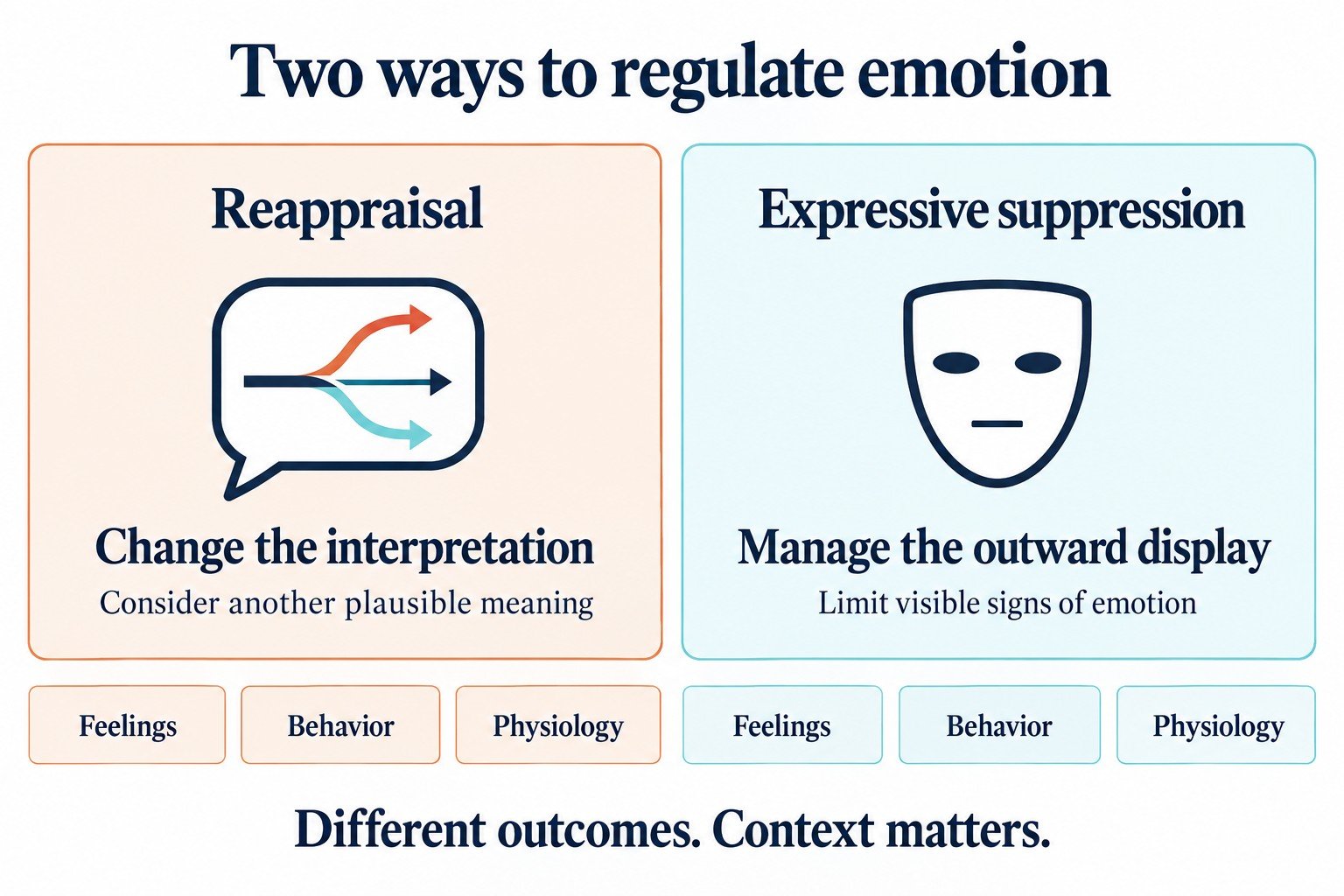
Cognitive Reappraisal vs. Expressive Suppression: What Experiments Reveal
Key takeaways
- Changing an interpretation differs from concealing an expression.
- Feeling less, showing less and changing physiological activity are separate outcomes.
- Small imaging experiments cannot diagnose how an individual regulates emotion.
- A useful strategy should fit the situation without denying real harm or forcing disclosure.
Imagine receiving a short message from a colleague: we need to talk. You might consider that the colleague is busy rather than angry. Or you might keep your face composed while feeling worried. These are different responses, even if an observer sees the same calm expression.
The first illustrates reappraisal; the second can involve expressive suppression. Understanding their differences helps make sense of emotional-regulation research without turning two strategies into moral categories. Our broader emotional-regulation guide covers the wider framework. Here, we compare the experiments directly.
Define the two strategies before comparing them
Cognitive reappraisal involves changing an interpretation in a way intended to alter the emotional response. In the message example, you generate a plausible alternative explanation. You do not need to decide that the message definitely means something positive; the point is to reconsider an initial assumption.
Expressive suppression involves limiting outward signs of emotion after a response is underway. A person may keep a neutral expression during a presentation or avoid raising their voice while upset. That observable restraint does not reveal everything happening internally.
These definitions concern what a person is attempting to do. They do not guarantee success or identify a stable personality type. Someone may reinterpret one event, conceal a reaction during another and use a different strategy later in the same conversation.
It is also possible to combine them. A clinician delivering difficult news may manage visible expression while choosing a careful perspective on the interaction. The comparison is most useful when we specify the strategy and goal rather than label the whole person suppressive or emotionally skilled.
What an early laboratory experiment measured
In James Gross’s 1998 experiment, 120 participants watched a disgust-eliciting film under different instructions. They were asked to reappraise, suppress visible expression or simply watch. The study examined emotional experience, expressive behavior and physiology.
Both regulation conditions reduced outward expression. Reappraisal reduced reported disgust, while suppression increased sympathetic physiological activation. The findings show why an observer’s judgment that someone looks calm cannot substitute for measurement of subjective experience or bodily responses.
The experiment used a particular film and instructions. It does not establish the health effects of every occasion when a person chooses privacy, pauses before speaking or maintains professional composure. A controlled comparison answers a narrower question than a lifetime rule about emotional expression.
Nor does the finding mean that sympathetic activity is inherently a clinical problem. A physiological response needs interpretation in relation to its setting, duration and outcome. The study did not diagnose disease from a participant’s response to a film.
What brain imaging added to the comparison
In a 2008 study by Goldin and colleagues, 17 women viewed brief films while following watching, reappraisal or suppression instructions. Researchers combined functional MRI with ratings and recorded facial behavior.
Reappraisal was associated with earlier prefrontal responses and reduced negative emotional experience, together with lower amygdala and insula responses. Suppression showed later prefrontal responses, reduced negative behavior and experience, and increased amygdala and insula responses under the study conditions.
The reduction in reported negative experience during suppression is important. It prevents an oversimplified account in which suppression never changes feelings. Different experiments can yield different patterns because tasks, timing, instructions and participants differ.
The small, specific sample also limits generalization. This study does not establish a universal neural timetable or a scan-based test for emotional maturity. The reported changes are findings from a group comparison, not instructions for identifying someone’s internal state by looking at their face.
A brain region is not a verdict on a strategy
Popular summaries sometimes describe reappraisal as the rational prefrontal cortex switching off the emotional amygdala. That shorthand loses the distinction between a measured response and a complete explanation. An imaging difference does not show that one region stopped functioning or that a person eliminated emotion.
Similarly, higher activity in a region should not automatically be called damage, failure or emotional storage. Functional MRI measures a signal related to blood oxygenation. Interpreting it requires the task and comparison, alongside the behavioral and subjective findings.
Ask what was actually compared. Reappraising a negative film versus watching it differs from comparing reappraisal with a clinical therapy course. A laboratory strategy instruction cannot stand in for every component of treatment or establish an individual treatment recommendation.
The most useful reading keeps several columns open at once: what people were told to do, what they said they felt, what they showed and what the physiological measures recorded. No single column supplies the entire result.
Compare outcomes rather than declaring a winner
| Question | Reappraisal example | Suppression example |
|---|---|---|
| What is being changed? | Interpretation of a situation | Visible emotional expression |
| What can an observer see? | Sometimes little obvious change | Reduced outward display |
| What needs separate measurement? | Feelings and physiological responses | Feelings and physiological responses |
| What shapes usefulness? | Plausibility and relevance of the interpretation | Purpose, setting and consequences of restraint |
This comparison helps identify a mismatch between goal and strategy. If you want to understand a misunderstanding, hiding your reaction may leave the interpretation untouched. If you need a short pause before a sensitive discussion, immediately displaying every feeling may not serve the situation either.
Neither example proves a universal outcome. They clarify the decision you are making. An approach can be useful for a limited purpose without being the best choice for every stage of an interaction.
Why social and cultural context matters
A 2007 study by Butler, Lee and Gross examined whether the social consequences of suppression depended on cultural values. Its findings caution against assuming that the same visible behavior has an identical interpersonal meaning across people and contexts.
That does not justify assigning a strategy to someone based on nationality or appearance. A useful conversation asks about the person’s preferences, relationships and circumstances. Cultural context is a reason to investigate meaning rather than apply a stereotype.
Consider a private conversation, a public ceremony and a high-pressure service interaction. The costs of disclosure and expectations about expression can differ. The laboratory question of reducing a response to a film does not determine which information someone should share in each setting.
Power also matters to the practical decision. A person may choose restraint because disclosure has consequences. Telling them to express everything without considering those consequences would confuse an experimental average with advice suited to their circumstances.
Try a more precise everyday question
For reappraisal, begin by separating observation from inference. The observation might be that a message was brief. The inference might be that the sender is angry. Ask whether another explanation fits the available facts and what information would help distinguish the possibilities.
A plausible alternative is more useful than compulsory positivity. If someone has actually behaved harmfully, reinterpretation should not require denying it. You can reconsider an assumption while still setting a boundary, seeking clarification or addressing the underlying problem.
For expression management, identify the purpose and endpoint. You might decide to pause during a meeting and return to the issue privately afterward. That differs from assuming that feelings should never be discussed. A plan for the next conversation makes the choice more concrete.
These are examples of decision-making, not a home replication of a brain-imaging protocol. You do not need to monitor imagined amygdala activity or prove a neurological change for a communication choice to be useful.
Evaluate courses and apps by the claim they make
A resource may help by providing examples, prompts or a place to organize thoughts. Judge those features directly. A claim that it permanently strengthens prefrontal control or removes the physiological costs of suppression needs evidence beyond the film experiments described here.
Ask whether the supporting research studied the actual program and relevant outcome. Improvement on a knowledge quiz is different from less distress in daily life. A testimonial about feeling understood is different from a controlled comparison of symptom change.
If emotional difficulties persist or interfere with functioning, consider professional support. A qualified clinician can discuss patterns, goals and treatment options. This article does not diagnose a regulation problem or establish that one preferred strategy is causing a medical condition.
Frequently asked questions
Is suppression the same as repression?
The experiments here concern deliberate management of outward expression. They should not be treated as tests of unconscious processes or proof that an emotion has been physically stored somewhere in the body.
Does reappraisal mean telling myself everything is fine?
No. It means reconsidering an interpretation. A useful alternative should fit the facts and leave room to act on real problems. Denying evidence of harm is not required by the concept.
Can brain imaging tell which strategy I should use?
The small group experiments reviewed here do not provide that individual decision rule. The goal, setting and consequences of a response remain necessary information.
Must I express every feeling immediately?
The evidence does not establish that obligation. Privacy, timing and consent matter. A temporary decision to manage expression should be assessed in its context, rather than automatically labeled harmful.
Sources and further reading
- Gross (1998): experience, expression and physiology experiment
- Goldin et al. (2008): fMRI comparison of regulation strategies
- Butler et al. (2007): suppression, culture and social consequences


