
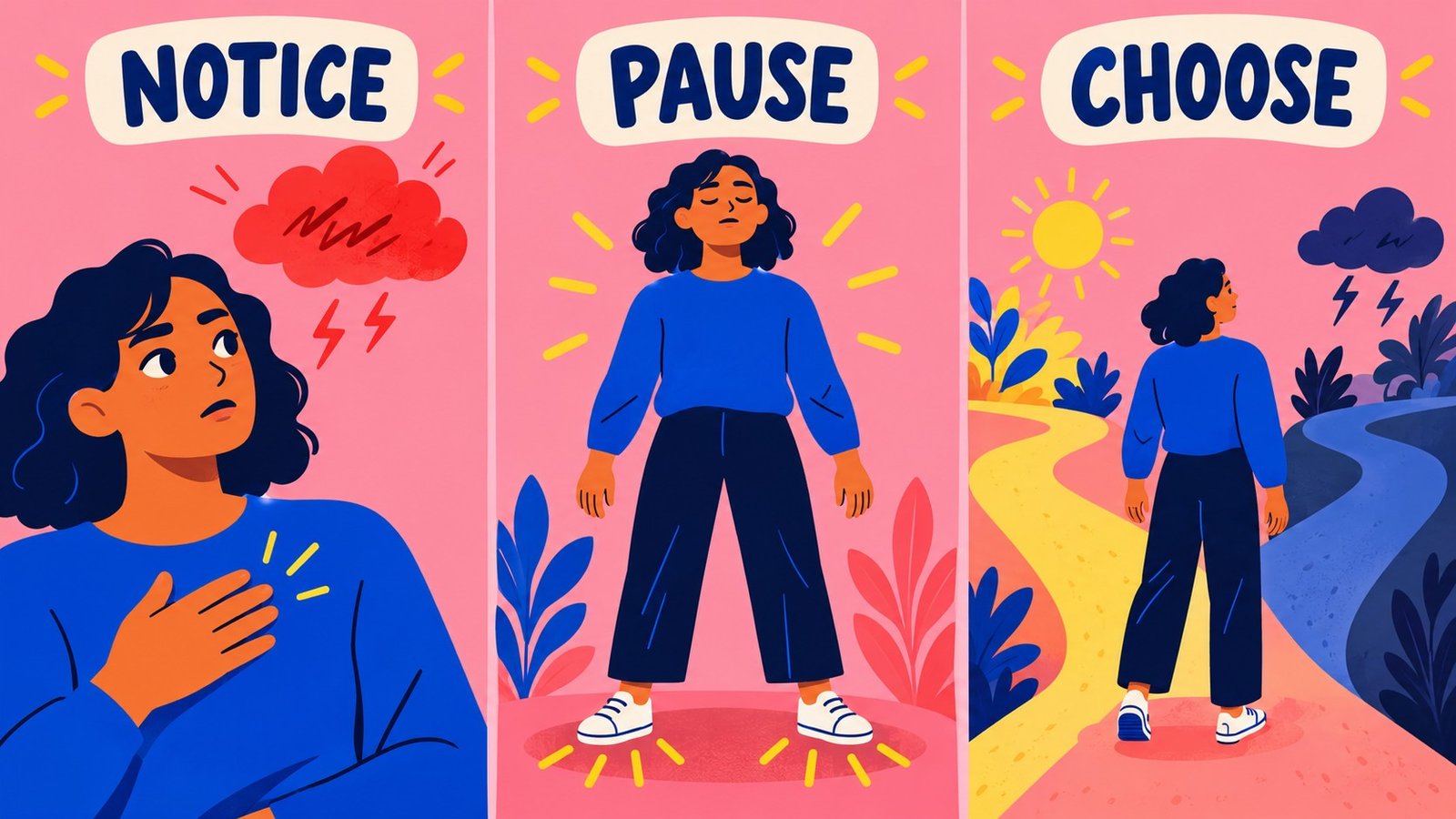
The Science of Emotional Regulation: What Happens in the Amygdala During Stress
Key takeaways
- The amygdala is part of a wider network, not a standalone fear button.
- Fast autonomic responses and the slower cortisol response follow different pathways.
- Affect labeling and reappraisal have experimental support, with important limits.
- Consumer relaxation wearables should not be equated with medical vagus nerve stimulation.
A sharp email arrives just before a meeting. Your shoulders tighten, your pulse rises and you begin rehearsing an angry response. By the time you notice the reaction, it already feels underway. This is a familiar example of the brain and body assigning significance to an event and preparing you to act. The science of emotional regulation studies how that preparation unfolds and what can change it.
Emotional regulation means influencing how an emotion unfolds, including its intensity, duration and expression. It does not require becoming calm on command. Sometimes the useful response is to tolerate discomfort, ask for support or change the situation that is producing it.
Understanding the science can make these moments less mysterious. It also helps separate practical tools from exaggerated promises about resetting your nervous system. The goal is greater flexibility in your response, rather than eliminating normal emotions or treating every stressful moment as evidence of a damaged brain.
The science of emotional regulation: what happens in the amygdala during stress?
The amygdala consists of several nuclei within the medial temporal lobes. Its connections help link sensory information, learning and biological significance. Threat is one important part of that work, but the amygdala also responds to novelty, uncertainty and rewarding or socially meaningful events.
Its activity depends on context and previous experience. A raised voice might signal danger in one situation and excitement in another. The hippocampus, sensory systems, insula and cortical networks contribute information that helps shape the response. No single region contains a complete explanation of an emotion.
Why “amygdala hijack” is only a metaphor
The phrase describes the feeling of reacting before you have thought a situation through. It can be useful shorthand, but the brain does not literally transfer command from a rational compartment to an emotional one. Thinking and feeling arise through interacting systems, and both can contribute useful information.
Likewise, diagrams showing a single fast route and a single slow route simplify a much richer picture. Research on defensive circuits does not establish a universal millisecond timetable for human anger, anxiety or decision-making. A stressful conversation involves memory, language, expectations and bodily signals as well as sensory processing.
In the science of emotional regulation, adrenaline and cortisol are different parts of the response
The sympathetic nervous system can rapidly increase heart rate and prepare the body for action. Adrenaline release through the sympathetic-adrenal system contributes to this response. The hypothalamic-pituitary-adrenal axis follows a hormonal cascade that releases cortisol on a slower timescale.
These coordinated systems help mobilize resources. A racing heart is therefore not automatically a sign that something has gone wrong. Problems can emerge when stress is persistent, disproportionate or difficult to recover from, particularly when it interferes with sleep, relationships or everyday functioning.
Top-down and bottom-up regulation in the science of emotional regulation
Researchers sometimes distinguish cognitive approaches from approaches that begin with the body. This is a helpful teaching distinction, although signals travel in both directions and the strategies often overlap. Breathing can influence attention, while changing your interpretation can alter bodily arousal.
| Approach | Example | What to expect |
|---|---|---|
| Cognitive | Name a feeling or consider another interpretation | May change attention and meaning; requires practice |
| Body-focused | Comfortable slow breathing or gentle movement | May reduce felt arousal; effects vary |
| Situational | Pause a conflict or reduce an avoidable demand | Changes the source of stress rather than only the response |
Prefrontal regions contribute to goals, attention and interpretation, but they do not simply send a universal inhibitory command to the amygdala. The relevant circuits vary with the task. Under intense stress, working memory and flexible thinking can become harder, which is one reason a short pause may be more useful than a complex argument with yourself.
What affect labeling adds to the science of emotional regulation
Affect labeling means putting an emotional experience into words. In a 2007 fMRI experiment by Lieberman and colleagues, labeling emotional faces was associated with reduced amygdala responses and greater activity in right ventrolateral prefrontal cortex compared with other task conditions.
This is evidence about an experimental task and a brain-imaging signal. It does not mean that saying the correct word instantly removes distress. A change in blood-oxygen-level-dependent activity is not a direct measurement of feeling safe, recovering from trauma or resolving a conflict.
In daily life, a simple label can create a useful pause: “I feel disappointed and tense.” The label need not sound scientific. Describing yourself as experiencing a neurotransmitter spike would add a biological claim you cannot verify and may distract from what you actually notice.
For a closer look at the distinction between brain activity and subjective experience, read Does Naming a Feeling Change It?
Four practical ways to apply the science of emotional regulation
1. Pause and breathe comfortably
If the situation allows, stop typing or speaking for a moment. Try a gentle inhale followed by a slightly longer, unforced exhale. Some people find a double inhale followed by a slow exhale comfortable, but there is no need to force a deep breath or repeatedly breathe hard.
A randomized study of daily five-minute breathing practices found benefits for mood and physiological arousal over a month. That supports investigating brief breathing routines; it does not establish a guaranteed immediate cure or prove one breath is the fastest treatment for anxiety. Stop if you feel dizzy, breathless or worse.
2. Name what you notice
Choose one or two ordinary words, such as anxious, embarrassed, frustrated or sad. Add a bodily observation if it helps: “My jaw is tight.” Then identify the impulse without acting automatically: “I want to send a harsh reply.” This makes the next choice more concrete.
Avoid judging yourself for having the feeling. The aim is to recognize your current experience, not to win an argument about whether it is reasonable. If naming it increases rumination, shift attention to your surroundings or a manageable practical task.
3. Reappraise without denying reality
Reappraisal means considering another plausible interpretation. Perhaps a colleague’s short message reflects time pressure rather than hostility. Before accepting that explanation, check the evidence. An alternative interpretation should be credible, not compulsory positive thinking.
You might ask, “What do I know, what am I assuming, and what can I clarify?” Reappraisal is less appropriate when it encourages you to dismiss mistreatment or remain in danger. Setting a boundary, leaving a situation or asking for help can be the more effective response.
4. Change one condition that maintains stress
Move away from an escalating exchange, take a short walk if appropriate, or reduce unnecessary sensory demands. Later, look for recurring patterns: too little sleep, unclear expectations or repeated conflict. A useful regulation plan addresses those conditions as well as the momentary reaction.
Practice in mildly stressful situations first. Write down the trigger, the strategy and whether it helped you behave in line with your goals. Improvement may look like recovering sooner or communicating more clearly, even when the emotion remains uncomfortable.
Does the science of emotional regulation support relaxation apps and wearables?
Guided meditation apps and tactile relaxation devices can offer structure or a pleasant cue to pause. Their usefulness depends on the person, the program and the evidence for the specific outcome. Feeling relaxed after using a device does not establish that it directly stimulated the vagus nerve.
Apollo Neuro and Sensate are consumer wellness products with marketing claims that require product-specific evaluation. They should not be described as interchangeable with clinical vagus nerve stimulation. Before spending money, examine independent controlled trials, comparison groups, adverse effects, subscription costs and return terms. No purchase is necessary to try the basic strategies above.
Frequently asked questions
Does chronic stress permanently damage the amygdala?
Chronic stress can be associated with changes in brain structure and function. Findings differ across animal experiments and human studies, and a scan cannot establish that everyday stress has permanently damaged an individual’s brain. Avoid both catastrophic claims and promises that a particular routine will reverse structural changes.
Is regulation the same as suppression?
No. Suppression usually refers to limiting outward expression after an emotion has developed. Regulation includes a broader range of strategies, such as changing the situation, redirecting attention or reconsidering meaning. Suppression can be useful in some circumstances, but relying on it alone may leave the underlying problem unresolved.
When should I seek professional support?
If distress is persistent, worsening or disrupting daily life, a qualified clinician can assess what is happening and discuss suitable support. Self-help strategies complement appropriate care. They are not a substitute for assessment of panic, trauma-related symptoms or other significant difficulties.
This article provides general educational information, not individual medical advice.
Sources and further reading
- Lieberman et al. (2007). Putting feelings into words.
- Balban et al. (2023). Brief structured respiration practices enhance mood and reduce physiological arousal.
- Gross (2015). Emotion regulation: Current status and future prospects.
- LeDoux (2000). Emotion circuits in the brain.
For a closer look at the breathing evidence, read cyclic sighing for stress: what the research actually shows.