
Interoception and the Insula: How the Brain Makes Sense of Signals Inside Your Body
Key takeaways
- Interoception includes processing that does not become conscious.
- The insula works with other regions rather than acting as a single emotion switch.
- Confidence in bodily awareness is different from accuracy on a measured task.
- Gentle observation can be useful, but distressing symptoms need appropriate assessment.
You notice your heart beating before an important conversation. You feel hungry while finishing a task. You become aware that your breathing has changed after climbing stairs. Each experience involves information from within the body, interpreted in a particular context.
Interoception is the name for this broad territory. It helps explain why bodily sensations and emotions often feel intertwined, but it does not mean that every uncomfortable sensation is anxiety or that a consumer device can identify its cause.
A useful approach asks three separate questions: what signal is present, how are you interpreting it, and what response would be helpful? That leaves room for both psychological context and ordinary medical evaluation.
From a bodily change to an experience
Signals arise from many tissues and travel through several neural routes. The nervous system processes information about the body’s ongoing condition while coordinating responses. Much of this work happens without deliberate attention.
What reaches awareness is not a raw dashboard of every organ. Attention, expectations, recent activity and context can influence experience. A pounding heart after exercise and a pounding heart while waiting for news may be interpreted differently even when the sensation overlaps.
This does not make a sensation imaginary. It means experience includes both incoming information and its interpretation. Recognizing that distinction can help you describe what you feel without prematurely deciding what caused it.
Why researchers study the insula
The insula lies within the lateral folds of the cerebral cortex and contains functionally diverse areas. It interacts with regions involved in bodily regulation, attention, action and emotion. Calling it the body’s single control center would obscure that broader network.
In Critchley and colleagues’ heartbeat-detection study, activity in right anterior insular/opercular cortex related to accuracy during an interoceptive task. The findings linked a specific experimental measure to neural activity.
They did not show that the insula alone creates feelings, that its size determines emotional health or that a particular wearable improves its function. A research association is a starting point for interpretation, not a consumer diagnostic rule.
Three meanings that are often mixed together
Garfinkel and colleagues studied three dimensions of interoception: accuracy on behavioral tasks, self-reported bodily sensitivity, and the correspondence between confidence and accuracy. Their results supported treating these as distinguishable dimensions.
| Dimension | Example question | What it does not establish |
|---|---|---|
| Accuracy | How well did I perform on this task? | Accuracy for every organ or situation |
| Self-reported sensitivity | How aware of my body do I feel? | Objective correctness |
| Metacognitive awareness | Does confidence match performance? | A diagnosis or a general wellness score |
A person can feel highly attentive to internal sensations without being especially accurate on a particular test. That is a reason for careful measurement, not a reason to dismiss what the person experiences.
Why heartbeat exercises are not a complete assessment
A heartbeat task measures performance under specified conditions. Different tasks impose different demands, and a result should not be generalized to hunger, breathing or pain without evidence. Beliefs about pulse rate and the way instructions are delivered can also matter.
A consumer heart-rate reading measures a physiological signal through its own sensor and processing method. It does not directly reveal how accurately the brain interprets that signal. Heart-rate variability is likewise not a complete score for interoception or emotional regulation.
If an app claims to train body awareness, ask which ability it targets and how success was measured. A calmer self-report can be meaningful without proving a change in anterior insular activity.
A gentle way to observe without overinterpreting
Describe before explaining
Use ordinary language: “My breathing feels faster” or “There is tension in my shoulders.” Try to separate that description from a conclusion such as “My nervous system is broken.” The second statement adds a diagnosis that the sensation alone cannot support.
Include context
Consider recent activity, meals, sleep and the situation around you. You do not need to monitor every signal continuously. A brief observation can be enough to decide whether you need a break, food, an adjustment or help.
Choose a comfortable focus
If attention to heartbeat or breathing makes you more distressed, shift toward something external, such as noticing objects in the room or the support of a chair. Do not force breath holds, unusually deep breathing or prolonged symptom checking.
Respond to the actual need
A helpful response may be practical rather than physiological: reduce an immediate demand, ask a question or seek care. For related context, read our explanation of stress physiology and cortisol.
What a wearable can add, and what it cannot
A vibration cue or biofeedback display may provide a reminder to pause or a structured exercise. That can be convenient, but a soothing sensation does not establish direct vagus nerve stimulation, treatment of anxiety or improved interoceptive accuracy.
Ask whether evidence relates to the exact device, comparison and outcome being advertised. Compare the recurring cost, comfort, privacy and accessibility with a simple reminder or a practice you already find helpful. No particular product is necessary to understand the concept.
For emotional context, our guide to emotional regulation during stress distinguishes practical coping from claims about switching a brain region on or off.
When interpretation should give way to assessment
Do not assume that new, persistent or worsening symptoms are explained by interoception. Chest pain, severe breathlessness, fainting or a sudden neurological change can require urgent assessment. Existing medical advice and prescribed treatment should take priority over a general body-awareness exercise.
If inward attention repeatedly triggers distress or compulsive checking, discuss it with a qualified clinician. The aim is a useful relationship with bodily information, not perfect vigilance. Less monitoring can sometimes be the more workable choice.
Interoception, proprioception and external senses
Interoception concerns information about the internal condition of the body. Proprioception concerns body position and movement, such as knowing where a hand is without looking. External senses provide information about the surrounding world. The boundaries can be discussed differently across research traditions, so it helps to state the particular signal or task being studied.
In an ordinary moment, these sources work together. Sitting before a presentation, you may notice a quickened heartbeat, the position of your feet and the sound of people entering the room. The experience is integrated, even though a researcher might isolate one component to ask a focused question.
This is one reason a single heartbeat score cannot summarize the entire brain–body relationship. It samples an ability under specific conditions. A broad phrase such as “body awareness” can be useful in conversation, but it needs a more precise definition when used to advertise a measured improvement.
Separate a sensation, an interpretation and a decision
Consider the thought “My heart is racing, so I cannot handle this conversation.” The sensation is a perceived rapid heartbeat. The interpretation is that it predicts inability to cope. The decision might be to leave, ask for a pause or continue with support. Distinguishing these steps creates room to choose without declaring that the sensation must be harmless.
A more descriptive account could be: “I notice a stronger heartbeat, I am worried about what it means, and I need a moment to decide what help would be useful.” That statement communicates experience and uncertainty. It avoids replacing one unsupported conclusion with another, such as insisting that all symptoms are just stress.
For a familiar, previously assessed situation, a clinician may have helped you develop an appropriate response. Use that individual plan. For a new or concerning symptom, seek appropriate advice rather than using a body-awareness technique to explain it away. This article cannot determine the medical cause of a sensation.
In a journal, keep any observation short and practical. You might note the situation, a plain description of the sensation and what response helped. Continuous measurement is unnecessary for this exercise and can become burdensome. Stop if the activity promotes more distress or checking rather than useful understanding.
Finally, consider privacy before entering bodily observations into an app. Read what is stored, whether information is shared and whether you can delete or export it. An accessible paper note or an occasional conversation may meet the same practical need. Convenience is a reasonable purchase consideration, but it does not validate a claim that the app measures an emotion directly.
Frequently asked questions
Is interoception the same as intuition?
No. Intuition is a broader description of a judgment or feeling. Bodily information can contribute to it, but a strong gut feeling does not guarantee accuracy.
Does better heartbeat detection mean better emotional control?
Performance on a heartbeat task is not a general score for emotional regulation. The relationship depends on the task, person and outcome being measured.
Can I strengthen my insula with a device?
A device’s calming effect or feedback display does not establish a specific improvement in insular function. Look for direct evidence rather than assuming the mechanism.
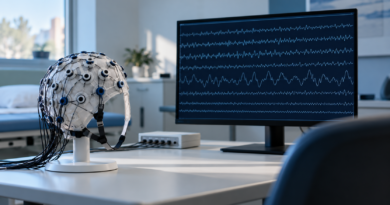
The featured illustration is conceptual artwork, not a brain scan or a measurement of individual brain function.
Sources and further reading
- Critchley et al. (2004). Neural systems supporting interoceptive awareness.
- Garfinkel et al. (2015). Knowing your own heart: distinguishing interoceptive accuracy from interoceptive awareness.
- Forkmann et al. (2016). Making sense of what you sense.