Cognitive Load Theory: Make Learning Clearer Without Chasing a Brain-Energy Score
Key takeaways
- The difficulty of the material and the demands of its presentation are different questions.
- Worked examples and integrated explanations can help learners focus on relevant relationships.
- Visual competition and task switching are related subjects, not interchangeable measures of cognitive load.
- Judge an adjustment by understanding and later performance, not only by how effortless it feels.
A diagram is on one page, its explanation on another and the task instructions in a separate window. Before you can understand the subject, you have to work out which pieces belong together. That extra coordination can become part of the learning problem.
Cognitive load theory offers a way to ask whether a task’s design helps the learner think about the right things. It is more specific than the idea that modern life overloads everyone’s brain. It also leads to more useful decisions than buying another productivity tool because a sales page mentions mental bandwidth.
The aim is not to eliminate effort. Learning a new concept can require careful thought. The aim is to distinguish effort spent understanding the concept from effort spent navigating avoidable obstacles in its presentation.
What cognitive load theory explains
In Sweller’s foundational work, the central issue was how problem-solving demands could compete with learning useful structures, or schemas. A learner might complete steps toward an answer without acquiring the relationships needed to solve a similar problem later.
Working memory is limited when processing unfamiliar information. Prior knowledge changes what counts as a manageable unit. A short instruction that is obvious to an experienced reader may require a beginner to look up several terms and hold their meanings together.
This makes cognitive load a relationship between a person, a task and its presentation. It is not a fixed trait or an insult to someone’s ability. The same person may navigate a familiar field fluently and need much more guidance in another.
Separate the concept from its presentation
Some demands arise because the subject contains interacting elements. Others arise from how the material is arranged. Sweller and Chandler’s research on difficult material discusses this distinction in terms of element interactivity and presentation.
Imagine learning an unfamiliar budgeting method. Understanding how income, fixed costs and irregular expenses relate is part of the subject. Searching through disconnected screens to find which number belongs in which category is an additional design demand. Removing the search does not remove the reasoning.
When reviewing a lesson or workflow, ask where the effort goes. Are you making a meaningful comparison, or repeatedly finding the key? Are you practicing a skill, or guessing which instruction applies? These questions turn a broad feeling of overload into a change you can test.
Why a worked example can help
A worked example shows a solution with the relevant steps made visible. It can give a beginner a structure to examine before independent problem solving. The important feature is the connection between the steps and the reason for each step, not simply seeing a finished answer.
Consider a hypothetical lesson on interpreting a risk percentage. First show a small, fully explained comparison. Then ask the learner to complete a similar comparison with some guidance removed. Finally, ask for an explanation of why the numbers differ. This is an illustrative teaching sequence, not a guarantee about every learner.
Copying an answer without thinking is a different activity. To check whether the example helped, use a new question that requires the same relationship. If the learner can only reproduce the original layout, the material may have become familiar without the reasoning becoming usable.
Guidance needs to change with experience
More explanation is not always better. In an experiment on the expertise reversal effect, additional explanatory text helped novices but was less helpful for participants given relevant expertise. That experiment (a 2011 study) had 104 students spend about 30 minutes with animated instructional material on a mathematical optimization algorithm (gradient descent), randomly assigned to see it with or without added text, as novices or as people with prior knowledge. The value of the presentation depended on prior knowledge.
This is why a single ideal interface or lesson format is unlikely to suit everyone. A beginner may need definitions beside a diagram. Someone experienced may prefer the diagram without repeated basic explanations. Accessibility needs can introduce further reasons for offering different representations.
If you teach, ask learners what they already know and check performance rather than assuming expertise from confidence. If you are learning, select material that supplies missing foundations without forcing you through large amounts of information you already use fluently.
What visual clutter research can establish
McMains and Kastner’s visual-cortex experiments investigated competition among visual stimuli and the effects of grouping and attention. They support studying how a display’s organization affects processing. They do not establish a universal rule that every object on a desk drains a measurable amount of brain fuel.
The distinction matters because useful reference information can also look busy. A musician’s score, a mechanic’s diagram and a researcher’s annotated page may contain many elements while remaining well organized for someone who knows how to read them.
Instead of pursuing emptiness, make relationships legible. Put a definition near the symbol it explains. Group information used together. Remove decorative elements that compete with the current task. Keep necessary labels and accessibility support even if a minimal aesthetic would look cleaner.
Task switching asks a different question
In Rubinstein and colleagues’ experiments, alternating tasks produced switching-time costs affected by rule complexity and cues. The study measured performance in controlled classification and arithmetic tasks. It did not count the calories consumed by an ordinary afternoon of email.
For everyday planning, the relevant question is often how much context must be reconstructed after an interruption. A note naming the next action may be useful. Grouping related administrative tasks may also be worth testing. Those are practical applications to evaluate, not exact translations of a laboratory effect size.
Our deep work article covers sustained focus more broadly. This article focuses on instructional design and understanding, so a long uninterrupted session should not be mistaken for proof that the material was learned well.
Try a small redesign before adding software
| Observed difficulty | Adjustment to try | Check whether it helped |
|---|---|---|
| Repeatedly searching for a diagram key | Place the key beside the diagram | Explain the relationship without searching |
| Unsure how to start a new problem | Review one annotated worked example | Attempt a different problem using the same principle |
| Losing the thread after interruptions | Leave a brief next-action note | Resume with fewer missing steps |
| Familiar pages but weak recall | Answer a question without the source open | Compare the explanation with the reference |
Choose one obstacle and keep the target clear. For example, if the problem is matching labels, do not simultaneously change the device, lesson, background music and study time. A smaller change gives you a clearer account of what was useful.
Record an outcome connected to the job. In a learning task, that may be a correct explanation or transfer to a new example. In a workflow, it may be fewer missed steps. An attractive dashboard or a lower self-rated effort score is not enough by itself.
Evaluate planning and focus apps by their actual function
A tool may help by collecting instructions, limiting selected interruptions or making the next action visible. Ask which of those functions you need before comparing subscription plans. A system with many settings may introduce its own navigation and maintenance work.
Try a small realistic task. Can you find the relevant note? Can essential notifications still reach you? Is the interface usable with your accessibility tools? Can you export work, control permissions and cancel without losing necessary records?
Do not infer clinical or cognitive benefits from labels such as brain-friendly or AI optimized. A manufacturer’s explanation of a feature is not independent evidence of improved learning. This article has not personally tested or ranked commercial tools.
Avoid the brain-energy shortcut
The brain uses energy, but a feeling of mental fatigue does not tell you how much glucose a specific region consumed. Neither a busy display nor switching between tasks proves that a person has exhausted a daily fuel allowance. Cognitive load theory is not a home metabolic test.
This distinction protects the useful part of the idea. You can simplify an instruction because it causes avoidable confusion without claiming to have measured neurotransmitters or rescued the prefrontal cortex. A modest explanation often leads to a more checkable result.
Persistent or new difficulties with attention and everyday functioning deserve appropriate assessment. Rearranging a workspace may help a specific task, but it should not be used to dismiss a broader change in health or substitute for support someone needs.
Frequently asked questions
Does less cognitive load always mean better learning?
No. Removing unnecessary demands can help, but meaningful thinking and practice still require effort. Judge the result by understanding and later use rather than comfort alone.
Is cognitive load the same as working-memory capacity?
No. Capacity concerns what can be processed under particular conditions, while load concerns demands imposed by a task and its presentation. Prior knowledge changes how those demands are managed.
Should I remove every object from my desk?
No. Keep what supports the task and organize it clearly. A useful reference or accessibility aid should not be removed just to create a minimal appearance.
Can an app measure my cognitive load precisely?
Ask what signal it records and how the estimate was validated. A timer, activity log or proprietary score does not automatically measure the instructional demands discussed here.
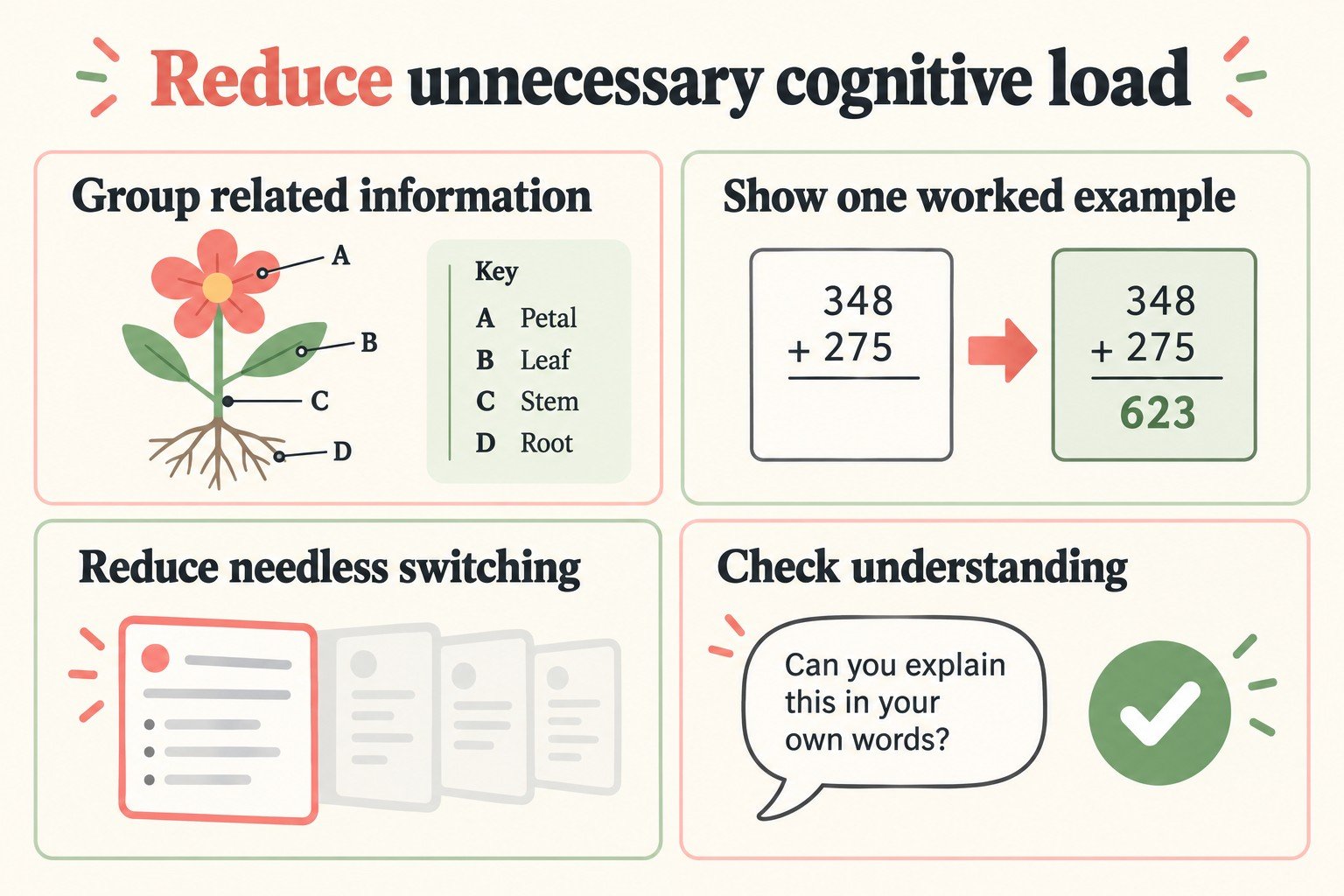
The featured image is an editorial visual. It does not depict experimental data, an identified patient or a clinical outcome.
Sources and further reading
- Sweller (1988). Cognitive Load During Problem Solving.
- Sweller and Chandler (1994). Why Some Material Is Difficult to Learn.
- Rey and Buchwald (2011). Expertise reversal experiment.
- McMains and Kastner (2011). Visual competition and attention.
- Rubinstein et al. (2001). Executive control in task switching.