tDCS for Cognitive Enhancement: Why a Changed Brain Response Is Not a Memory Upgrade
Key takeaways
- Motor-cortex excitability and performance on a memory task are different outcomes.
- Anodal means better and cathodal means worse is an unreliable shortcut for complex cognition.
- A stronger current does not simply produce a larger version of the same effect.
- Research findings do not provide an individualized DIY protocol or validate a specific consumer device.
A small device promising to accelerate the brain sounds like a shortcut around practice, sleep and difficult learning. The appeal becomes stronger when the explanation includes a real scientific finding: weak electrical stimulation can change a measured response in the human cortex.
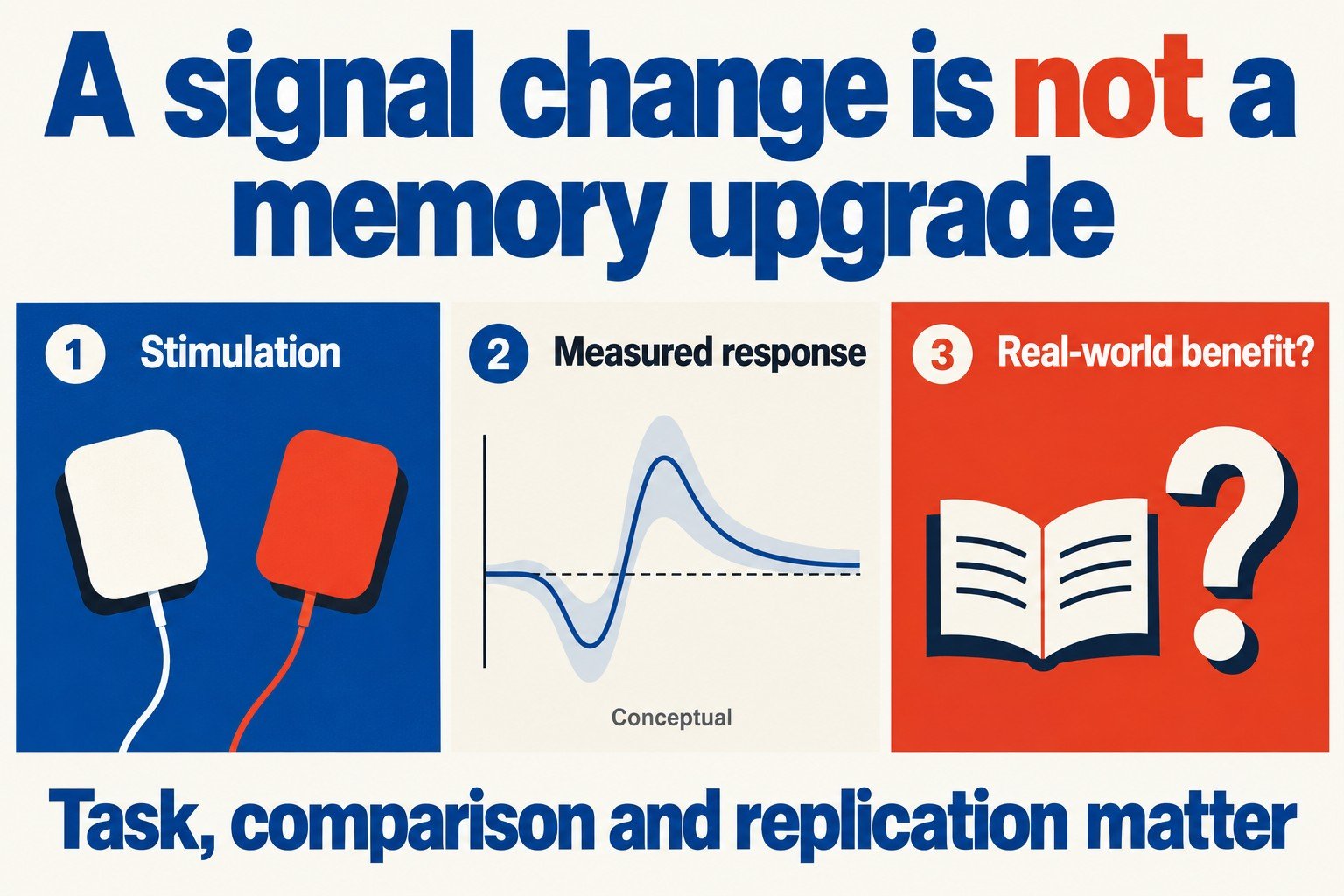
The missing step is whether that change improves the ability a buyer actually cares about. tDCS cognitive enhancement research must bridge that gap through controlled performance measurements. A biological signal is relevant evidence, but it is not the final outcome.
This article examines three primary studies that show why the distinction matters. It explains the evidence without providing electrode placements, current settings or a home stimulation routine.
What tDCS is intended to change
Transcranial direct current stimulation applies a weak direct current through scalp electrodes. Researchers specify the arrangement, duration and other conditions because the intervention is defined by more than the name of the technique.
In a landmark Nitsche and Paulus study published in 2000, stimulation changed motor-cortex excitability. The investigators assessed the change through responses elicited by transcranial magnetic stimulation, rather than by asking participants whether they felt more intelligent.
Under those conditions, anodal and cathodal stimulation produced different directions of excitability change. The authors proposed changes in membrane polarization as part of the explanation. This was an important physiological demonstration, not a universal cognitive-enhancement trial.
A measured response in a motor pathway does not itself establish improved reading, examination performance or creativity. Those claims need appropriate tasks and comparisons of their own.
Excitability is not an intelligence score
Excitability describes how a system responds under a specified measurement. It does not mean that every increase is beneficial or that every decrease is harmful. Useful cognitive performance depends on the task, not simply on making a signal larger.
Consider a hypothetical device advertisement showing an increased response next to a student studying. Unless the study also measured a relevant learning outcome, the image supplies a connection that the experiment has not demonstrated.
Our adult neuroplasticity article discusses the broader problem of connecting measured brain changes with learning. The practical question is what a person can do better, for how long and under which conditions.
That link is deliberately a question rather than an assumption. A technique can be scientifically useful for probing a mechanism even when it is not established as a general consumer upgrade.
More stimulation does not mean more of the same
Batsikadze and colleagues’ 2013 experiment tested the relationship between stimulation intensity and motor-cortex effects. It found a partially nonlinear pattern: a change in conditions could alter the direction of the measured response, rather than merely scaling its size.
In particular, cathodal stimulation did not always produce the simple inhibitory effect suggested by a basic polarity rule. The outcome depended on the experimental conditions used. This is a reason to resist translating a simplified diagram into an independent adjustment of a device.
The finding does not prove that every protocol has unpredictable effects. It establishes that the relationship cannot be reduced to one universally linear rule. The direction and duration of the physiological change require measurement.
It also does not identify a dose that maximizes intelligence. The study’s outcome was motor-cortex excitability, so using it to select a personal memory-enhancement setting would change the question without obtaining the necessary evidence.
A working-memory replication tested the cognitive claim
Jiang, Jones and von Bastian’s 2024 preregistered study examined whether stimulation improved visual working-memory capacity. It was a conceptual replication of a prior positive study and recruited forty-eight healthy young adults.
Participants completed counterbalanced sessions involving posterior parietal stimulation, dorsolateral prefrontal stimulation and sham stimulation. They then performed a visual orientation-reproduction task. The study addressed methodological concerns through its sample, trial count, counterbalancing and task design.
The researchers found no evidence of the predicted selective benefit. Effects were absent across the tested regions and task loads, with Bayesian analyses generally supporting the absence of the proposed effect under these conditions.
This result challenges a particular enhancement finding. It does not settle every tDCS application, every clinical population or every repeated-session protocol. A careful account should avoid both declaring a universal upgrade and declaring the entire field disproven by one experiment.
Why preregistration and sham comparison matter
Preregistration records planned hypotheses and analysis choices before results are known. It helps readers distinguish a test of a prediction from a pattern noticed afterward. It does not eliminate every limitation, but it makes the evidential trail easier to assess.
A sham comparison addresses whether performance differs from a comparison procedure intended to control aspects of the intervention experience. The credibility of the comparison still matters, especially when sensations could reveal the condition.
Counterbalancing is useful because people may improve simply by repeating a task. Changing the order of conditions across participants helps separate a stimulation effect from practice or sequence effects.
Our placebo and clinical-trial guide explains why improvement after an intervention is not automatically improvement because of it. A before-and-after testimonial cannot do the work of a suitable comparison.
Translate the outcome before judging the promise
| Reported result | What was measured? | Further evidence needed |
|---|---|---|
| A cortical response changed | A physiological signal | A relevant performance benefit |
| Task scores improved | A defined cognitive test | Replication and durability |
| A participant felt focused | A subjective experience | A controlled assessment of the promised ability |
| A device uses a researched technique | A category label | Evidence for that device and intended use |
The same framework applies to a disappointing result. Failure to improve one laboratory task cannot prove that no other question is worth investigating. It sets a boundary around the claim that was actually tested.
Ask whether a result concerns immediate performance, later retention or transfer to an unfamiliar task. A benefit on the trained exercise is not automatically a benefit in an ordinary workday.
Safety cannot be inferred from a small current
The studies discussed here used defined research procedures, eligibility criteria and oversight. Those conditions are part of the evidence. They do not certify that an improvised setup or a different device is safe for a particular person.
Noninvasive describes an approach to delivering stimulation; it is not a promise of no risk. A useful safety assessment needs the exact intervention, intended purpose and relevant medical circumstances, rather than reassurance based only on the size of the equipment.
Do not use the mechanism discussion as a recipe. Someone considering stimulation for symptoms should seek an appropriate clinical assessment and discuss the specific device and proposed use with a qualified professional.
This article does not determine current regulatory authorization for any named product. Authorization for a specific indication, where applicable, would need to be checked directly and would not automatically extend to unrelated enhancement claims.
Questions for a device or service provider
Ask for a study using the actual system and the outcome being advertised. A paper on motor responses should not be substituted for evidence of better memory, and a trial in one clinical group should not be presented as proof for healthy users.
Ask what the comparison group received, how many participants were studied and whether the result was replicated. Request the duration of any benefit and information about adverse events, withdrawals and eligibility exclusions.
Finally, establish what happens if the expected benefit does not appear. Costs, support and return terms are practical questions, but favorable answers cannot repair an unsupported scientific claim.
These are evaluation questions, not a recommendation to buy. Science Chronicle has not performed hands-on testing of a tDCS product for this article, and none of the cited papers constitutes our endorsement of one.
Common questions about tDCS enhancement
Is anodal stimulation always a cognitive boost?
No. A label describing polarity does not specify the final cognitive effect. The working-memory replication found no benefit in the tested conditions, while motor studies illustrate why a simple polarity story is incomplete.
Does a null trial mean tDCS has no biological effect?
No. A physiological effect and an improvement on a cognitive task are separate findings. The studies can be read consistently once their outcomes are kept distinct.
What would make an enhancement claim stronger?
Replicated, well-controlled evidence for a meaningful outcome in the intended users, with clear information about durability and safety, would be more informative than an isolated brain-response change or testimonial.
Sources and further reading
- Nitsche and Paulus, 2000: motor-cortex excitability after tDCS
- Batsikadze et al., 2013: nonlinear intensity-dependent effects
- Jiang et al., 2024: preregistered working-memory replication