Omega-3s and Brain Health: Why DHA Biology Does Not Guarantee Better Memory
Key takeaways
- ALA, EPA and DHA are related omega-3s, not interchangeable label amounts.
- A biological role does not prove benefit from extra supplementation.
- Raising a blood fatty-acid measure is different from improving cognition.
- Check EPA/DHA amounts, serving size, medicines and the reason for use before buying.
A nutrient can be important to the brain without being a proven memory enhancer in a capsule. Omega-3s illustrate that distinction especially well. Their biological roles are established, while claims about preventing cognitive decline require evidence from actual interventions.
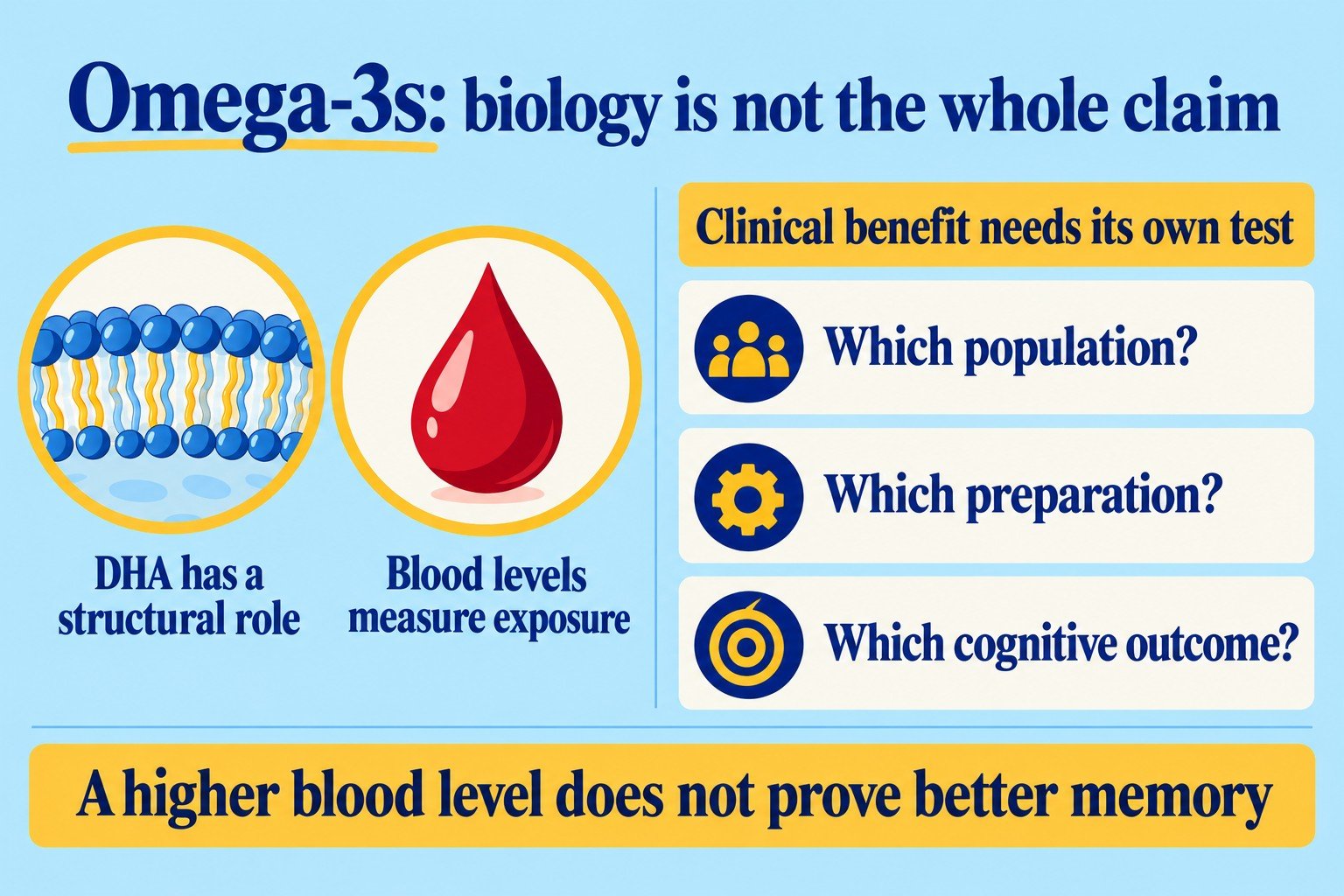
This article focuses on EPA and DHA, the human trials behind brain-health claims and practical label comparisons. It does not treat every fish-oil product as the same intervention or use a membrane diagram as proof that a supplement will improve someone’s daily memory.
Distinguish ALA, EPA and DHA
Alpha-linolenic acid, or ALA, is an essential omega-3 fatty acid found in plant foods. Eicosapentaenoic acid and docosahexaenoic acid are usually shortened to EPA and DHA. The NIH Office of Dietary Supplements explains their sources and physiological roles.
Conversion of ALA into the longer-chain omega-3s is limited. A product’s ALA amount therefore should not simply be read as an equal amount of EPA or DHA. The ingredient and quantity need to match the question being asked.
Omega-3s contribute to cell-membrane phospholipids, and DHA is especially abundant in the brain and retina. This is a reason to take nutrition seriously. It does not establish that a high supplemental intake improves every process performed by those tissues.
An analogy may help: a material being necessary for a building does not show that adding more of it improves every room. This is an illustration of the inference problem, not a model of nutrient metabolism or a suggestion that deficiency is unimportant.
A mechanism is the beginning of a treatment question
Membrane composition and signaling pathways provide biological reasons to investigate omega-3s. The clinical question is whether a particular intervention changes a meaningful outcome, compared with an appropriate control, in a specified population.
That population matters. A trial involving people with an established disease may answer a different question from a prevention trial in older adults or a performance trial in young students. Findings should not be moved between these groups without considering the differences.
The outcome matters too. A blood fatty-acid measurement can show that exposure changed. It cannot, by itself, demonstrate better learning, less depression or prevention of dementia. Each clinical claim needs evidence appropriate to that outcome.
This is why an explanation involving inflammatory resolution or membrane fluidity cannot replace an efficacy trial. The explanation may be plausible while the net clinical benefit remains uncertain or absent in the tested setting.
What the AREDS2 cognition study found
The AREDS2 randomized trial’s cognitive study tested cognitive function in 3,501 participants. The older participants were part of an eye-disease research population. The comparison included long-chain omega-3 supplementation and followed cognitive performance over several years.
There was no statistically significant advantage in the rate of cognitive-score change for participants assigned the omega-3 supplements. That result does not support a broad claim that the tested preparation protected cognition in this population.
It also does not establish that all foods containing omega-3s are useless or that nutrient inadequacy should be ignored. Those are different questions. The useful conclusion stays tied to the intervention and outcome actually studied.
The larger sample and longer follow-up are valuable because a cognitive-protection claim extends beyond a brief feeling of alertness. A product summary should make this result visible rather than citing only favorable mechanisms or observational associations.
What a DHA trial in Alzheimer disease found
In Quinn and colleagues’ 2010 randomized trial, 402 people with mild-to-moderate Alzheimer disease were assigned DHA or placebo for 18 months. The treatment did not slow the main measures of cognitive and functional decline.
In an imaging subgroup, the study also found no treatment effect on the rate of brain atrophy. Thus, an increase in fatty-acid exposure should not be translated into a promise that the intervention preserved brain volume or treated the disease.
This was a treatment trial in a defined clinical population. It does not settle every prevention question or every potential subgroup. Equally, uncertainty about other populations should not be used to claim that benefit was established here.
The practical lesson is to separate possible biological importance from demonstrated treatment effectiveness. A person with a diagnosis deserves a care plan grounded in the relevant clinical evidence, rather than a suggestion that a membrane nutrient necessarily replaces indicated treatment.
Why blood levels do not settle the benefit
A blood test can quantify aspects of fatty-acid status. That information is not a direct reading of memory capacity, brain membrane quality or an individual’s future dementia risk. Ask what the measurement is validated to do before treating it as a target.
The distinction becomes especially important when testing and supplement sales are bundled. A service may identify a number and recommend a product to change it. The missing question is whether changing the number improves the outcome you care about.
Do not assume that a higher result is always better or that one commercial target applies to everyone. Clinical context, the reason for testing and the evidence for action are necessary parts of interpreting any result.
Our cognitive reserve guide discusses the broader picture of brain health. No single nutrient measurement captures all of that picture or determines the cause of a cognitive concern.
Read the amount that actually appears on the label
The total fish-oil amount and the EPA/DHA amounts can differ substantially. A large number on the front of a bottle may describe oil weight rather than the combined amount of the fatty acids highlighted in a study.
Read the serving size, then find EPA and DHA separately where provided. Compare equivalent servings and the number of capsules required. This is a label-reading exercise, not a recommendation to pursue a particular intake for cognition.
| Label feature | Useful comparison | Unsupported conclusion to avoid |
|---|---|---|
| Total oil weight | What the full serving contains | All of it is EPA and DHA |
| EPA and DHA amounts | Amounts of each named fatty acid | More guarantees better memory |
| ALA amount | Which omega-3 is supplied | Equal to the same amount of DHA |
| Quality verification | What identity or quality checks cover | Proof of dementia prevention |
Our supplement evidence and quality guide explains why quality checks and efficacy are distinct. A product can meet a quality standard without having demonstrated a particular brain-health benefit.
Keep food choices and prescriptions separate
Choosing a food involves more than isolating one nutrient. Preferences, affordability, preparation and the overall dietary pattern matter. A supplement trial cannot automatically describe the effects of replacing one meal with another.
Similarly, prescription omega-3 products used for particular medical indications should not be treated as interchangeable with every retail supplement. The preparation, intended use and monitoring belong to the clinical decision.
If a clinician recommends an omega-3 product, ask what goal it addresses. A recommendation for one indication does not establish an unrelated cognitive benefit. Clear goals make it easier to understand whether a label claim is relevant or merely adjacent.
Consider adverse effects and interactions
Discuss supplements with a clinician or pharmacist if you take medicines, have a relevant health condition or are considering a high intake. Include the actual product and serving rather than only saying fish oil. The full ingredient list and intended use matter.
The NIH guidance notes that some large high-dose trials in people with cardiovascular disease or elevated cardiovascular risk found increased atrial fibrillation. That finding should not be generalized to every exposure, but it does challenge the assumption that more is automatically harmless.
Persistent or worsening memory problems deserve assessment rather than repeated supplement changes. A blood test or product response cannot determine the cause alone. Seek appropriate care without waiting to prove a specific nutrient mechanism.
Frequently asked questions
Does DHA being abundant in the brain prove a supplement improves memory?
No. Abundance describes biology. The intervention still needs to demonstrate a benefit on the relevant cognitive outcome. The trials reviewed here did not establish an overall benefit in their studied populations.
Are plant omega-3s identical to fish-derived EPA and DHA?
No. ALA, EPA and DHA are different fatty acids. Read which one a food or supplement supplies rather than treating the omega-3 total as a single interchangeable amount.
Does a quality seal prove dementia prevention?
No. Check what the seal actually verifies. Identity and quality testing cannot substitute for a clinical trial of disease prevention.
Should I stop a prescribed product because of these cognition results?
Discuss prescribed treatment with your clinician. Its indication may be different from cognition, and these results do not determine whether an individual should start, stop or change it.
Sources and further reading
- NIH ODS: omega-3 biology, sources, labels and safety
- Chew et al. (2015): AREDS2 randomized cognition study
- Quinn et al. (2010): DHA trial in Alzheimer disease
Continue reading
- Cocoa Flavanols and Brain Blood Flow: Why a Biological Signal Is Not a Memory Guarantee
- Protein Foods and Powders: Look Beyond the Grams on the Label
- Exorphins, Gluten and Dairy: What Laboratory Findings Can and Cannot Explain About Brain Fog
- How to Read a Nutrition Facts Label Without Being Distracted by the Front of the Pack