
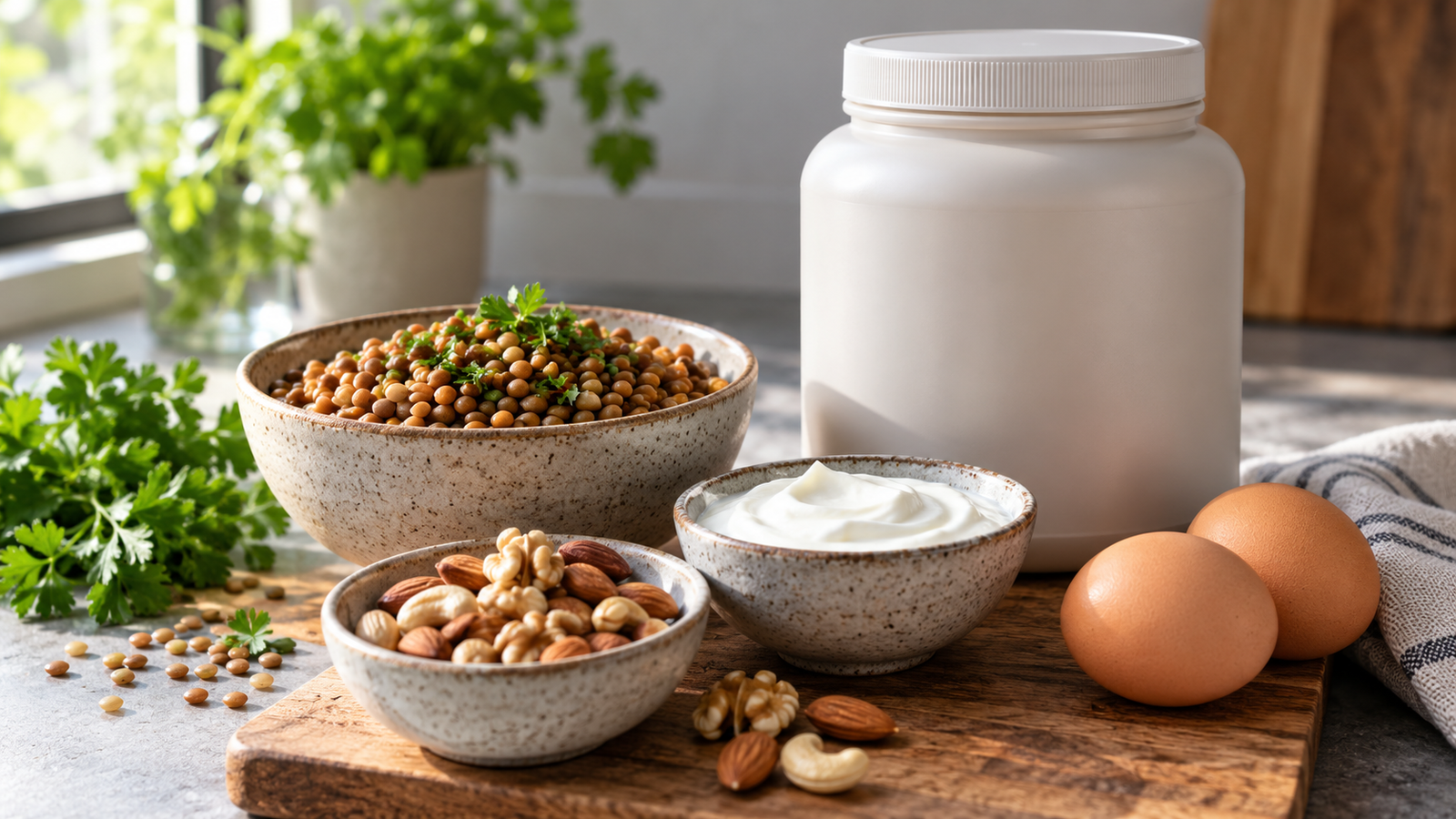
Protein Foods and Powders: Look Beyond the Grams on the Label
Key Points:
- Protein grams are one part of a food or powder comparison.
- Consider the complete food, serving, other ingredients, convenience and total cost.
- A biological role for protein does not prove that an additional product benefits every person.
- No named powder was tested or endorsed, and individual needs require appropriate context.
Educational reporting, not individual diagnosis, treatment or dietary advice. Dated milestone reports describe the original event; current clinical decisions require current guidance and a qualified healthcare professional.
Protein grams are easy to display prominently on a package. The harder question is what a food or supplement contributes to an actual eating pattern and whether it solves a specific need. A product with a high number is not automatically the most useful choice, and a protein powder is not automatically necessary because protein is important. Start with the purpose of the food, read the complete label and distinguish general nutrition information from individual requirements or evidence about a particular supplement.
Protein has many roles
Harvard's Nutrition Source explanation of protein describes proteins throughout the body, including structural and functional roles, and explains amino acids as their building blocks. Some amino acids must come from food. This biological importance does not establish that every person benefits from maximizing intake or adding a powder. Individual needs vary with circumstances, and an educational article cannot determine a personal target from a general label claim or a reader’s interest in the subject.
The same resource emphasizes the food package that accompanies protein: foods also provide fats, fiber, sodium and other components. The phrase is a useful reminder that a nutrient is consumed as part of a food or formulation. Comparing only protein grams can obscure meaningful differences. A food’s convenience, affordability, allergies and role in the meal also matter, so the most helpful comparison begins with a practical question rather than an assumption that the largest protein total wins.
| Choice | Useful things to examine | Question a protein total cannot answer |
|---|---|---|
| Legumes or other plant foods | Preparation, fiber, serving and meal role | Whether the food suits every individual diet |
| Dairy, eggs or other animal foods | Composition, allergies, storage and serving | How the full eating pattern compares |
| Protein powder | Ingredient source, complete formulation and quality documentation | Whether supplementation is needed or beneficial individually |
| Protein-marketed snack | Whole label, portion, price and intended use | Whether the front-of-pack claim makes it a better overall choice |
Distinguish an individual requirement from a marketing target
Harvard discusses general reference information and explicitly notes variation with factors such as age, activity and health. A registered dietitian can help interpret an individual’s needs. A number promoted by a brand or influencer may not be appropriate for a particular person. Before turning a general recommendation into a shopping list, ask what population the recommendation concerns and whether it applies to the question you are actually trying to solve.
For an original example, someone seeking a portable breakfast has a different problem from someone following a clinician’s nutrition plan. The first comparison may focus on preparation and a balanced meal; the second needs individualized interpretation. A guide should not collapse these situations into one universal powder recommendation. This article provides a way to read and compare information, not a personalized prescription, performance plan or instruction to change a medically supervised diet.
Read the complete product label
The FDA's Nutrition Facts guide explains how serving size and nutrient information work. For a powder, bar or drink, inspect the current ingredient list and the appropriate facts panel, not just the protein claim. Products may contain sweeteners, flavorings, added nutrients or other ingredients. A familiar product name can remain while the formulation changes. Use the exact current version and amount basis when making a comparison, and identify any detail you cannot verify.
Suppose a hypothetical powder lists 20 grams of protein per 30-gram serving and another lists 25 grams per 50-gram serving. The second has more per listed serving, while the first has more per equal weight. Neither calculation establishes which is appropriate or better tasting. A comparison of cost per serving also needs the same clarity. These invented values illustrate label arithmetic; they are not real product specifications, recommended servings or evidence of a health benefit.
Food and powder solve different practical problems
A powder can be convenient in some circumstances, but convenience should be assessed rather than assumed. Consider preparation, storage, portability, cleanup and whether it replaces or accompanies other food. A food option may provide a different mixture of nutrients and be more useful in a meal. A powder may fit a particular plan but still require scrutiny of ingredients and quality. The comparison is contextual, not a contest between all foods and all supplements.
Our proposed worksheet asks what problem the purchase addresses, what alternatives already exist and what benefit would justify the cost. If the answer is simply protein is important, the need has not yet been defined. Try describing the specific constraint: limited preparation time, an individual dietary plan or another verified circumstance. This makes it easier to consider a useful alternative, including an ordinary food or no new purchase, instead of accepting the product category as the starting assumption.
Quality testing and effectiveness are separate
The NIH Office of Dietary Supplements explains that independent quality seals do not guarantee safety or effectiveness. If a protein product is marketed as a supplement, check the relevant regulatory and quality information for that exact product. Do not equate a manufacturing claim with a clinical outcome. A product can be consistently made without establishing that it improves a particular health or performance endpoint for the person considering it.
Verify a testing claim with the issuing organization’s current information and identify its scope. Does the evidence match the product and formulation? What was actually assessed? Avoid vague phrases such as scientifically approved when the documentation concerns only an ingredient or a limited quality program. We have not independently tested powders for this article. A seller’s statement, a third-party quality record and a clinical study should be labeled separately so readers can see what each contributes.
Be precise about performance evidence
A study of a training program, total dietary intake and a particular supplement cannot automatically support a claim about every powder used under different conditions. Identify the participants, comparison and outcome. Was the result about muscle strength, body composition, recovery or another measure? A change in one endpoint should not become a promise of all the others. Personal testimonials can describe experience but do not replace a suitable comparison when making a general effectiveness claim.
If a brand cites research, follow the link and compare the studied preparation with the product being sold. Check whether the study addresses a similar population and relevant use. If those details are unavailable, state the limitation rather than filling it with confidence. A buying guide can explain what evidence would be useful without pretending that it has completed a clinical review or verified every claim in a manufacturer’s bibliography.
Include tolerance, allergies and interactions in the decision
Ingredient sources and additional components matter for people with allergies, sensitivities or medical restrictions. Read the current label and seek appropriate advice when individual health circumstances are involved. The ODS resource also emphasizes discussing supplements with healthcare providers and considering interactions. Do not assume that an everyday nutrient makes every concentrated formulation suitable for everyone, or that a product described as natural has no meaningful risks or limitations.
Record the exact product and serving information when preparing a question for a clinician or dietitian. A photograph of the label for private reference can be more useful than recalling only the flavor or brand. Avoid sharing personal medical information publicly to obtain a quick product recommendation. A general comment thread cannot perform the individualized assessment that a health-related purchasing decision may require, and this article is not a substitute for that assessment.
Compare total cost without manufacturing a winner
Calculate the amount of product you would actually use, including any recurring delivery or subscription commitment. Check current prices and cancellation terms directly. Cost per gram of protein can be an arithmetic comparison, but it does not capture the entire food or product’s role. Label the calculation and explain its limits rather than treating it as a complete quality score. A low unit price is useful only if the product is suitable and serves a real need.
The central lesson is to move from a bold protein number to a complete, specific question. Understand the food or formulation, compare like amounts, examine evidence and consider individual circumstances. A responsible guide should remain useful if no affiliate link is present and should allow the reader to conclude that a familiar food, a professional consultation or no additional purchase is the better next step. More protein on a label is information, not a complete decision.
Sources and further reading
- Protein • The Nutrition Source.
- How to Understand and Use the Nutrition Facts Label | FDA.
- Dietary Supplements: What You Need to Know – Consumer.