Ultra-Processed Foods: What the NIH Feeding Trial Actually Tested
Key Points:
- The 2019 NIH inpatient trial involved 20 adults and compared two-week periods on each diet.
- Participants consumed about 500 more calories per day on the ultra-processed diet during that study.
- The controlled short-term result does not provide a personalized long-term weight forecast.
- Read the actual design and outcomes before extending the finding to every food or individual.
Educational reporting, not individual diagnosis, treatment or dietary advice. Dated milestone reports describe the original event; current clinical decisions require current guidance and a qualified healthcare professional.
A study can provide important evidence without answering every question suggested by its headline. The NIH’s 2019 controlled feeding trial compared two dietary patterns under unusually closely monitored conditions. It found differences in how much participants ate and how their weight changed during the study. Understanding the design helps explain why the result mattered, while also showing why it should not be turned into a claim about every packaged food, every person or an exact personal weight prediction.
What the researchers compared
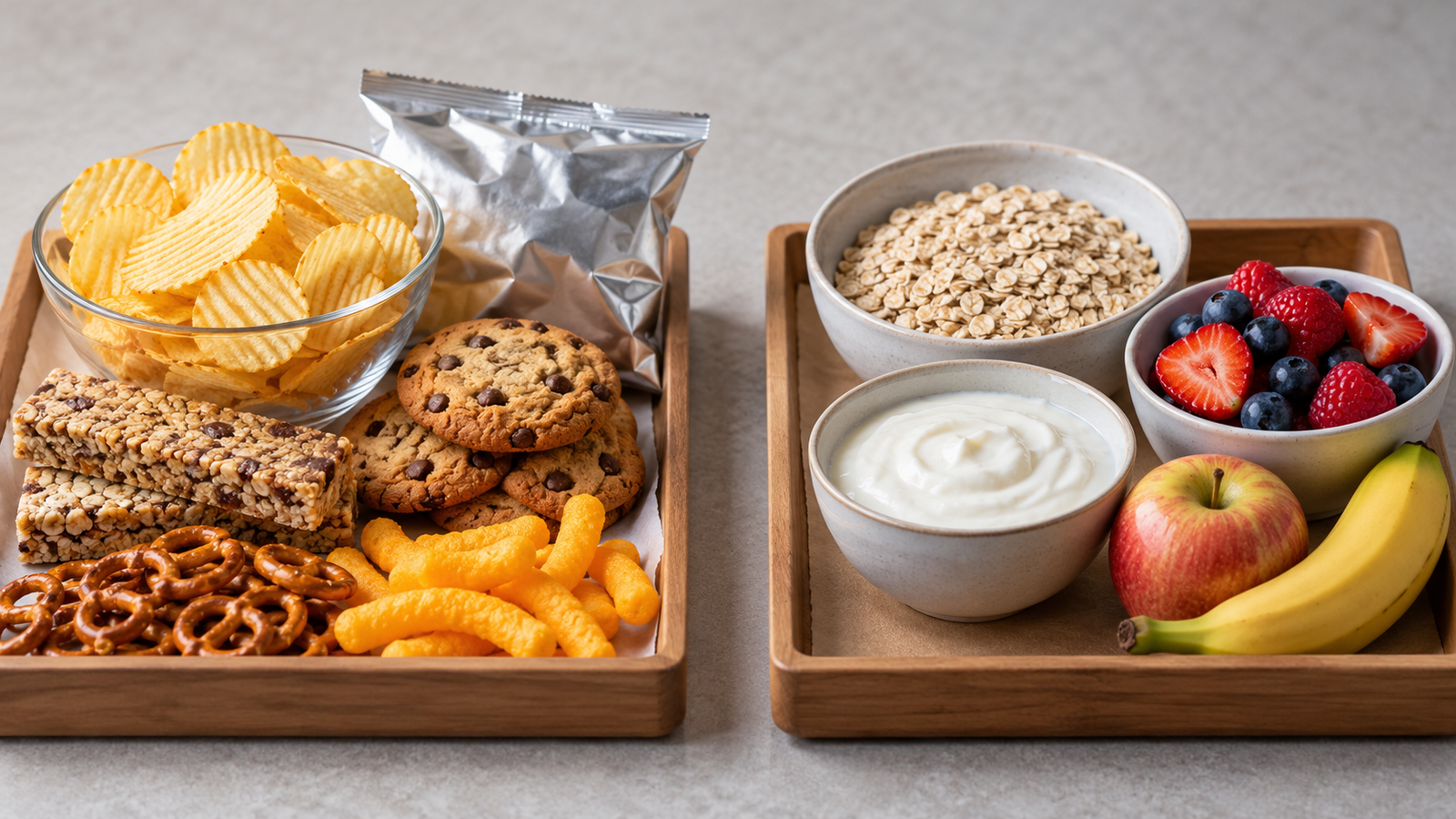
The NIH's May 16, 2019 report describes a study of 20 adult volunteers who stayed at the NIH Clinical Center for one continuous month. Participants received an ultra-processed diet and a minimally processed diet for two weeks each, in random order. They could eat as much or as little as they wanted. The diets were constructed to have comparable provided amounts of several nutritional components, while differing in the processing pattern being investigated.
This design is different from asking people to remember their usual diets and looking for associations with health. Researchers controlled the food environment and assigned the diet order. That made the comparison informative about the tested conditions. It did not make the study a complete account of lifelong eating, every possible formulation or all circumstances outside a research center. A careful summary preserves both the strength of the controlled comparison and the limits of its scope.
| Feature | Reported detail | Interpretive limit |
|---|---|---|
| Participants | 20 adults | A small study population |
| Setting | One continuous month at the NIH Clinical Center | Controlled conditions differ from daily life |
| Diet periods | Two weeks on each diet, randomized order | Short-term comparison |
| Intake difference | About 500 more calories per day on the ultra-processed diet | Average under these study conditions |
| Weight change | About 0.9 kg gained during the ultra-processed period and a similar amount lost during the other period | Not a forecast of an individual’s future weight |
Why allowing participants to choose the amount mattered
The study did not simply assign a fixed amount of food and then compare labels. Participants could choose how much to eat from what was provided. That distinction is central to interpreting the intake result. Comparable offered nutrients do not mean equal consumed quantities when people are free to eat different amounts. A summary that says the diets were identical in calories without explaining offered versus eaten food can make the experiment difficult to understand.
For an original analogy, two tables can each offer a similar amount of food while guests eat different portions. The analogy does not explain why the trial participants behaved as they did; it only clarifies the difference between what is available and what is consumed. In the actual study, the recorded intake was part of the outcome. Keeping that distinction visible prevents an apparent contradiction between the planned menus and the observed difference in consumption.
What ultra-processed meant in this report
NIH describes the study as using the NOVA classification system, which considers the nature of industrial processing and ingredients. Processing is not a single everyday action with one uniform effect. A broad category can include varied products. The tested menus therefore matter. Do not replace the study’s classification with an improvised rule such as anything in a package or anything with an unfamiliar ingredient name. That would change the question being discussed.
When reading another study, check whether it uses the same classification and how foods were assigned. Similar terminology can conceal differences in methods. A comparison across studies should preserve the definitions rather than assume that a shared headline word guarantees identical categories. This article explains one historical trial and its interpretation; it is not a complete review of later processing research or an authoritative classification of every product in a supermarket.
A causal comparison still has a defined boundary
The controlled design supports a stronger causal interpretation for the tested dietary conditions than a simple observational association would. The NIH report emphasizes that distinction. However, the intervention changed a dietary pattern, not one isolated ingredient. Identifying which properties produced the effect requires additional work. The result should not be described as proving that a particular additive alone caused the intake difference, or that every food assigned to the category would have the same effect.
The NIH account notes that researchers wanted to investigate which aspects of the foods influenced eating behavior. It also discusses possible contributions from differences such as protein levels. This is a useful example of scientific progress: demonstrating an effect under a defined comparison can be important even when the complete mechanism remains unresolved. A responsible explanation should not erase that uncertainty simply because the headline has a clear and memorable conclusion.
Short-term averages are not individual forecasts
The reported average intake and weight changes describe a small group over short periods. They do not tell a reader exactly what will happen after replacing one snack or changing one meal. Individual circumstances and the wider food environment differ. Avoid multiplying the study’s average daily calorie difference across a year and presenting the result as a personal weight prediction. That calculation would introduce assumptions the trial did not test.
Similarly, do not turn a group mean into a statement that every participant responded identically. A good summary distinguishes an average from the distribution of individual experiences when those details are available. The NIH release provides a useful institutional account, but a question requiring finer statistical interpretation should be taken to the underlying paper and its methods. The source used here is clearly identified so readers can see the level of evidence this explanation directly draws on.
Access and practicality belong in the discussion
The NIH report explicitly notes that preparing less-processed food can require more time and money and that access matters. An explanation should not convert the trial into a judgment about people’s character or effort. Real households face constraints involving income, storage, cooking facilities, disability, work and care responsibilities. A controlled research center can standardize conditions that daily life cannot. Recognizing that difference makes the finding more usable, not less scientifically important.
For an original planning example, a household might identify one convenient meal component to compare rather than attempt an unrealistic total overhaul. The comparison could include price, preparation and the current Nutrition Facts panel. That is a practical suggestion, not an intervention tested by this trial or a personal diet prescription. If a dietary change relates to a medical condition or treatment, individual advice from an appropriately qualified professional should guide the decision.
Use labels and research for different jobs
The FDA label-reading guide helps explain serving information and nutrient amounts. It cannot by itself reproduce the NIH trial’s classification or predict how much someone will eat. Conversely, the feeding trial does not replace the current label when comparing the composition of two specific foods. Each source answers a different question. Combining them responsibly means preserving those roles rather than pretending one number or category provides a complete account of nutrition.
Our suggested reading note contains the study design, participants, setting, diet definition, measured outcomes and unresolved mechanism. Add a separate line for any practical suggestion you make yourself. That separation is useful when discussing the study publicly because it shows where the evidence ends and interpretation begins. It also makes it easier to update the explanation if later research investigates a different menu, a longer period or a more diverse population.
What this trial contributes
The study’s value lies in a controlled comparison showing that the tested dietary patterns affected intake and short-term weight under the reported conditions. Its limits include the small sample, brief duration and questions about the responsible features of the foods. Those points can coexist. Scientific caution does not require pretending the result was meaningless, and enthusiasm does not justify extending it to claims the experiment did not examine.
When sharing the finding, name the year, setting and short-term design. Use the approximate numbers with their denominator and time period, and avoid promises about an individual’s outcome. A useful article leaves readers better able to understand the experiment and evaluate later evidence. It should not use a memorable trial as a shortcut to fear, blame or a product recommendation unsupported by the research being cited.
Sources and further reading
- NIH study finds heavily processed foods cause overeating and weight gain | National Institutes of Health (NIH).
- How to Understand and Use the Nutrition Facts Label | FDA.