
Why Puppies Follow Human Pointing: What Early Social-Cognition Studies Show
Key takeaways
- The large study involved young dogs from a service-dog breeding program, not a random sample of all breeds.
- Point following, looking toward a person and seeking help are different social behaviors.
- Heritability concerns variation in a studied population; it is not a genetic percentage of an individual’s behavior.
- Early success supports developmental preparedness without proving a complete absence of prior learning.
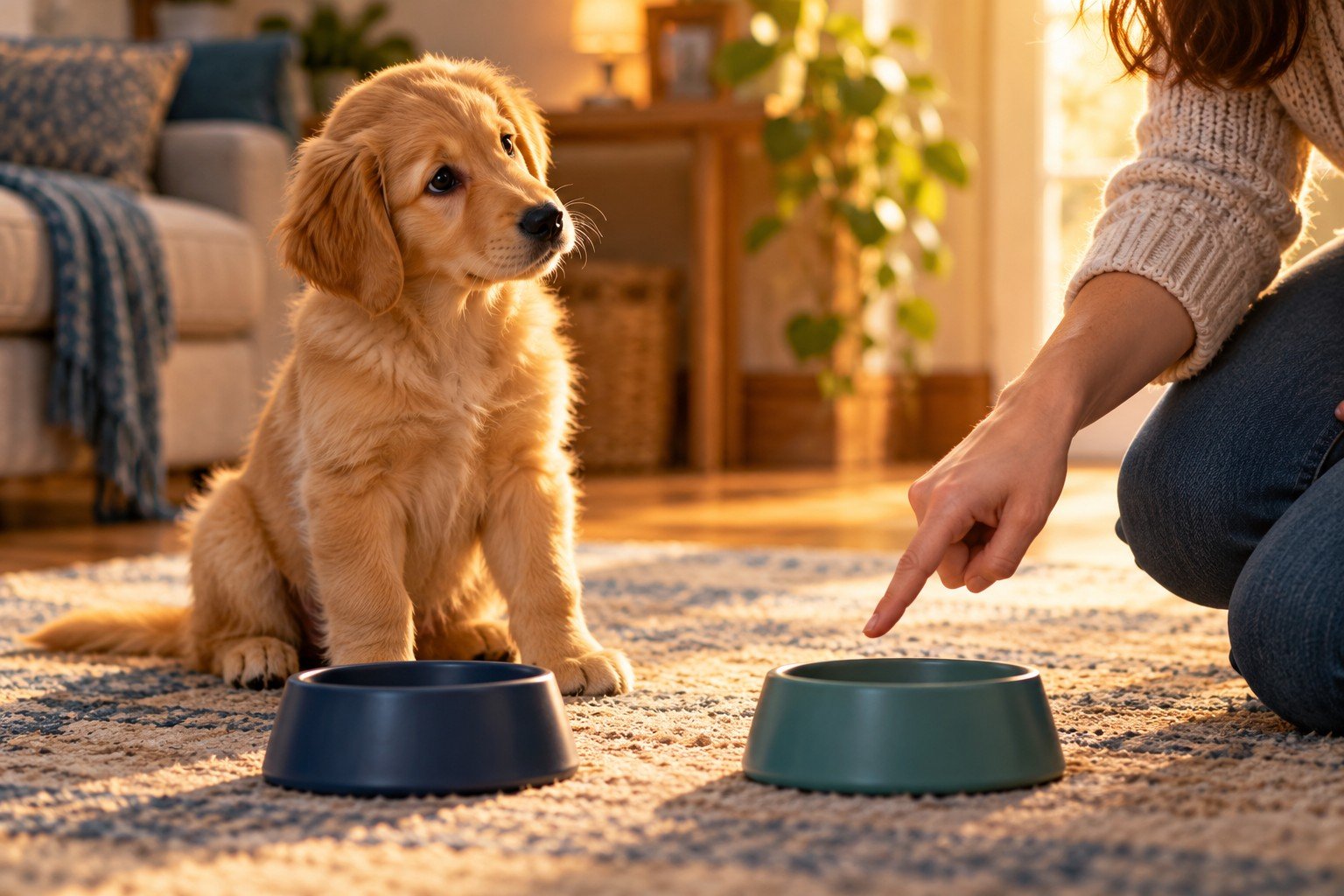
A person points beside a container, and a puppy goes to investigate. That small interaction raises a large developmental question: how does a young dog come to use a human gesture as useful information?
It is not enough to say that puppies are friendly or intelligent. An experiment needs to specify the signal, the available choices and how success changes with experience. A dog can be attracted to a person without knowing which of two locations a gesture indicates.
Research on why puppies follow human pointing combines developmental testing with comparisons among relatives and, in another study, between dog and wolf puppies. The results support early-emerging social abilities while leaving important room for learning, individual variation and careful interpretation of genetic estimates.
What the 375-puppy study asked about how puppies follow human pointing
In a 2021 study by Bray and colleagues, researchers tested 375 puppies around eight weeks old on a battery of social-cognitive measures. The question was whether sensitivity to human communication appeared early and showed variation related to genetic similarity.
Puppies used human gestures successfully, and the researchers found no evidence that this performance required learning across the task’s trials. The study also estimated that genetic factors accounted for more than forty percent of variation in point following and attention to human faces within the tested population.
The population matters. These were puppies from a service-dog breeding program with pedigree information, not a random sample representing every breed, living environment and developmental history. That design made the genetic analysis possible while setting limits on generalization.
Pedigree records let the researchers compare performance among relatives with different degrees of genetic similarity. That is the basis for estimating heritable variation here. The estimate describes these young service-dog candidates in their shared breeding and rearing context.
How puppies follow human pointing in a test
The University of Arizona research-team account describes tasks using two possible food locations. A human gesture or a marker provided information about the relevant container. Other measures examined attention to a person and behavior during a problem the puppy could not solve alone.
These tasks ask related but different questions. Following a point concerns using a directional cue. Looking toward a speaking person concerns social attention. Looking to a person during difficulty concerns seeking information or assistance under that particular arrangement.
An account that merges all three into puppies understand humans loses the experimental detail. A young animal might perform well on one measure and differently on another. The battery makes it possible to examine that structure rather than assume one broad ability.
The direction and form of a gesture also matter. Pointing toward a nearby container is not equivalent to giving a distant instruction in a noisy park. The study identifies an early capacity in controlled tasks; broader everyday use remains a separate practical problem.
Early performance does not mean no experience
The phrase no evidence of learning across trials addresses a specified explanation: that the puppies initially failed and acquired the correct response through practice within the test. It does not erase every interaction they had experienced before testing.
Biological preparedness and learning are compatible. A developing animal can be particularly ready to attend to certain information while still being shaped by its environment. Treating the two as mutually exclusive makes the evidence less accurate, not more decisive.
Eight weeks is early in a dog’s life, but it is not the instant of birth. A result at that age cannot, by itself, establish what an animal knew on its first day. Developmental claims should retain the age at which the behavior was actually measured.
For owners, this means an early response is worth noticing without becoming a reason to skip patient interaction or expect flawless performance. A research finding about a group is not a promise about what every young pet will do in a changed setting.
What heritability does and does not mean when puppies follow human pointing
Heritability is a population-level description of variation under a particular set of conditions. It concerns how differences among individuals are statistically related to genetic differences in that population. It is not the fraction of one puppy’s action that was caused by genes.
If a study attributes substantial variation to genetic factors, that does not imply that the behavior cannot change. Nor does it mean that the remaining variation can all be assigned to one environmental influence. Different environments and samples can change the estimate.
This distinction prevents a common error: describing a puppy as forty percent genetically programmed to understand people. The study did not divide an individual mind into genetic and learned portions. Its analysis addressed differences among related animals.
The estimate also concerns specified measures. It should not be extended to intelligence, affection, trainability in every setting or suitability for a particular household without evidence for those outcomes. A useful genetic result becomes misleading when its label expands beyond the trait tested.
What dog–wolf comparisons add
A 2021 study by Salomons and colleagues compared forty-four dog puppies and thirty-seven wolf puppies between five and eighteen weeks old. Dog puppies were more attracted to humans, followed human gestures more skillfully and made more eye contact in the tested tasks.
The dog–wolf sample included several tasks; the gesture comparisons involved thirty-one dog puppies and twenty-six wolf puppies. Both groups followed pointing above chance on average, but dogs performed better. Wolf puppies were not above chance on the separate marker task. The result is a difference in performance, rather than an absence of all gesture use in wolves.
The wolf puppies received intensive human care from around ten or eleven days old, including hand feeding and overnight contact. The assistance-dog puppies generally had less early human contact. This makes a simple explanation based on wolves having no human experience unlikely, although species and rearing histories were not experimentally interchangeable.
Human-directed tasks measure a particular social skill. The species performed similarly on the study’s nonsocial memory and inhibitory-control tasks, so the findings do not establish a ranking of overall intelligence.
Keep the behavioral measures separate when puppies follow human pointing
| Measure | Question it addresses | Conclusion requiring additional evidence |
|---|---|---|
| Following a point | Can the puppy use this directional cue? | Understanding every human intention |
| Attention to a speaking person | How strongly does the animal orient socially? | A complete measure of attachment |
| Looking toward a person during difficulty | Does the animal seek social information here? | General dependence or independence |
| Similarity among relatives | Is variation associated with genetic relatedness? | A fixed genetic percentage for one puppy |
A puppy can be quick to follow a nearby point yet less inclined to look back when a container will not open. Those outcomes need not conflict: choosing a location and turning to a person during difficulty place different demands on attention and experience.
What it suggests about canine cognition when puppies follow human pointing
The studies support investigating human communication as an important part of the dog’s developmental environment. Early sensitivity can help make cooperation possible, but the measured behavior still emerges from an animal in a particular situation.
The research does not identify one neuron or gene that makes a puppy understand pointing. A pedigree-based estimate is different from locating a causal genetic variant, and both differ from establishing a full neural mechanism.
Our article on dog responses to human faces discusses another level of evidence. A brain response to a face and a puppy’s choice after a gesture can inform a broader research program without becoming interchangeable tests.
The comparative contribution is therefore specific: some social information can guide behavior very early, and individuals vary in how strongly they use it. Explaining that variation is more productive than describing every dog as naturally able to read minds.
How owners can tell whether puppies follow human pointing
When you notice a response to a gesture, describe the situation. Was the object close to your hand? Had the dog already seen where it was placed? Did you also look, move or speak in that direction? Several cues may be available at once.
A home observation can show that a particular interaction works for your pet. It does not isolate the mechanism or provide a standardized comparison with the research sample. A successful moment is useful without being an intelligence test.
Likewise, an unsuccessful response is not a reason to label a puppy unintelligent. Attention, motivation and familiarity can all affect what an animal does. The study’s result should encourage clearer expectations rather than a demand that every young dog perform on cue.
The takeaway is to treat an early response as a starting point for communication. A clear gesture in a quiet setting may be easier to follow than several competing cues. The studies explain why cooperation can emerge early, while leaving room for the individual puppy’s development.
Common questions about puppy pointing
Are puppies born understanding people?
The study found early performance at around eight weeks. That supports developmental preparedness, not a direct test at birth or complete comprehension of human communication.
Does heritability mean training cannot help?
No. Heritability describes variation in a population under particular conditions. It does not establish that a behavior is unchangeable in an individual.
Are dogs smarter than wolves?
The comparison concerned human-directed social tasks. It does not supply a single ranking of every cognitive ability in either species.
Can one pointing test predict my puppy’s future?
These findings do not validate a one-trial forecast of behavior, suitability or relationship quality. A brief response should be interpreted within the animal’s development and everyday circumstances.
Sources and further reading
- Bray et al., 2021: early-emerging sensitivity to human communication
- University of Arizona research team: puppy tasks and pedigree context
- Salomons et al., 2021: dog and wolf puppy comparison