
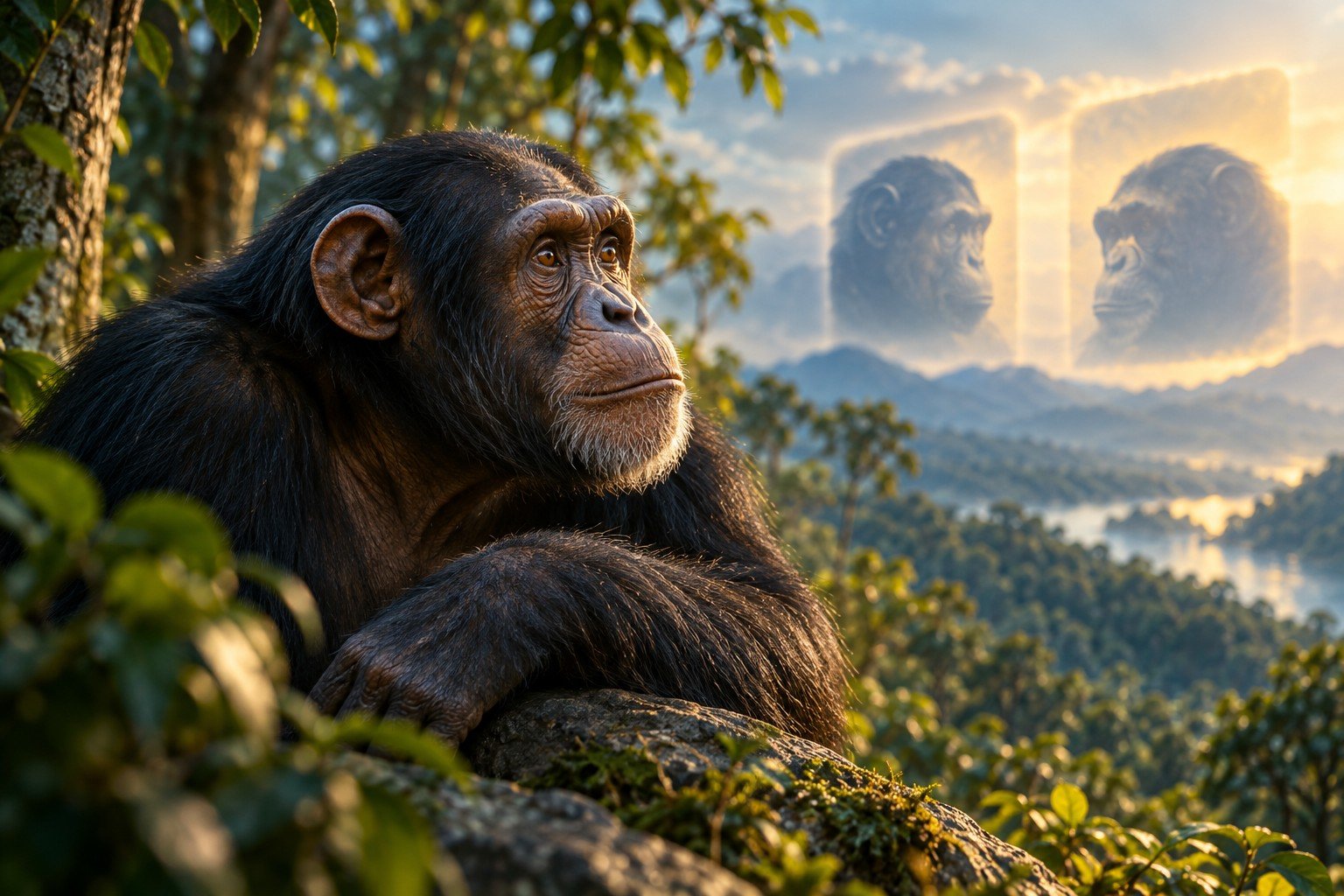
Ape Social Memory: How Chimpanzees and Bonobos Recognize Long-Lost Groupmates
Key takeaways
- The study measured visual attention, rather than asking apes to describe memories.
- The combined sample was twenty-six apes; looking biases differed across research sites.
- The longest separation case is not the typical separation for every participant.
- Remembering an individual and consciously reliving a shared event are different claims.
A familiar face can matter long after the last meeting. For a person, recognition might be accompanied by a name, a remembered conversation or a feeling about the relationship. Studying the corresponding ability in another ape requires a method that does not depend on a verbal report.
Ape social memory research uses observable choices and attention to ask what remains recognizable across time. In a 2023 experiment, scientists presented chimpanzees and bonobos with photographs of former groupmates and strangers. Eye tracking supplied a way to compare attention without requiring a spoken answer.
The result supports unusually durable social recognition. Its value becomes clearer when the sample, comparison and interpretation are kept separate. A longer gaze can be evidence of recognition without becoming a complete transcript of what the animal remembers.
What the twenty-six-ape experiment tested about ape social memory
The 2023 study by Lewis and colleagues tested twenty-six chimpanzees and bonobos across four populations in three countries. The combined sample included both species, and fifteen participants were female. The task compared side-by-side images of a former groupmate and an unfamiliar same-sex individual.
Researchers measured where participants looked. The apes showed an attentional bias toward former groupmates, providing evidence of recognition across long separations. The result concerned a defined photo-viewing task rather than an actual reunion.
The population result needs context: clear looking biases were concentrated in the more research-experienced Kumamoto groups, rather than equally strong at every site. Screen familiarity and testing conditions are plausible contributors, so the combined finding should not be described as uniform behavior across all participants.
The experiment’s central strength is the comparison between known social history and an unfamiliar face. That arrangement connects a present response to a past relationship more directly than an anecdote about an animal seeming pleased to see someone.
How eye tracking measures ape social memory
An eye tracker estimates where a participant is looking over time. In a preferential-looking design, the relevant outcome is how attention is distributed between the displayed alternatives. Researchers can compare that outcome with a prediction based on prior familiarity.
This is different from training an animal to press a particular button for a reward after recognizing a face. It also differs from treating a human observer’s impression of excitement as the main measure. The method creates a specified, quantifiable response.
However, looking time is an indirect measure. The study counterbalanced image positions and controlled image properties and identities. Some analyses excluded trials in which an ape looked at only one image, so interpreting the result also requires attention to engagement and trial selection.
The trials lasted three seconds. A short difference in fixation time is a measurable recognition-related response, not evidence that an animal spent the session intentionally recalling its entire relationship. The method’s precision concerns where attention was directed; the remembered content remains less accessible.
What the longest separation case means
The Johns Hopkins research-team account describes separation histories ranging from at least nine months to as long as twenty-six years. The exceptional long interval involved a bonobo viewing images of relatives she had not seen for that period.
That example shows why the study attracted attention, but it should not replace the distribution of experiences across participants. A maximum is not an average. It does not mean every participant had been separated from every pictured individual for twenty-six years.
The analysis of separation duration among nonrelatives covered intervals up to about nine and a half years. The twenty-six-year case involved relatives and therefore belongs to a different comparison. Neither result identifies a maximum possible memory duration.
When a headline highlights decades, check whether the statement concerns an individual case, a group-level pattern or an estimate of a typical duration. All three could be scientifically meaningful, but they answer different questions and should not be substituted for one another.
Ape social memory is more than visual familiarity
The Berkeley research-team account explains that pictured former companions had lived with participants for at least a year. Relationship quality was rated retrospectively by knowledgeable caretakers and researchers who were blind to gaze data. The relationship–attention association was weak in the main analysis and clearer in an exploratory analysis of more attentive trials.
That context matters because a familiar face can belong to an individual with a rich interaction history. A study of former companions is different from a test of recognizing a picture briefly encountered during a training session.
At the same time, a documented relationship does not allow scientists to read a participant’s exact feeling during the test. A gaze measure cannot, by itself, distinguish every possible mixture of recognition, interest, affection or other social response.
It is reasonable to describe the result as evidence that social history can remain behaviorally relevant. A stronger claim that an ape consciously felt nostalgia would require evidence addressing that particular experience. Human emotion words should not quietly become additional experimental measurements.
Recognition is different from episodic recollection
Recognizing an individual means identifying some continuity between the present stimulus and previous experience. Remembering a particular shared event adds details about what happened and its context. These are related but distinguishable cognitive claims.
The photograph task did not ask which activity the two animals once performed together or when a particular encounter occurred. A successful recognition interpretation therefore does not establish a complete autobiographical account of the relationship.
Our article on cuttlefish memory examines a different experimental question: using food, place and timing information. Comparing the studies is useful because it shows how the design determines which aspect of memory can be assessed.
Neither task should be inflated into a universal memory score. A species could perform well on one kind of problem and face different demands in another. The meaningful comparison concerns the information used and the conditions under which it guides behavior.
Read the ape social memory sample at the right level
Each participant can view several image pairs or contribute several looking-time measurements. Those observations help characterize an individual’s response. They do not turn that participant into several independently sampled apes.
Similarly, a pictured former companion is a stimulus with a particular history, not an additional participant whose memory was tested. A clear account distinguishes the animals doing the looking from the individuals represented in the photographs.
| Number or observation | What it represents | What it does not represent |
|---|---|---|
| Twenty-six participating apes | Combined tested sample | Twenty-six animals of each species |
| Multiple viewing trials | Repeated observations of attention | A new ape in every trial |
| A twenty-six-year separation | An exceptional documented interval | The average interval for all participants |
| Longer looking at a former groupmate | Evidence supporting recognition | A verbal report of a remembered event |
This distinction is especially important when a striking case is embedded within a broader study. Both the individual history and the overall pattern can matter. Neither should be used to disguise uncertainty in the other.
What the findings suggest about evolution
Long-lasting recognition in our close relatives makes a comparative question possible: which features of social memory were present in shared evolutionary history, and which developed differently? The study supplies evidence relevant to that question without reconstructing every step of the past.
A living chimpanzee or bonobo is not a preserved human ancestor. Similarities can inform hypotheses about common ancestry, but present-day species have their own histories. A careful account avoids describing one as an earlier, incomplete version of the other.
The experiment also does not identify a complete neural circuit for long-term face memory. Eye tracking measures an output of perception and cognition. Connecting that output to a mechanism would require additional neural evidence and appropriate comparisons.
That is why a behavioral finding remains useful even without a brain-scan image. It defines a capacity that a mechanistic study can then try to explain. The experimental sequence begins with a well-specified phenomenon rather than a broad assumption about what an ape must remember.
What ape social memory research cannot promise people
The research does not test a memory supplement, face-training application or treatment for memory loss. A commercial claim based on this experiment would still need evidence that the actual product improves a relevant human outcome.
It also cannot tell a reader whether a forgotten acquaintance indicates a medical problem. Human recognition depends on circumstances that this animal experiment was not designed to evaluate. A comparative result should not become an individual diagnosis.
The useful everyday lesson is about evidence: a familiar face can be investigated through a clear response and a documented history. The next question should identify what new measurement would distinguish competing explanations, rather than assume the most emotionally appealing one is already proved.
Common questions about ape social memory
Did the apes remember old friends for decades?
The findings support recognition of former groupmates across long separations, including an exceptional decades-long case. They do not show that every participant retained every relationship for the same length of time.
Did researchers reunite the animals?
The reported recognition task used photographs and eye tracking. Viewing a picture and meeting a former companion are different events with different behavioral demands.
Does longer looking prove affection?
No. Attention is the measured response. Relationship history can help interpret it, but a gaze duration does not provide a complete report of emotion or conscious experience.
Was this a new 2026 study?
No. The paper discussed here was published in 2023. This article explains its methods and implications without presenting the research as a newly completed experiment.
Sources and further reading
- Lewis et al., 2023: familiar-conspecific memory experiment
- Johns Hopkins research team: study design and separation histories
- Berkeley research team: familiar faces and gaze measurements