Closed-Loop Sleep Sounds: What Slow-Wave Stimulation Studies Show About Memory
Key takeaways
- Closed-loop refers to measurement and timing, not merely a particular sound color.
- A larger slow-wave response and better memory are separate outcomes.
- Positive word-recall results do not establish a universal boost to every kind of learning.
- Sleep continuity and real-world usability belong beside any claimed benefit.
A sound played during sleep seems an unlikely memory aid. Yet the timing of a brief sound can be used to investigate how sleeping brain rhythms relate to later recall. The interesting element is not a magical recording; it is the relationship between a measured signal and a precisely timed intervention.
Closed-loop sleep sounds research has produced both promising results and important failures to improve performance. Reading those findings together helps distinguish a research method from a consumer promise.
The key questions are simple: what was measured, how was the sound timed, which memory task was tested and did the intervention preserve sleep? Each question changes what a result can mean.
What makes a system closed-loop?
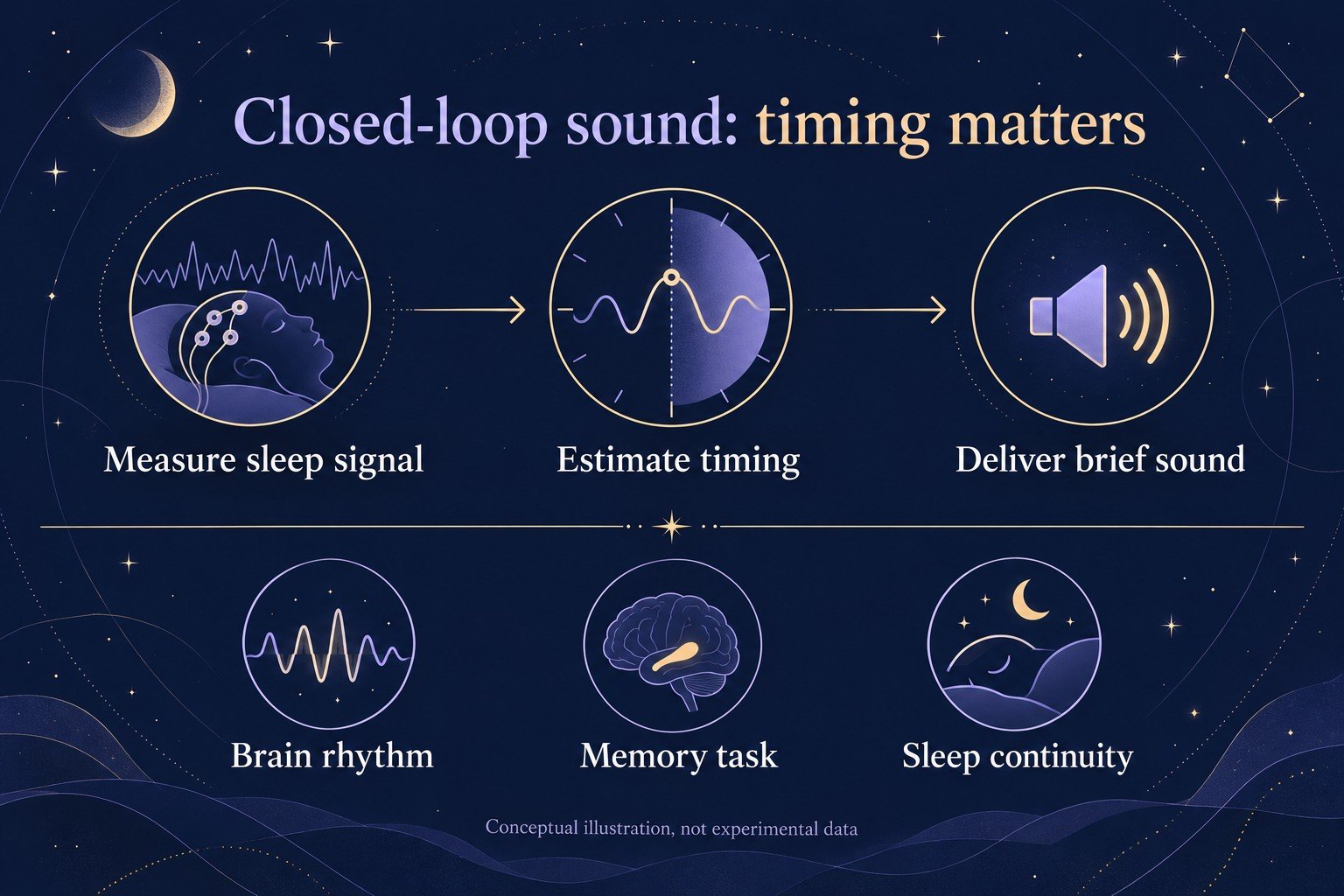
A closed-loop system uses ongoing information to guide its next action. In these sleep studies, an algorithm analyzes an EEG signal, estimates the timing of a slow oscillation and schedules a brief sound in relation to that estimate.
The feedback is the defining feature. A recording that plays at fixed intervals does not become closed-loop merely because the sounds are brief. Likewise, a soothing soundtrack does not establish that it measures an individual’s sleep phase.
The measured signal and the delivered sound also have different roles. The EEG supplies information used by the algorithm; the sound is the intervention. A product description should explain both rather than replacing the process with an attractive waveform animation.
This is a conceptual explanation, not a home timing protocol. The studies used defined equipment and monitoring arrangements that a generic audio file does not reproduce.
A foundational experiment showed timing mattered
Ngo and colleagues’ 2013 study delivered auditory stimulation in relation to ongoing slow oscillations during sleep. Sounds timed in phase with the oscillation enhanced the rhythm and phase-coupled spindle activity, alongside improved consolidation of declarative memory.
Stimulation out of phase did not produce the same effect. This comparison is central to the interpretation. It suggests that the relationship to the ongoing rhythm mattered, rather than establishing that any quiet noise during sleep improves recall.
Declarative memory concerns information such as material a person can deliberately recall. The study’s result does not automatically extend to every skill or form of learning. The outcome should remain attached to the task used to measure it.
The experiment provides a way to manipulate sleep-related physiology and test its functional relevance. It does not show that a person can absorb entirely new lessons from an ordinary overnight recording.
What an older-adult study actually measured
Papalambros and colleagues’ 2017 experiment included thirteen healthy adults aged sixty to eighty-four. Each completed a stimulation night and a sham night in randomized order. An algorithm used EEG to predict slow-wave timing and deliver pulses of pink noise.
Slow-wave activity and spindle activity increased during stimulation intervals relative to matched periods of the sham night. However, slow-wave activity averaged across the entire sleep period was similar between conditions.
Participants also completed a verbal paired-associate task before and after sleep. Overnight improvement in word recall was greater after stimulation, and the improvement was associated with a particular measure of slow-wave change.
This is a positive result in a small, defined sample. It does not establish that the participants obtained more deep sleep overall, that dementia was prevented or that every older adult would benefit from a retail device.
Why an interval effect is not a whole-night verdict
An effect during a selected stimulation interval answers a different question from an effect across the whole night. Averaging can combine periods with different responses, while a local response may leave a broader measure unchanged.
The 2017 findings make that distinction concrete. A description saying the intervention increased all-night deep sleep would go beyond the reported comparison. The correct account identifies the interval and the physiological measure.
The same care applies to a consumer sleep score. A single number can hide the separate contributions of measurement, processing and interpretation. Its presence does not establish that the system reproduced the timing or outcome of a laboratory experiment.
Our adult neuroplasticity guide discusses why a biological process can be real without validating every intervention marketed around it.
A motor-memory study found a different outcome
Baxter and colleagues’ 2023 study tested closed-loop stimulation during afternoon naps in twenty healthy young adults. Participants trained on a motor-sequence task before sleeping and were tested afterward.
The stimulation evoked slow oscillations, spindles and coupled events, but it also disrupted sleep. Despite the physiological effects, it did not improve motor procedural memory beyond the comparison condition. Participants improved after the naps to a similar degree across conditions.
The authors discussed possible ways to refine sound calibration and timing. Those proposals are future research directions, not proof that the negative performance result has already been solved.
The study illustrates an essential distinction: causing a measurable rhythm change does not guarantee that the relevant learning outcome improves. It also shows why sleep continuity is an outcome to protect, not an inconvenience to omit from the headline.
Memory is not one interchangeable endpoint
Word-pair recall and a practiced finger sequence test different abilities. A benefit for one does not automatically predict a benefit for the other. Differences in age, sleep opportunity and protocol can also affect how studies should be compared.
These studies are therefore not best understood as one simple contest in which a positive paper defeats a null paper. They test related questions under different conditions and help define where an intervention might or might not work.
For the individual reader, the practical outcome is more specific than boosting memory. Is the goal retention of studied vocabulary, performance of a trained sequence or better functioning during an ordinary day? Evidence should match the goal.
Our correlation and causation article explains why an association between a physiological measure and performance does not automatically identify the entire causal pathway.
Read a sleep-sound claim in four parts
| Part of the claim | Question to ask | Common overreach |
|---|---|---|
| Measurement | What ongoing sleep signal is recorded? | Assuming a soundtrack detects brain state |
| Timing | How does the algorithm use that signal? | Calling fixed playback closed-loop |
| Physiology | Which interval and rhythm changed? | Describing every change as more deep sleep |
| Benefit | Which task improved relative to comparison? | Promising general memory enhancement |
Add a fifth practical question: what happened to awakenings and sleep continuity? A favorable rhythm response does not make a disrupted night irrelevant. Both findings belong in an assessment.
The table is an evaluation framework, not a ranking of products. The cited papers did not test every current headband, subscription or sleep speaker, and Science Chronicle has not performed hands-on product testing for this article.
Pink noise alone does not establish equivalence
The older-adult study used pink-noise pulses within a specific measurement-and-timing procedure. A recording with the same sound label supplies only one component of that intervention.
Before spending money, ask whether the actual device was tested, which software version was used and what the comparison received. Request a result for the promised outcome rather than a general citation about sleep and memory.
Usability also matters: comfortable wear, understandable controls, privacy, maintenance and ongoing costs can affect whether a system fits a routine. These are separate considerations from whether its scientific claims are supported.
Persistent poor sleep, troublesome daytime sleepiness or suspected sleep-disordered breathing warrant appropriate assessment. A memory-oriented audio experiment should not substitute for identifying why sleep is impaired.
Common questions about closed-loop sleep audio
Is an ordinary pink-noise playlist the same technique?
No. The defining intervention in these studies included ongoing measurement and responsive timing. A fixed recording does not supply that feedback loop.
Does a bigger slow wave prove better memory?
No. The motor-memory experiment changed oscillatory activity without an added performance benefit. The memory outcome must be measured separately.
What is the most defensible takeaway?
Precisely timed sound is a useful research tool with promising, task-specific findings. Its practical value depends on reliable measurement, suitable timing, preserved sleep and replicated benefits for the outcome a user actually wants.
Sources and further reading
- Ngo et al., 2013: phase-specific auditory sleep stimulation
- Papalambros et al., 2017: older-adult word-recall experiment
- Baxter et al., 2023: sleep physiology without improved motor memory