
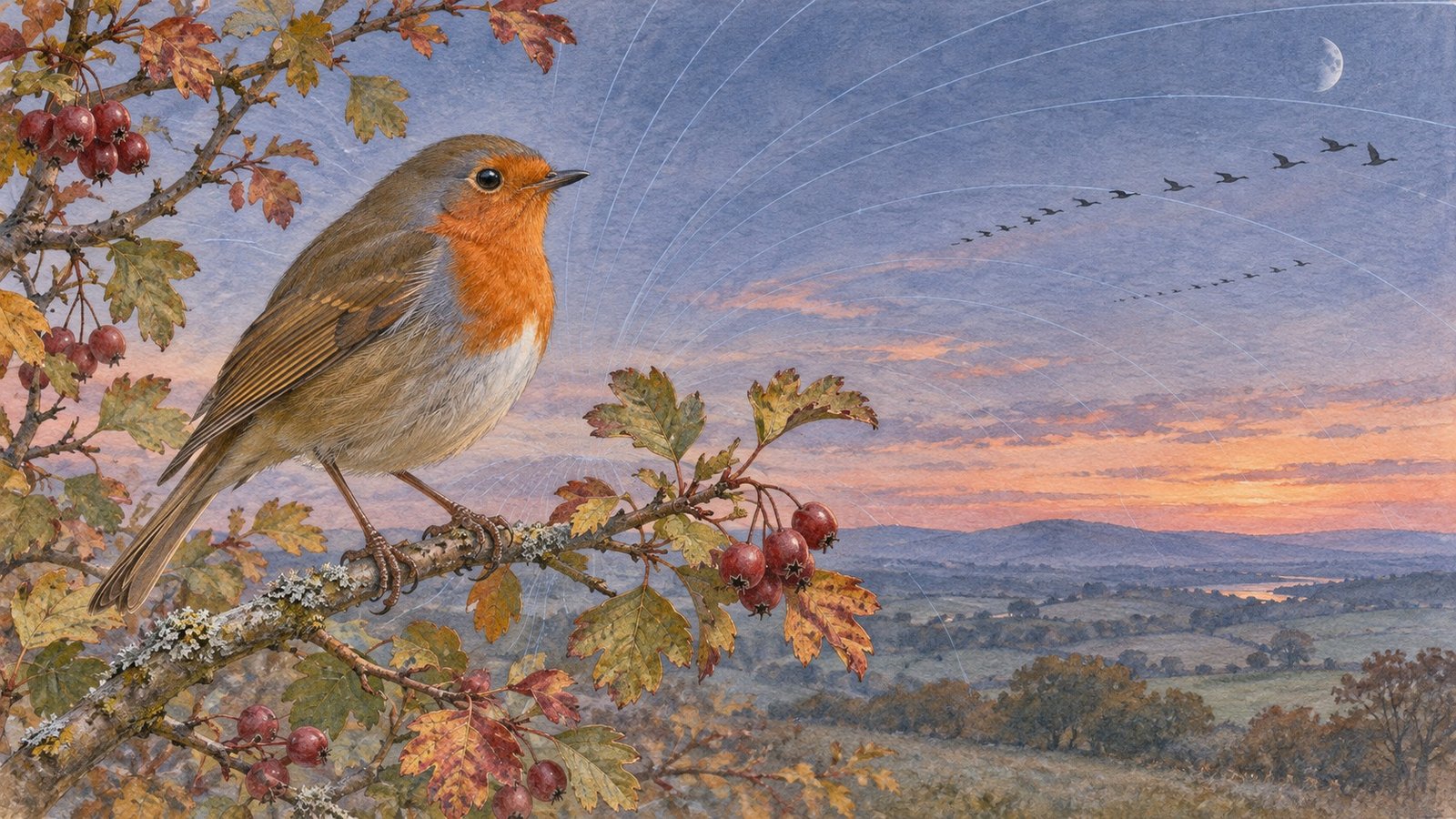
Migratory Birds and Magnetoreception: What Cryptochrome Experiments Actually Show
Key takeaways
- Cryptochrome 4 is a candidate involved in a proposed light-dependent magnetic mechanism.
- Magnetic effects in a purified protein are different from navigation in a living bird.
- A robin brain-region experiment supports a visual pathway for compass orientation.
- Quantum magnetoreception does not mean birds possess a biological GPS screen.
A small songbird crossing unfamiliar terrain raises a large question: what information lets it keep an appropriate direction? The word quantum can make the answer sound like a finished explanation. The actual research is more interesting because it connects chemistry, sensory processing and behavior while leaving important links open.
This article examines magnetic-compass evidence, particularly work involving European robins. It does not treat every migratory species as using an identical system. Nor does it turn one sensory mechanism into a complete explanation of departure timing, route choice or arrival at a breeding site.
Begin with the question the experiment asks
A compass provides directional information. A map concerns position. Successful navigation can require information about both, together with decisions about where and when to move. Calling a mechanism a compass is therefore a meaningful limit, rather than a modest synonym for knowing the whole route.
For a familiar comparison, a handheld compass can indicate an orientation without telling its user which town they are in. That analogy helps separate questions, but it does not imply that a bird experiences a needle or reads a human map. The animal’s sensory experience remains a different subject.
When reading a migration headline, ask which outcome was measured. Was it a chemical reaction, a bird’s preferred orientation in a test, a brain response or an observed journey? Evidence at one level can inform another without directly measuring it.
What a radical pair means
A radical pair consists of two radicals whose electron-spin states can influence their chemical behavior. In the proposed compass mechanism, light initiates reactions involving cryptochrome, and magnetic conditions affect the reaction pathway. The hypothesis connects an environmental field with a potentially usable biochemical signal.
This is a claim about particular physical and chemical processes. It is not a claim that the bird consciously performs quantum calculations. Terms such as spin and quantum describe the proposed mechanism; they do not imply unusual intelligence, awareness of physics or access to supernatural information.
An explanation should also keep its arrows visible. A magnetic effect on a reaction would need to influence an appropriate biological signal, be processed by the nervous system and support orientation. Showing one arrow does not, by itself, demonstrate every later step.
What the cryptochrome 4 experiment found
Xu and colleagues' 2021 study reported magnetic sensitivity in the photochemistry of cryptochrome 4 from the European robin under in-vitro conditions. Robin CRY4 showed greater sensitivity than the compared chicken and pigeon proteins. Mutations helped investigate the contributions of successive radical pairs.
The essential phrase is in vitro: the experiment examined protein behavior outside the intact animal. It provided molecular evidence relevant to a candidate mechanism. It did not record a robin’s entire sensory pathway during migration or establish how a magnetic signal appears in its experience.
The comparison also concerns the tested proteins and conditions. It should not become a universal ranking of navigational ability across birds. A difference in one protein experiment cannot summarize all the cues, life histories and behaviors of the species compared.
What the brain-pathway experiment added
Zapka and colleagues' 2009 European robin study examined a forebrain region called cluster N. Birds with bilateral lesions there lost oriented magnetic-compass behavior while retaining sun- and star-compass orientation. Cutting the ophthalmic branch of the trigeminal nerve did not remove magnetic-compass orientation in the reported experiments.
Those results support a role for a visual-processing pathway in this species’ magnetic compass. They do not identify CRY4 as the necessary receptor. The experiments address a different link in the chain from a purified-protein measurement, and neither should be presented as a substitute for the other.
The distinction also prevents an overbroad conclusion that the trigeminal system has no magnetic role in any animal or context. The measured question was compass orientation in European robins under the study’s conditions, rather than every possible component of magnetic navigation.
Why two compatible findings are not a completed mechanism
It is reasonable to investigate how the molecular and behavioral findings fit together. It is less reasonable to remove the uncertainty simply because the studies point in compatible directions. A complete causal account needs evidence that the proposed parts interact in the relevant living system.
Consider a hypothetical investigation with three findings: a sensor responds in a laboratory, a brain region contributes to behavior, and the animal changes its orientation under a manipulation. These observations create a productive research program. They do not automatically prove that this sensor is the unique source of the behavior.
The practical reading rule is to distinguish consistency from identification. A result can be consistent with a hypothesis while alternatives or missing connections remain. That is not an argument against the research. It describes why the next experiment matters.
What evolutionary comparisons can contribute
A 2024 study of cryptochrome evolution investigated patterns of adaptation and loss of a putative magnetoreceptor in passerines. Such comparisons provide another way to examine whether a proposed component fits the diversity of birds, rather than assuming that one mechanism must be universal.
Evolutionary evidence does not directly show a particular bird choosing a direction. It can help test the plausibility and distribution of a candidate mechanism. That contribution should be described separately from chemical measurements and orientation experiments.
For a reader, the question is whether a paper concerns a protein sequence, expression, molecular behavior or animal performance. A broad phrase such as scientists found the navigation gene can blur these categories and imply a level of certainty the measurement does not supply.
A compact evidence map
| Evidence type | What it can address | A claim that needs more evidence |
|---|---|---|
| Protein photochemistry | Magnetic effects on a candidate molecule | The molecule directs a living bird’s route |
| Neural intervention | A pathway’s contribution to a tested behavior | The identity of the complete receptor system |
| Orientation behavior | Direction choice under defined conditions | A full account of geographic navigation |
| Evolutionary comparison | Distribution and history of a candidate | Direct proof of its role in every species |
Use this table to place a finding, not to reduce research to a simple hierarchy. Different experiments can resolve different uncertainties. The strongest account connects them without pretending that their measurements are identical.
Can birds see magnetic fields?
The phrase can be a useful shorthand for a proposed vision-linked compass, but it invites an unsupported picture of luminous field lines floating across the landscape. The experiments discussed here do not reveal the exact subjective appearance of magnetic information to a bird.
A conceptual illustration may use curved lines to help a reader imagine the field. Those lines should not be mistaken for a photograph of the animal’s perception. A visualization communicates an idea; it is not an observation of what the bird sees.
This boundary matters because an appealing image can become more memorable than the study design. Keep the measured outcome beside the metaphor. It is possible to explain a difficult mechanism vividly while retaining uncertainty about sensory experience.
What the evidence means for a birdwatcher
You can observe a species, its location, direction of movement and surrounding conditions without inferring its internal compass mechanism from that sighting. A robin turning on a branch is not an experiment distinguishing magnetic information from other cues.
For an observation notebook, record the species identification, date, place, behavior and uncertainty. Separate what you saw from your interpretation. If you did not observe sustained travel, avoid labeling a short movement a migration route simply because the season seems appropriate.
Choose binoculars, a field guide or a recording app for the observation task you actually have. A product does not become more useful because its marketing mentions quantum navigation. Check practical specifications, access needs, costs and privacy settings on their own terms.
Our animal-behavior coverage of corvid experiments offers a related reading lesson: a carefully designed task can reveal something important while leaving wider claims about an animal’s abilities unresolved. The same discipline applies to a compass experiment.
Questions for the next magnetoreception headline
Start by identifying the species and whether the study used an intact animal. Then write down the manipulation and the measured outcome. Those details often reveal that a headline about migration is actually reporting protein chemistry or a constrained orientation test.
Next, ask what new connection was established. Did the work identify a candidate, demonstrate a response, test necessity or explain how information reaches a later stage? Progress can take any of these forms, but the words should match the contribution.
Finally, keep the paper’s date and scope attached to its result. A useful historical experiment remains useful without being presented as the latest or final answer. Magnetoreception is a compelling research subject precisely because it invites tests across several levels of explanation.
Frequently asked questions
Has CRY4 been proved to be a complete navigation system?
No. The protein study supplies molecular evidence relevant to a candidate compass mechanism. A complete navigation account would require further connections to sensory processing and behavior in living animals.
Does quantum mean the bird consciously calculates a route?
No. It refers to the physical description of the proposed chemical mechanism. It does not establish a conscious calculation, an unusual mental state or a literal geographic display.
Can one observation tell me which cue a bird used?
Usually the observation alone cannot isolate a mechanism. A claim about the cue responsible requires a design that distinguishes it from alternatives, rather than a plausible story added after the sighting.