Ketones and Brain Energy: What Human Memory Studies Actually Show
Key takeaways
- Beta-hydroxybutyrate is a ketone body, not a direct score of cognitive performance.
- A rise in circulating ketones and an improvement in everyday function are different outcomes.
- Promising cognitive-impairment trials do not automatically apply to healthy buyers or different formulations.
- Major dietary changes and metabolic conditions warrant individualized professional guidance.
A product described as brain fuel offers an appealingly simple story: deliver more of the right molecule and think more clearly. Biology and clinical evidence are more demanding. A substance being available for energy use does not establish that adding it improves the task you care about.
Ketones and brain energy are a genuine research subject. The useful way to approach it is to distinguish a metabolic mechanism, a measured change in the body and a meaningful human outcome. That separation makes promising findings easier to appreciate without turning them into a universal purchase recommendation.
This article focuses on human cognition studies and how to interpret the options. It does not supply a ketogenic diet prescription or a ketone target to pursue at home.
What ketone bodies are
Ketone bodies include beta-hydroxybutyrate, often abbreviated BHB, and acetoacetate. They participate in energy metabolism and can provide an alternative substrate for the brain. Researchers investigate whether this property could help under conditions associated with impaired glucose metabolism.
Alternative does not mean universally superior. A person’s nutritional needs, clinical condition and the intervention being considered all matter. The phrase brain fuel should begin a question about outcomes rather than end the evaluation.
Our cognitive reserve guide discusses brain health more broadly. A metabolic measurement should not be treated as a complete account of that larger picture.
Compare diets, MCT preparations and exogenous ketones
A ketogenic dietary intervention changes the overall eating pattern. Medium-chain triglycerides, or MCTs, can be used in preparations designed to increase ketone production. Exogenous ketone products supply ketones or precursors through a different route. These approaches should not share evidence merely because all mention BHB.
Compare the actual intervention in a paper with the product under consideration. Was it a calorie-matched drink, an infusion or a supported dietary program? What else changed? Did participants receive monitoring or help that a retail customer would not receive?
The distinction is practical as well as scientific. A diet affects shopping and meals. A drink can add cost, calories or tolerability problems. A trial’s instructions are not a general invitation to copy its intake without considering the person’s health and treatment plan.
What the six-month MCT trial found
The BENEFIC randomized trial compared a ketogenic MCT drink with placebo in people with mild cognitive impairment over six months. The report describes improvements on selected cognitive measures, including memory, language and executive-function tests, in the studied intervention group.
This is encouraging evidence for a specific formulation and population. It does not show that the participants were cured, that progression to dementia was prevented or that an unrelated ketone product will reproduce the result. The clinical question remains larger than a single favorable test comparison.
When reading such a study, check participant retention, tolerability and disclosed commercial relationships as well as the result. The BENEFIC authors include researchers from the company that makes the studied drink. Those details affect how confidently a finding can be applied and what a larger confirmatory study would need to address.
Brain uptake is different from clinical benefit
A smaller imaging analysis related to this research examined white-matter energy supply in participants assigned to a ketogenic MCT drink or placebo. It reported changes involving ketone uptake and relationships with processing speed. This helps connect a metabolic hypothesis with human measurements.
It should not be counted as a wholly independent large trial proving disease prevention. Related analyses can illuminate different outcomes while sharing participants or an intervention framework. Counting papers without checking their relationship can make the evidence appear larger than it is.
An imaging change and a daily-life improvement are also different endpoints. A stronger claim about independence or long-term disease course needs evidence that directly measures that claim. Interesting biological activity is a reason to investigate, not permission to skip that step.
Dietary trials illustrate the uncertainty
A 2024 modified Atkins feasibility trial randomized 38 people with cognitive impairment attributed to Alzheimer’s disease. It reported adherence challenges and greater but statistically nonsignificant improvement in memory in the dietary group compared with control. The estimate was uncertain.
Feasibility matters because a plan that is difficult to maintain may not work as intended outside a supported study. At the same time, a small feasibility study is not designed to settle every efficacy question. Its contribution includes showing what a later trial must handle.
Do not treat a promising point estimate as a guaranteed benefit or an uncertain result as proof that every related approach is useless. Describe the study’s scope, comparison and uncertainty. This gives readers a more accurate picture than a headline chosen solely to support or reject a diet.
A controlled infusion is not a retail supplement test
A study in people with type 2 diabetes investigated BHB infusion and reported an improvement in a working-memory measure under the tested conditions. The primary outcome, global cognition, did not change, and the crossover study included 18 participants. This directly addresses that experimental exposure, population and endpoint.
An infusion differs from swallowing a drink, and one measured cognitive domain differs from general intelligence or all-day productivity. A seller citing this work should explain those differences rather than using the word ketone as if it made every delivery method equivalent.
For a buyer, the key question is whether the exact formulation has evidence for the desired benefit. If the only support is a different intervention in a different clinical group, the product-specific conclusion remains open.
Use a clear evidence checklist
| Question | Why it changes the interpretation |
|---|---|
| Who participated? | Cognitive impairment and healthy performance are different applications |
| What was given or changed? | Diets, MCT drinks, ketone salts, esters and infusions are not interchangeable |
| What was the comparator? | Expectation, calories and dietary support can affect a comparison |
| What improved? | A metabolite, test score and functional outcome answer different questions |
| How long was follow-up? | An immediate effect cannot establish long-term prevention |
Read the outcome before the promotional summary. If the result was a blood concentration, describe it that way. For memory tests, identify the task and the comparison. A prevention claim goes beyond the experiment if researchers measured no disease outcome.
Also look for findings that do not fit the sales story. Were some domains unchanged? Was the study small? Did participants stop because of tolerability or the burden of the intervention? A useful account includes those details even when the overall research direction is promising.
Think about safety before pursuing a number
CDC explains that diabetic ketoacidosis is a serious, potentially life-threatening complication associated with inadequate insulin and dangerous ketone accumulation. It is not a wellness achievement. People with diabetes should follow their clinical plan for glucose, ketones and illness rather than copying an online optimization target.
Do not reduce or stop prescribed insulin to produce ketones. Discuss major carbohydrate restriction, fasting or supplements with the professional managing a metabolic condition, particularly when medicines are involved. This article does not recommend a personal ketone range.
For someone with memory symptoms, nutritional experimentation should not delay assessment. A new problem may need evaluation that a supplement seller cannot provide. Bring the symptom history and a list of medicines and products to the appointment.
Before buying a brain-fuel product
Write down the outcome you want. If it is a diagnosed condition, start with a clinical discussion. If it is convenience or taste, evaluate those ordinary qualities without adding an unproven claim about protecting neurons.
Review ingredients, serving information, tolerability, independent quality information, recurring cost and return terms. Quality testing can address whether a product meets a specified standard; it does not by itself prove memory benefit. Our supplement evidence guide explains that distinction.
This article has not personally tested or ranked brands. A purchase should not depend on an implied endorsement drawn from a general mechanism. It is reasonable to decide that an uncertain cognitive benefit does not justify the cost or complexity for your purpose.
Frequently asked questions
Do ketones replace all of the brain’s need for glucose?
No such conclusion follows from the studies discussed here. The brain’s use of an alternative substrate does not establish that all normal metabolic requirements disappear or that more ketones always improve function.
Does higher BHB mean better memory?
Not automatically. A concentration is a metabolic measurement. Cognitive benefit requires an appropriate outcome comparison, and any relationship may depend on the population and intervention.
Can a ketone drink prevent Alzheimer’s disease?
The trials described here do not establish that claim. Improvements on selected measures in cognitive impairment should not become a promise of prevention for healthy consumers.
Should I copy a trial’s diet or dose?
A research protocol is not an individualized recommendation. Discuss major dietary or supplement changes with a qualified clinician when health conditions, symptoms or medication are involved.
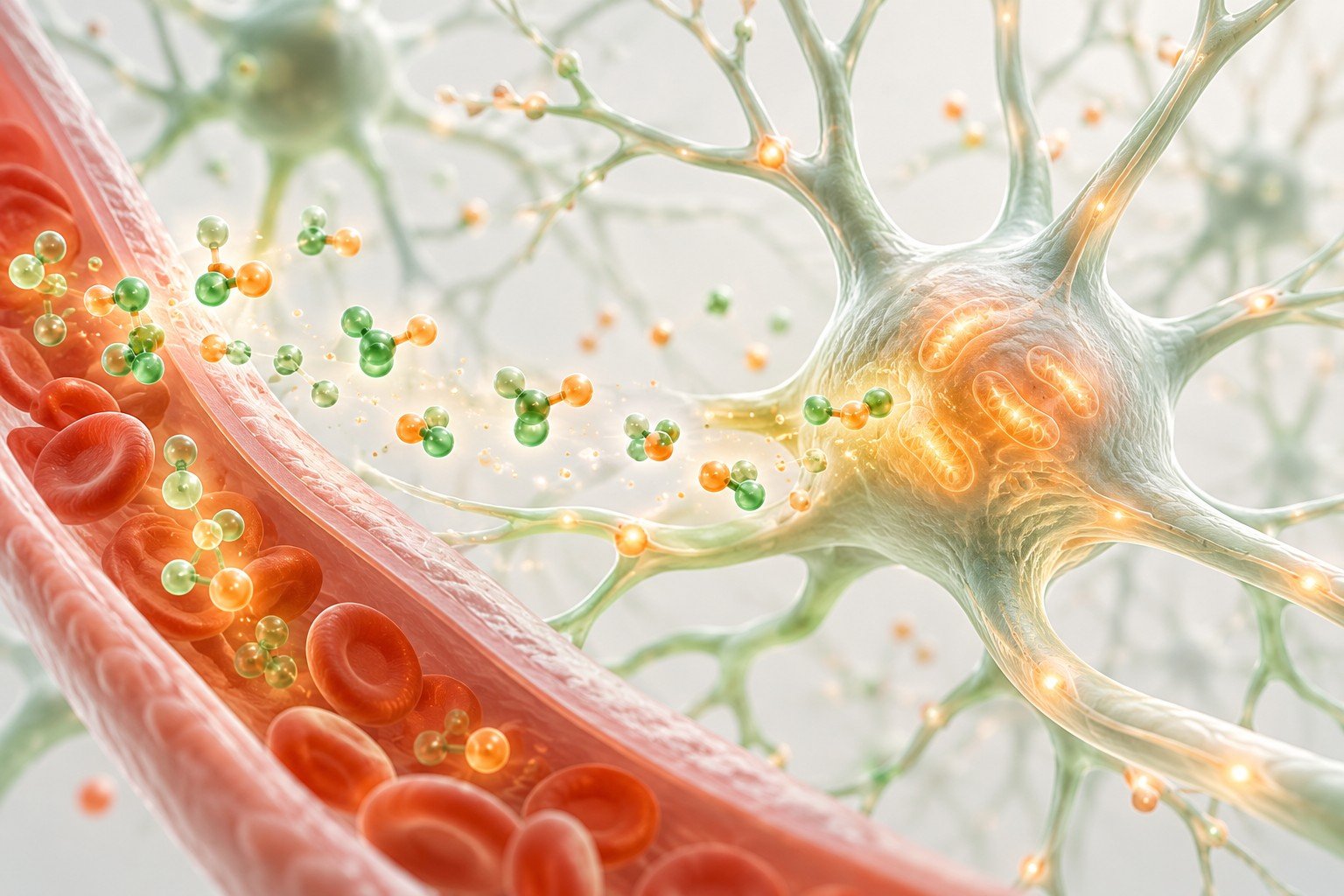
Conceptual illustration of a neuron, blood vessel and molecular shapes representing an alternative energy substrate.
Sources and further reading
- Fortier et al. (2021). A ketogenic drink improves cognition in mild cognitive impairment: Results of a 6-month RCT. Alzheimer’s & Dementia, 17, 543-552.
- Roy et al. (2021). A ketogenic supplement improves white matter energy supply and processing speed in mild cognitive impairment. Alzheimer’s & Dementia: Translational Research & Clinical Interventions.
- Buchholz et al. (2024). A randomized feasibility trial of the modified Atkins diet in older adults with mild cognitive impairment due to Alzheimer’s disease. Frontiers in Endocrinology, 15, 1182519.
- Jensen et al. (2020). Effects of beta-hydroxybutyrate on cognition in patients with type 2 diabetes. European Journal of Endocrinology, 182, 233-242.
- CDC. Diabetic Ketoacidosis.
Continue reading
- Brain Insulin Resistance and Memory: What the Metabolic Connection Really Means
- GLP-1 Drugs and Dementia Risk: What Observational Studies Cannot Prove
- Epigenetic Clocks and Brain Age: What a Biological-Age Test Cannot Promise
- Lecanemab’s Traditional FDA Approval: Why Confirming Clinical Benefit Mattered