
Epigenetic Clocks and Brain Age: What a Biological-Age Test Cannot Promise
Key takeaways
- Chronological age, methylation-based age estimates and cognitive function are different measurements.
- A model trained for one tissue or purpose may not perform the same way elsewhere.
- Technical variation and biological context matter when comparing repeated tests.
- Cellular reprogramming experiments do not validate consumer supplements or claims of whole-brain rejuvenation.
A report saying that your biological age is younger than your birthday age can be satisfying. A later report showing a change can feel like a verdict on a new routine. Before interpreting either number, it is worth asking what produced it and what it was designed to predict.
Epigenetic clocks are important scientific tools. Their usefulness does not require treating them as a complete measure of health. The same distinction applies when a product uses a clock score to suggest that the brain has become younger.
This article focuses on methylation-based estimates and their limits. It separates measuring a pattern from proving that changing the pattern improves an outcome people care about, such as memory, independence or disease risk.
What an epigenetic clock measures
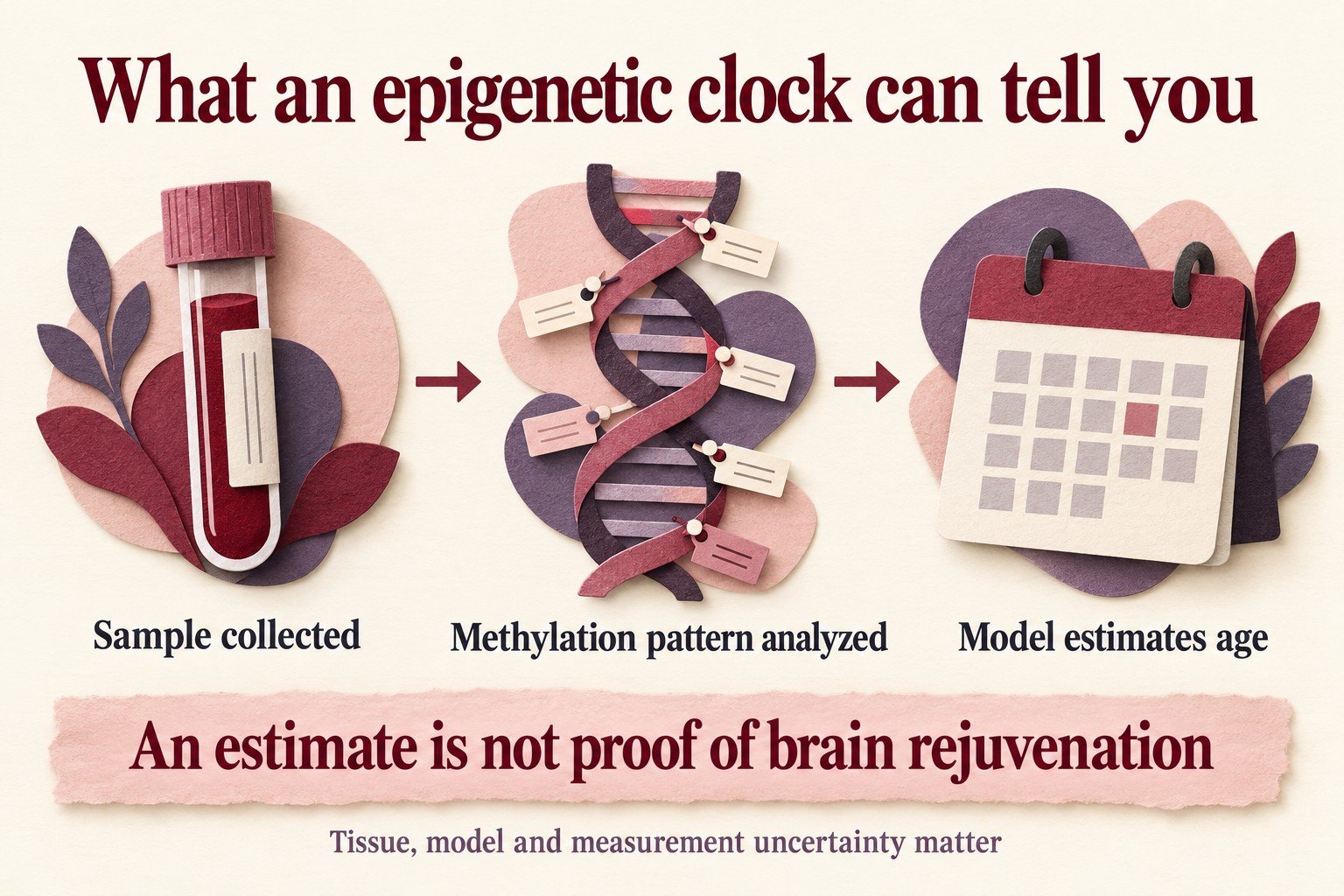
DNA methylation involves chemical marks associated with the regulation and organization of genetic information. A clock combines measurements at selected sites using a statistical model. The output depends on the sites and relationships that the developers selected or learned from data.
Horvath’s 2013 multi-tissue model was developed using thousands of samples across many tissue and cell types. It showed that methylation patterns could support age estimation across a broad range of samples. That achievement opened research questions about development, aging and disease.
It did not make every possible age estimate interchangeable. A model designed to predict chronological age and another designed around a different outcome can produce different kinds of information. The word clock should be followed by the model’s name and purpose.
For basic background, our epigenetics guide explains how gene activity can change without rewriting the underlying DNA sequence. A chemical mark is not simply an instruction to turn an entire person younger or older.
Why tissue matters for brain-age claims
Blood, saliva and brain tissue contain different cell populations and biological information. A measurement in one may be associated with processes elsewhere without directly sampling those processes. This is a major distinction when a consumer report uses brain-related language.
Shireby and colleagues’ cortical-clock research developed an age-prediction model specifically for human cortex and examined the limitations of applying existing clocks across ages and tissues. It illustrates why calibration and the training data matter to the interpretation.
Ask whether a service is measuring a brain sample, estimating a brain-related characteristic from another sample or reporting a general age-associated score. Those are different claims. An association needs validation before it becomes an individual diagnostic conclusion.
Even a good research model does not provide a complete account of someone’s cognition. A person can have concerns about memory that require clinical evaluation regardless of whether a commercial report looks reassuring.
Chronological age, predicted age and function differ
Chronological age is elapsed time. A methylation-based estimate is a model output. Function concerns what a person or tissue can do. These may be related in research without being the same measurement.
Imagine a hypothetical test result five units below a person’s chronological age. Without knowing the model’s error, reference group and calibration, it is difficult to judge the importance of that gap. A precise-looking number can conceal substantial uncertainty.
The same issue applies to the label accelerated aging. Ask whether it refers to a difference from expected age, a rate estimated by a particular method or another statistical quantity. Do not compare numbers from different definitions as if they used the same ruler.
Repeated tests require reliability
In research on improving clock reliability, Higgins-Chen and colleagues examined variation between technical replicates and developed computational approaches to reduce noise. Some clock estimates differed substantially between replicates in the data studied.
This does not mean that every test is meaningless. It means that interpreting change requires evidence about the exact assay and model. A company should explain how it distinguishes a meaningful longitudinal signal from measurement variation.
If the service changes its algorithm between tests, ask whether previous results were recalculated consistently. If collection or processing conditions differ, ask how those differences are handled. Comparing two outputs without that information may create a story that the measurement cannot support.
A lower score is not automatically a treatment benefit
A biomarker can be useful for research before it becomes a validated substitute for a clinical outcome. Showing that an intervention moves a score is different from showing that it improves health, and different again from showing that the score explains the improvement.
For a brain-health claim, look for an appropriate measure of cognition or function as well as the biomarker. For a prevention claim, look for a suitable disease outcome and follow-up. The strength of the wording should match the evidence actually collected.
Consider the alternative explanations in a before-and-after story. Other behaviors may have changed. The first result may have been unusually high or low. Selection, measurement error and lack of a comparison group can all complicate interpretation. A testimonial cannot resolve those issues alone.
What cellular reprogramming research shows
Lu and colleagues’ 2020 study investigated expression of selected reprogramming factors in mouse retinal ganglion cells. The work reported changes in age-related molecular signatures and visual function in specific experimental settings. It is important mechanistic research.
It is not evidence that a supplement resets human neurons or that a retail test can confirm whole-brain rejuvenation. Gene delivery to selected cells in an animal model differs fundamentally from taking a commercial product or adopting a general wellness routine.
The relevant next questions concern translation, delivery, control, safety and meaningful outcomes. A striking image of an animal experiment should not remove those questions from a human purchasing decision. The promise of a research direction is not the same as readiness for everyday use.
Stress-related changes also need context
NIA summarizes research on stress-related changes in methylation-based age measures, including changes that decreased after recovery. This suggests that measured age-associated patterns can respond dynamically under some conditions.
It does not mean that the passage of time reversed or that every change in a report represents restored brain tissue. The result, population, stressor and clock all matter. Dynamic measurements can be scientifically interesting while remaining incomplete guides for individual treatment.
For a reader, the useful lesson is to keep the measurement’s context visible. A number should arrive with an explanation of what it reflects, how uncertain it is and what decisions it can reasonably inform.
Questions before paying for an age test
| Question | What a useful answer should clarify |
|---|---|
| Which model is used? | Its name, intended purpose and validation evidence |
| What sample is analyzed? | Tissue type, collection method and relevant limitations |
| How repeatable is the result? | Technical reliability and uncertainty for longitudinal comparison |
| What does a change mean? | Whether clinically meaningful outcomes have been demonstrated |
| What data are retained? | Storage, access, sharing and deletion arrangements |
Ask whether the service supplies a measurement, interpretation by a qualified professional or a product recommendation tied to the result. Those are separate activities. A score should not quietly become a prescription for a supplement sold by the same company.
Check total cost, repeat-testing expectations, access to the underlying report and whether updates change the scale. A subscription that encourages frequent retesting may be difficult to evaluate if the expected meaningful interval and measurement variability are not explained.
Keep brain-health decisions connected to real needs
If your goal is improving a routine, define an ordinary outcome such as following a study plan or managing an existing condition. If your concern is a new symptom, seek appropriate assessment. Neither decision requires accepting a commercial age score as the final authority.
Our cognitive reserve and aging article discusses another way researchers think about brain health. Reserve, a methylation estimate and a clinical diagnosis answer different questions. Combining their names does not create a single complete test.
This article has not tested or ranked consumer age-testing services. It is reasonable to find the science interesting while deciding that a test would not change an evidence-based action. The best next step is the one that addresses the actual concern.
Frequently asked questions
Is an epigenetic clock a direct measurement of neuron age?
Not in the general consumer sense. A result depends on the sample and model. Blood or saliva does not directly sample every neuron, and a model output is not a complete inventory of brain health.
Does a younger score prove a supplement works?
No. The change must be interpreted with reliability, an appropriate comparison and relevant health outcomes. A biomarker result alone cannot establish the claimed benefit.
Can all clocks be compared directly?
No. They may use different inputs, training goals and scales. Compare the actual methods and intended interpretation before treating their numbers as equivalent.
Has reprogramming research proven human brain rejuvenation?
The mouse retinal experiment described here does not establish that claim. It supports further investigation, while human applications require their own evidence and safety evaluation.
The featured image is an editorial visual. It does not depict experimental data, an identified patient or a clinical outcome.
Sources and further reading
- Horvath (2013). DNA methylation age of human tissues and cell types.
- Shireby et al. (2020). Recalibrating the epigenetic clock in human cortex.
- Higgins-Chen et al. (2022). Reliability of epigenetic clocks.
- Lu et al. (2020). Reprogramming and visual function in mice.
- NIA. Stress-induced changes in biological-age measures.


