Epigenetics: How Gene Activity Can Change Without Rewriting DNA
Key Points:
- Gene activity can change without a change to the underlying DNA sequence.
- Epigenetics does not mean that every experience rewrites DNA or produces a predictable inherited effect.
- Keep the measured biological change separate from claims about health outcomes.
- A mechanism described in research does not validate a commercial product promising to optimize genes.
Educational reporting, not individual diagnosis, treatment or dietary advice. Dated milestone reports describe the original event; current clinical decisions require current guidance and a qualified healthcare professional.
Epigenetics often appears in headlines about aging, stress, nutrition and inherited experiences. The word describes real biological processes, but it can also be stretched into a vague promise that almost any lifestyle choice will rewrite your future. A better starting point is a distinction: the sequence of DNA and the ways a cell uses that sequence are related, but they are not the same thing. Understanding that difference makes both the science and its limits easier to follow.
Instructions and their use
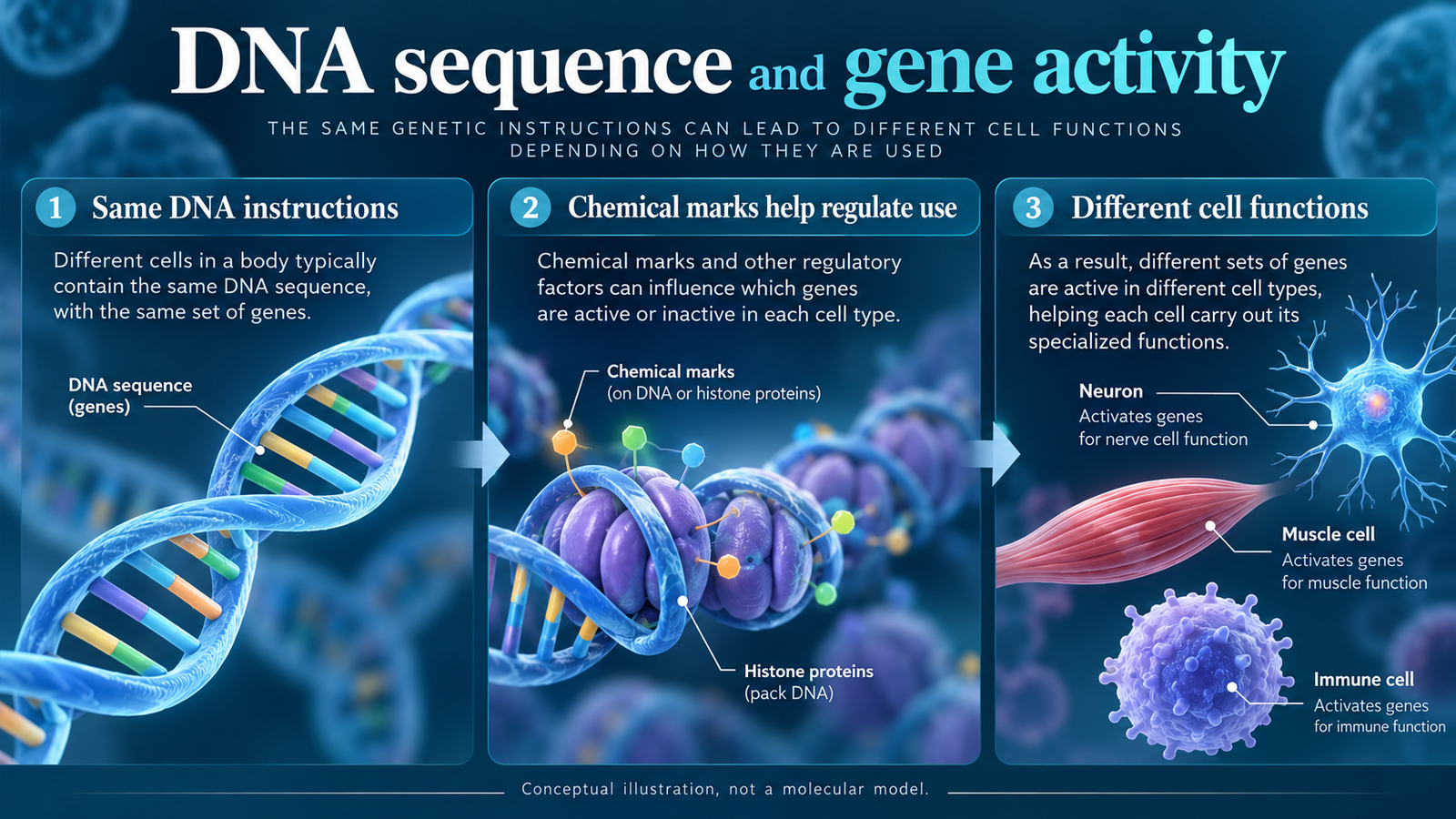
The National Human Genome Research Institute's epigenomics fact sheet describes chemical marks on DNA and associated proteins that can influence gene activity without changing the DNA sequence. Different cell types generally contain essentially the same genome, yet use different sets of instructions. A muscle cell and a nerve cell have different jobs. Explaining those differences requires attention to regulation, not simply a list of genes present in the body.
Think of a shared instruction manual used by several departments. Each department refers to different pages for its work. That is an analogy for selective use, not a literal model of cells or proof that genes operate like independent switches. Biological regulation involves interacting processes, and an illustration necessarily leaves much out. The analogy is useful only while it preserves the distinction between the information in a sequence and the context in which that information is used.
| Term | What it concerns | What not to infer |
|---|---|---|
| DNA sequence | The order of DNA’s building blocks | That sequence alone describes every cell’s activity |
| DNA methylation | Chemical marks associated with regulation | That one mark has the same effect in every context |
| Histone modification | Changes involving proteins around which DNA is organized | That a simple lifestyle score captures all regulation |
| Epigenome | The collection of relevant marks and associated regulatory information | That it is fixed or identical across every tissue |
Why researchers study chemical marks
NHGRI explains DNA methylation and histone modification as important examples of epigenomic processes. Studying these marks can help researchers investigate development, cell specialization and disease. A study might compare patterns across tissues, ages or exposures. The first reading question is therefore what was measured and where. A finding in one kind of cell should not be casually described as a measurement of the whole person, much less a prediction of every future health outcome.
Suppose a hypothetical study compares a mark in blood samples from two groups. A careful summary would identify the sample type, the groups and the measurement. It would not automatically claim that the same pattern occurs in the brain, explains a symptom, or can be reversed by a product. Those are additional questions. They may be scientifically interesting, but each requires its own evidence rather than being bundled into the initial observation.
Association and mechanism are different steps
An exposure and an epigenetic pattern can occur together without establishing a simple chain of cause and effect. The exposure might influence the pattern, the disease process might influence both, or other differences between groups might matter. This is a general evidence-reading distinction, not a verdict on every epigenetics study. Read the study design before deciding whether the language should be associated with, may contribute to, or directly causes a particular change.
A mechanism study asks how a process works. An observational study may identify patterns worth investigating. A clinical trial asks a different question about an intervention in people. A commercial claim can slide between these levels: a plausible cellular mechanism is presented as if it were a proven personal benefit. To check the slide, write down the measured endpoint and compare it with the promised outcome. The larger the gap, the more evidence is needed to bridge it.
Inheritance needs careful wording
The NHGRI fact sheet notes that epigenetic marks can be maintained as cells divide and that some can be passed between generations under particular circumstances. It also explains that much of the epigenome is reset when genomes pass from parents to offspring. These statements should not be compressed into a claim that every experience is biologically inherited. Cell-to-cell persistence within one organism and transmission across human generations are different topics with different evidentiary demands.
When a story discusses inherited stress or diet effects, ask which organism was studied, how many generations were observed and what alternative explanations were considered. An animal experiment may illuminate a mechanism without establishing the same effect in human families. A family association also involves shared environments and behaviors. Clear reporting identifies those limits rather than using inheritance as an emotionally powerful explanation for experiences that the study did not directly measure.
What an epigenetic test would need to demonstrate
A test can produce a number without establishing that acting on that number improves health. Before treating a commercial result as useful, ask about analytical validity, interpretation and practical consequences. Does the test measure its chosen markers consistently? What population supports the interpretation? Does a change in the reported score correspond to an outcome that matters? These are our proposed evaluation questions; the NHGRI educational page is not an approval of a consumer testing service.
For an original example, imagine a company reports a younger biological-age score after a lifestyle program. You would need to know whether the same sample method and analysis were used, whether there was a suitable comparison group and whether the change exceeded ordinary measurement variation. You would also need evidence before equating the score change with longer life or reduced disease. A visually precise dashboard cannot supply those missing links by itself.
Read nutrition claims without magical language
NHGRI identifies diet and other environmental factors as possible influences on the epigenome. That broad biological observation does not establish that a named food, supplement or routine can reset someone’s genes. A useful nutrition article should identify the actual intervention and study population instead of turning epigenetics into an all-purpose explanation. It should also distinguish a measured molecular change from an established health benefit and avoid assigning blame for illness through simplistic lifestyle narratives.
Our suggested claim-checking note has four lines: the biological process proposed, the measurement actually taken, the outcome promised, and the evidence connecting them. If the connection is absent, write that explicitly. This allows a reader to appreciate an interesting mechanism while declining an unsupported product claim. It also helps separate research interest from purchase intent, which is particularly important when scientific language appears beside a discount code or subscription offer.
Use the science to ask better questions
For a new epigenetics story, begin with the source’s date and purpose. The NHGRI fact sheet used here was updated in 2020 and serves as an educational foundation; it is not a review of every later study or a current clinical guideline. Follow a specific new claim to its own methods and results. Preserve the tissue, organism and endpoint when summarizing it, and describe uncertainty instead of replacing it with a stronger headline.
The most useful takeaway is that biology includes regulation as well as sequence. That insight creates important research questions, but it does not make every attractive explanation true. You can be curious about epigenetics without buying a test, accepting a sweeping inheritance story or treating a laboratory marker as a personal destiny. A good explanation leaves you with clearer distinctions and more precise questions, rather than a promise that an unseen molecular switch can solve every problem.