
Microplastics in Human Brains: What Autopsy Studies Reveal and Cannot Prove
Key takeaways
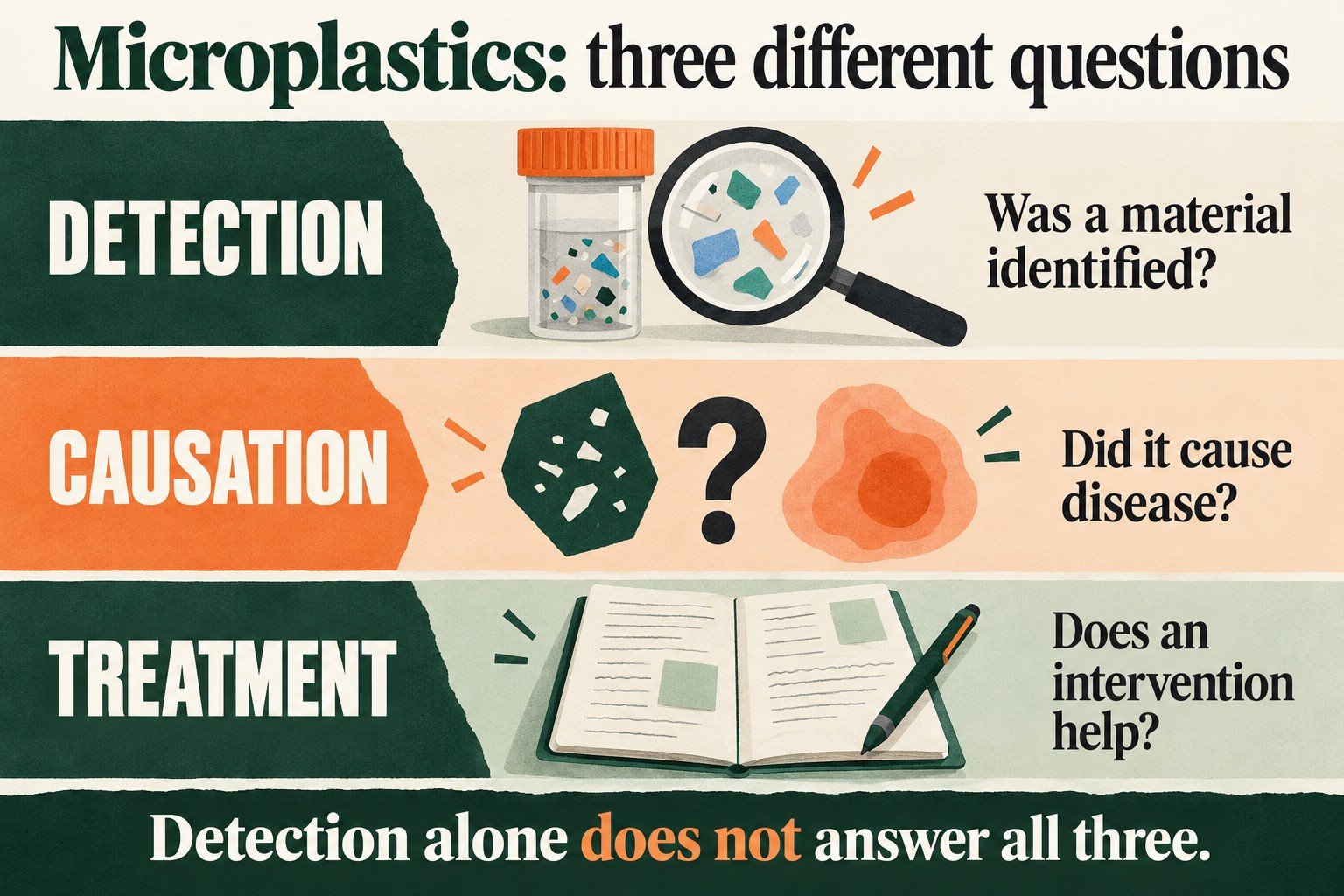
- Detection, causation and treatment are three separate evidence questions.
- A 2025 brain-tissue study and a 2024 olfactory-bulb study used different methods and sampled different tissues.
- Higher concentrations in a dementia group cannot establish whether accumulation preceded the illness.
- A product that removes particles from water has not thereby demonstrated removal from the human brain.
Few environmental headlines feel as personal as the claim that plastic has been found in human brains. The findings deserve attention, but frightening imagery can make a laboratory observation sound like an individual diagnosis.
Brain microplastics research is developing methods to identify material in tissues and investigate possible health consequences. Those are essential tasks. They are also different from proving that a detected particle caused a disease or that a consumer product can remove it.
This guide separates the human evidence from the conclusions that would require further studies. It also offers a way to read the next dramatic headline without treating uncertainty as either reassurance or a reason for panic.
What did the 2025 autopsy study report?
Nihart and colleagues’ Nature Medicine study used complementary analytical approaches to investigate microplastics and nanoplastics in human kidney, liver and brain tissues. The researchers reported greater concentrations in brain samples, with polyethylene prominent among the polymers detected.
Samples collected in 2024 showed higher brain concentrations than those collected in 2016. A separate group with documented dementia had still higher concentrations. The study used chemical analysis and microscopy to strengthen material identification; it was not a trial assigning exposure or treatment.
These are findings in particular postmortem samples, not a representative measurement of every living person. The paper also has a linked 2025 author correction. Readers comparing versions should use the current article and accompanying notices, rather than an early screenshot or a preprint as though it were a separate replication.
Another study examined the olfactory bulb
In a 2024 São Paulo autopsy case series, Amato-Lourenço and colleagues examined olfactory-bulb tissue from 15 adults. Microplastics were identified in eight individuals. The investigators used micro-Fourier transform infrared spectroscopy and reported procedural controls intended to check contamination.
The olfactory bulb is associated with smell processing. Finding particles there supports investigation of a possible entry pathway, but it does not trace the journey of each particle. The study did not show that all detected material crossed the blood–brain barrier through the same route.
This study should not be treated as a direct numerical replication of the larger-tissue analysis. Its sample region, detected particle sizes and method differ. Two papers can contribute to the same research question without producing measurements that can simply be placed on one trend line.
Why methods and units matter
A chemical measurement of polymer mass and a count of visible particles describe different properties. One large fragment and many small fragments could contribute differently to these measures. Without the method and unit, a bigger number is difficult to interpret.
The two human studies illustrate that distinction through their analytical approaches. Ask whether a headline refers to a mass concentration, a particle count or an image selected to show a material’s shape. A micrograph is not automatically a measurement of total burden.
Sample preparation matters too. A useful methods description explains how tissue was collected, how background contamination was assessed and how the material was identified. These questions are part of evaluating evidence, not an accusation that a particular study is wrong.
Avoid mixing detection capability with absence. A method designed to identify one range of sizes may not characterize all smaller particles. Conversely, the ability to detect a very small amount does not establish a clinical threshold at which it causes harm.
A dementia association does not establish direction
The dementia-group result in the 2025 study is important because it raises a health question. The design cannot show whether higher accumulation preceded disease, followed changes associated with disease or reflected another difference between groups.
Imagine two explanations consistent with a postmortem association. A material could contribute to a disease process, or an existing disease could change the material’s handling. This is a reasoning example, not a claim that either explanation has been demonstrated here. A useful study would seek evidence that distinguishes them.
That is why phrases such as plastics cause Alzheimer’s go beyond the result. The opposite claim, that detection has no possible health significance, also goes beyond it. The scientifically useful position is to identify what the study measured and what would test the causal question next.
Our correlation and causation guide explains the general reasoning. The same discipline applies to environmental tissue measurements even when the material itself is concerning.
What other human tissue evidence contributes
A 2024 study by Marfella and colleagues examined carotid-artery plaques removed during surgery and followed patients for cardiovascular events. Detection of microplastics and nanoplastics in plaque was associated with a higher subsequent risk of the study’s composite outcome.
This adds longitudinal human evidence in a different clinical setting. It is still observational, and carotid plaque is not brain tissue. Its outcome cannot be repackaged as an estimate of dementia risk or proof of a particular route into the brain.
When several tissue studies appear together in a news story, check whether they answer the same question. A detection study, an observational follow-up and a laboratory toxicity experiment can complement one another. Combining their headlines does not turn them into a randomized prevention trial.
Three questions to keep separate
| Question | Evidence needed | What is insufficient alone? |
|---|---|---|
| Was material detected? | Appropriate sampling, controls and identification | A striking illustration |
| Did it cause a health outcome? | Evidence addressing timing, alternatives and mechanism | A postmortem group association |
| Does an intervention help? | Relevant comparative human outcome data | Removal from a laboratory solution |
This table is also a way to evaluate a commercial claim. If a product is sold on the strength of a detection paper, ask which evidence connects that paper with the promised benefit. A bibliography is useful only when its contents support the actual statement.
For example, demonstrating that a filter captures particles under specified test conditions could support a claim about that filter’s performance. It would not demonstrate that using it clears existing material from brain tissue or prevents neurological disease.
What health agencies can and cannot conclude
The FDA’s information on microplastics and nanoplastics in food describes substantial measurement and health-evidence gaps. It does not provide a validated personal brain-burden threshold or recommend a brain-detox product.
The EFSA topic overview likewise identifies exposure, absorption, biological behavior and potential hazards as questions for assessment. An agency investigating an issue is not the same as the issue having been fully quantified for individual consumers.
Read a safety statement within its scope. Food exposure, occupational conditions and a postmortem tissue finding are not identical questions. A general statement about one setting should not be stretched into proof of complete safety everywhere or proof that every exposure is clinically harmful.
Respond without buying an unproven detox
If a service offers a body-plastic score, ask what specimen it analyzes, how accurate the method is and whether the result has an established clinical interpretation. A number from one compartment should not be presented as a direct measurement of another without validation.
If a supplement or procedure promises clearance, request human evidence for the exact intervention and relevant outcome. Ask how clearance was measured, whether a comparison group was used and whether important harms were assessed. The word detox does not specify a testable process.
You can make ordinary environmental or purchasing choices for their own reasons without attaching a medical guarantee. Follow product-use and food-safety instructions. Avoid turning a desire to reduce waste or unnecessary exposure into a claim that a particular household change has been shown to prevent dementia.
For persistent cognitive symptoms, seek an appropriate clinical assessment rather than assigning them to a headline. Our cognitive reserve and aging guide explains why brain health decisions need more context than one exposure story.
Common questions about brain microplastics
Can these autopsy findings tell me my own brain concentration?
No. A result from selected postmortem tissue does not measure your individual burden. A population headline cannot substitute for an appropriately validated personal test.
Does finding plastic prove it crossed the blood–brain barrier?
Detection in a tissue does not, by itself, reconstruct the route of entry. The olfactory-bulb study raises a pathway question; the tissue analyses do not establish one universal route for all particles.
What would meaningfully strengthen the evidence?
Independent replication with transparent methods, comparable measurements, better exposure histories and studies connecting exposure to subsequent outcomes would help. Treatment claims need their own evidence that an intervention improves something that matters, rather than an assumption that detection already supplies the answer.
Sources and further reading
- Nihart et al., 2025: microplastics in decedent human brains
- Author correction, 2025, linked to the Nihart article
- Amato-Lourenço et al., 2024: microplastics in human olfactory bulb
- Marfella et al., 2024: carotid plaque and cardiovascular follow-up
- FDA: microplastics and nanoplastics in food
- EFSA: microplastics and nanoplastics in food
Continue reading
- Long COVID and Cognition: Mechanism Clues, Rehabilitation Trials and Testing Limits
- Hearing Aids and Dementia Risk: What ACHIEVE and Newer Trials Actually Show
- Sleep Apnea and the Brain: What Imaging Studies and CPAP Trials Can Establish
- SLC6A4 and Stress: What the 5-HTTLPR Story Can and Cannot Predict


