MTHFR Variants and Brain Health: Folate, Homocysteine and the Limits of a DNA Report
Key takeaways
- Common MTHFR variants and rare severe MTHFR disorders are different situations.
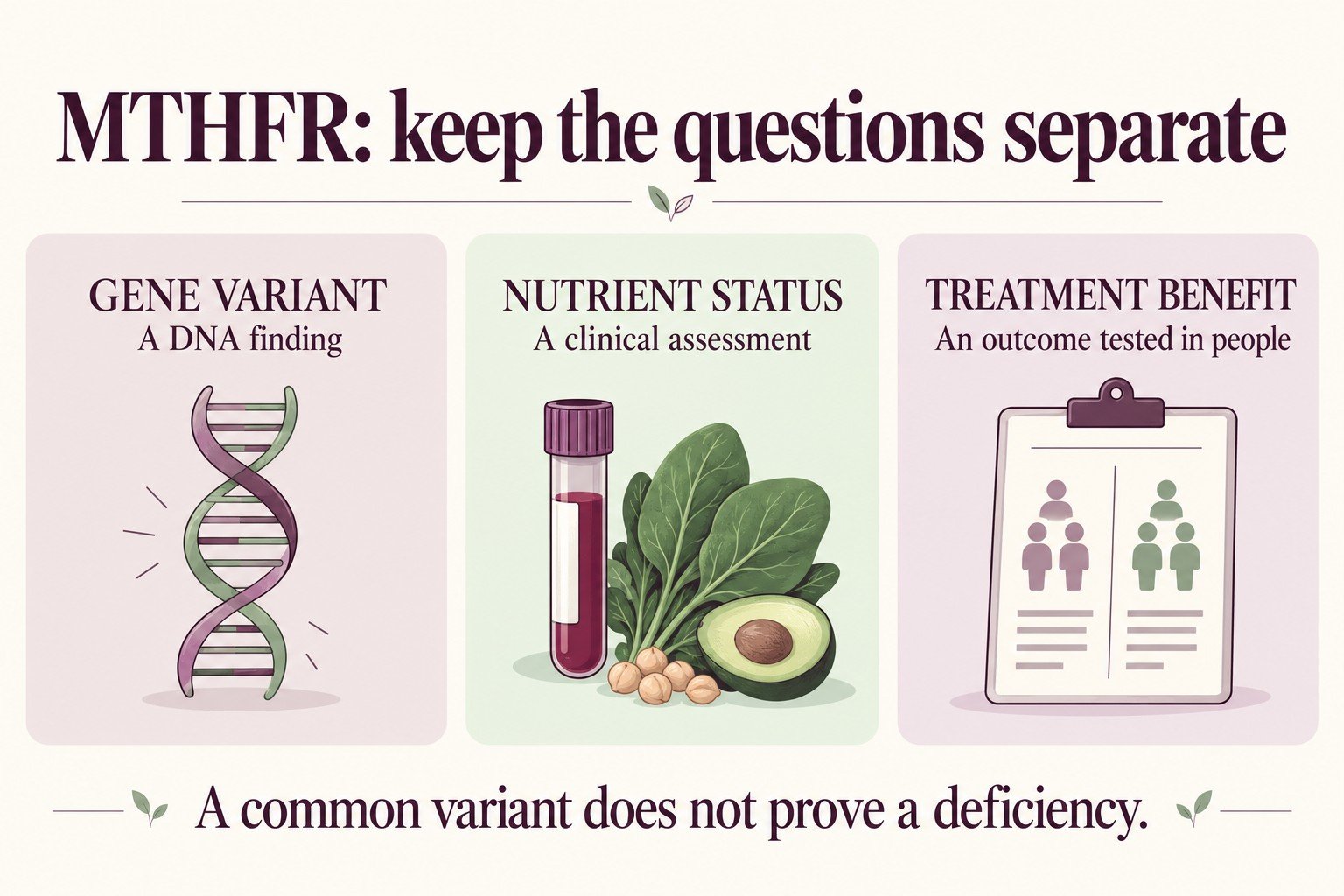
- Genotype, nutrient status and symptoms are separate pieces of evidence.
- A biochemical improvement does not guarantee a cognitive benefit.
- A useful test or treatment should answer a defined clinical question.
A genetic report can make MTHFR sound like a master switch for mood, concentration and detoxification. A highlighted variant may be followed immediately by a recommendation for methylated vitamins. That sequence is convenient for a sales page, but it compresses several scientific questions into one conclusion.
The gene has a real metabolic role. The challenge is deciding what a particular result means for a particular person. Understanding common variants, folate status and the outcomes of human trials helps separate a useful clinical question from a story that promises to explain every symptom.
What MTHFR does, and what a variant means
MTHFR stands for methylenetetrahydrofolate reductase. The enzyme participates in folate metabolism, helping produce a form used in the pathway that converts homocysteine to methionine. A change in the gene can affect aspects of the enzyme’s function.
That is not equivalent to a complete shutdown of methylation. A DNA variant describes a sequence difference. It does not directly measure every metabolic reaction, the amount of a nutrient in the body or neurotransmitter levels in a living person’s brain.
The commonly discussed results are C677T and A1298C. The CDC’s MTHFR guidance distinguishes these common findings from extremely rare variants that can have substantial health effects. A severe inherited disorder and a common consumer-report result should not be treated as interchangeable diagnoses.
The wording matters. Seeing mutation in an older research title does not mean that every person carrying the common variant has a disease. Ask which variant was identified and what condition, if any, has actually been established.
Nutrient context changes the interpretation
In Jacques and colleagues’ 1996 study, researchers examined 365 participants from the NHLBI Family Heart Study. The relationship between the common thermolabile MTHFR variant and fasting homocysteine differed with folate status. A genotype difference was seen at lower folate concentrations but not in the higher-folate group.
This observational result illustrates an interaction between a genetic finding and a measured nutritional context. It does not establish that everyone with the variant is deficient or that a supplement will improve memory. No cognitive benefit was demonstrated by identifying the biochemical association.
The practical lesson is to resist skipping the middle of the argument. A report that says variant present, therefore brain fog, therefore this product needs evidence for both transitions. A pathway diagram cannot supply the missing clinical measurements.
Common variants are not a reason to avoid folic acid
CDC states that people with common MTHFR variants can process folate, including folic acid. It does not recommend avoiding folic acid because of C677T. For people who could become pregnant, its recommendation remains 400 micrograms daily to help prevent neural tube defects, including for those with an MTHFR variant.
That advice concerns a well-defined public-health outcome. It should not be rewritten as a brain-fog treatment or a personalized prescription for high amounts. If you have a relevant medical history or have been given different clinical advice, discuss your circumstances with the professional managing your care.
Likewise, a product labeled methylated is not automatically a better cognitive treatment. To support that claim, evidence would need to connect the actual preparation with a meaningful outcome in relevant participants. A biochemical name does not establish comparative clinical superiority.
Lowering homocysteine is not the same as improving cognition
Homocysteine can be a useful research measurement, but it is not a direct score of memory or mental clarity. A treatment may lower its concentration without improving the cognitive outcome that matters. Human trials make this distinction concrete.
In Aisen and colleagues’ 2008 randomized trial, 409 people with mild to moderate Alzheimer’s disease and normal baseline folate, vitamin B12 and homocysteine received high-dose B vitamins or placebo for 18 months. The regimen lowered homocysteine but did not slow decline on the primary cognitive measure or improve secondary outcomes.
That result does not argue against treating a documented deficiency. The participants and question were specific. It does show why lowering a marker cannot be assumed to produce the desired brain outcome, particularly when a commercial claim moves directly from laboratory improvement to dementia prevention.
A positive imaging trial needs its own boundaries
The 2010 VITACOG trial enrolled 271 adults over 70 with mild cognitive impairment. A subset underwent MRI, and 168 completed that imaging component. Over two years, the B-vitamin group had a slower rate of whole-brain atrophy than placebo, with the response related to baseline homocysteine.
This is a positive finding for a defined imaging outcome in a selected population. It is not a trial showing that every common MTHFR carrier needs the same regimen. It also did not establish that the intervention prevents Alzheimer’s disease; the investigators called for further trials addressing that question.
Brain volume and everyday cognition are connected research topics, but they are not identical endpoints. A useful summary preserves the distinction instead of calling every favorable scan finding a demonstrated improvement in memory or independence.
A later cognitive trial adds an important counterpoint
A randomized trial reported in 2019 studied 279 older adults with mild cognitive impairment and elevated homocysteine. B12 and folic acid lowered homocysteine over two years, but there was no significant difference in the primary clinical dementia-rating outcome or the secondary outcomes at the final assessment.
Different studies can produce different findings because they test different populations, formulations and endpoints. The right response is to compare those details. Selecting the favorable imaging paper while omitting the later clinical result would give a reader an incomplete account.
None of these trials establishes a genotype-specific supplement plan based solely on a common MTHFR result. They instead show why the measured problem and the measured benefit need to be clearly connected.
Three questions that should remain separate
| Question | Relevant information | What it does not establish alone |
|---|---|---|
| Which variant is present? | A reliable genetic result | Current nutrient deficiency |
| Is there a clinical nutritional problem? | History and appropriately selected assessment | That the variant caused every symptom |
| Does a treatment help? | Relevant comparative human evidence | Benefit from every product with a similar label |
For example, a hypothetical person may carry C677T and have difficulty concentrating. Those two observations can coexist without proving a causal connection. Another person may have a clinically established deficiency requiring care. The DNA label does not erase the difference between those situations.
Our genetics, environment and risk guide explains why a genetic contribution should not be confused with a complete explanation. Here, the same principle applies to a metabolic pathway and a symptom that may need a broader assessment.
Ask what a proposed test will change
Before purchasing another panel, identify the decision it is intended to support. Will the result change an investigation, treatment or follow-up? What evidence shows that using this test improves that decision? A list of pathway-related measurements is not automatically a validated clinical plan.
If you already have results, keep the original report and bring it to the discussion. Include current medicines and supplements rather than only products marketed as methylation support. The relevant question is what you are actually taking and why, not the category used on the front label.
Persistent cognitive, mood or physical symptoms deserve assessment in their own right. Avoid assuming that a familiar gene abbreviation settles the cause. It can be relevant information without being the answer to every concern.
Read methylation marketing with a clear endpoint
Methylation is a broad biological process. Claims to optimize it need to specify what is being measured and what outcome improves. A program cannot demonstrate success merely by repeating that methylation matters to the body.
Our epigenetics explainer discusses gene activity without treating lifestyle as a remote control for DNA. Nutrient metabolism and epigenetic regulation are related subjects, but a claim in one area does not validate every intervention advertised in the other.
The more useful description names the starting problem, the intervention and the outcome. If those remain vague, adding a genetic score can create an appearance of personalization without demonstrating a better result.
Common questions about MTHFR and brain health
Does a common variant prove I need methylated vitamins?
No. It does not establish nutrient status or show that a particular preparation improves your symptoms. Common variants are not a reason to assume you cannot process folic acid. Individual treatment decisions need a relevant clinical context.
Does lower homocysteine mean better memory?
Not necessarily. The trials above include examples in which homocysteine fell without a corresponding clinical cognitive benefit. Biomarkers and meaningful outcomes should be reported separately.
What is the most useful takeaway?
Treat the genetic result as one piece of information. Establish whether there is a clinical problem, identify what decision follows and use evidence that matches the intended treatment. That approach is more informative than treating a common variant as a diagnosis of a broken brain pathway.
Sources and further reading
- Jacques et al., 1996: MTHFR, folate status and homocysteine
- Aisen et al., 2008: B vitamins and Alzheimer’s cognitive decline trial
- Smith et al., 2010: VITACOG MRI trial
- Kwok et al., 2019: B vitamins and cognitive decline in MCI
- CDC: MTHFR gene variant and folic acid facts