APOE ε4 and Alzheimer’s: What Genetic Risk, Biomarkers and Testing Decisions Mean
Key takeaways
- One ε4 copy and two ε4 copies should not be discussed as identical findings.
- A genetic result is different from a symptom assessment or amyloid measurement.
- The 2024 homozygosity study strengthens biological evidence without providing a personal countdown.
- Testing can have clinical relevance, including treatment-safety discussions, but needs a defined purpose.
An APOE result can feel unusually personal. It concerns a disease many people have seen in their family, and the report may appear to turn a few letters into a forecast of the future. Headlines calling two ε4 copies a genetic form of Alzheimer’s can make that forecast seem even more definite.
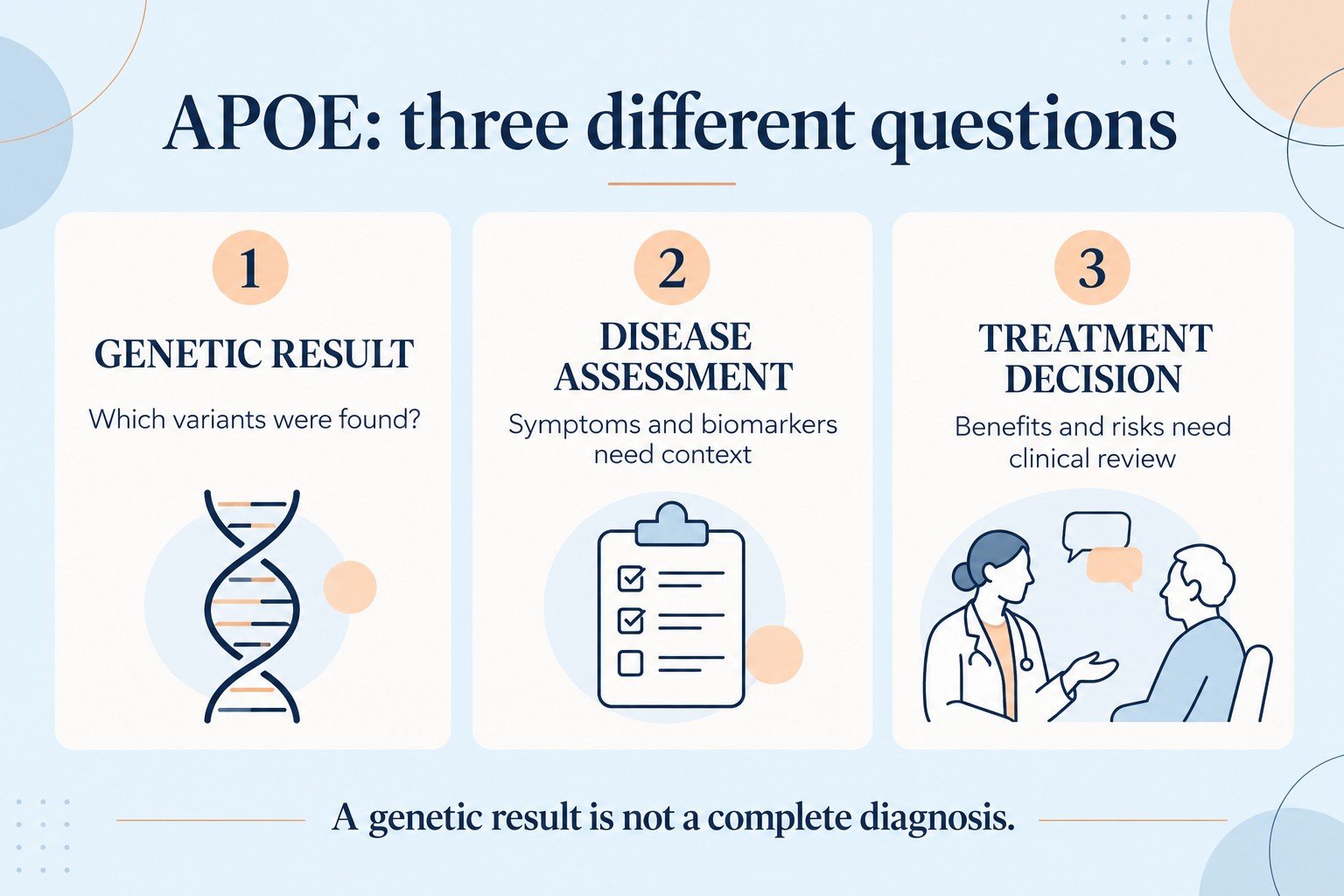
The findings deserve serious attention. They also deserve careful distinctions. Knowing a genotype, detecting disease-associated biology and assessing a person’s present symptoms are related activities, but they are not interchangeable. Keeping them separate makes the result more useful and less likely to be overinterpreted.
What an APOE result describes
APOE refers to the gene for apolipoprotein E. The commonly discussed forms are ε2, ε3 and ε4. People inherit an allele from each biological parent, creating combinations such as ε3/ε4 or ε4/ε4. The second combination is described as ε4 homozygosity.
The National Institute on Aging’s genetics fact sheet explains that ε4 increases Alzheimer’s risk while some carriers never develop the disease. It also distinguishes risk-related variants from the broader set of genetic findings relevant to Alzheimer’s.
A report saying ε4 present therefore leaves an important question unanswered: one copy or two? It should also explain the test’s intended use and limitations. A simplified risk category cannot provide all the context needed for a medical decision.
What the 2024 homozygosity study found
In Fortea and colleagues’ 2024 investigation, researchers analyzed pathological data from 3,297 people and clinical data from 10,039 people. The study combined several cohorts to examine disease biology and its timing in APOE ε4 homozygotes.
The investigators found a strikingly high prevalence of Alzheimer’s pathology and age-related biomarker abnormalities in ε4/ε4 participants. They argued that homozygosity represents a genetic form of the disease, with a more predictable sequence of biological changes than previously appreciated.
The key term is biological penetrance. The study’s evidence about pathology and biomarkers should not be rewritten as a guarantee that every person with that genotype will develop disabling symptoms at the same age. A cohort’s pattern is not an appointment on an individual’s calendar.
This distinction preserves the importance of the research. It does not reduce the result to a trivial risk association. It explains why a strong biological finding still requires careful interpretation when someone asks what will happen to me.
Biology, symptoms and daily function are different levels
A genetic test identifies a DNA-related result. An amyloid or tau assessment addresses a different part of the disease question. A clinical evaluation considers cognition, function, history and other relevant information. Each can contribute evidence without replacing the others.
Imagine two hypothetical people with the same APOE combination. One has no cognitive concerns; the other has progressive changes affecting daily activities. Their genotype matches, but the immediate clinical questions differ. The second person needs assessment of the changes rather than an assumption that the genetic report explains everything.
Likewise, a person without ε4 should not use that result to dismiss persistent symptoms. Absence of this risk allele is not a comprehensive exclusion of Alzheimer’s or every other cause of cognitive difficulty. The purpose of evaluation is to investigate the actual problem.
Why a single risk percentage can mislead
Risk estimates depend on what outcome was counted, over what period and in which participants. A percentage for a selected research cohort cannot automatically become a universal lifetime probability. Before interpreting a number, ask what event the number actually predicts.
Disease-associated biology, a clinical diagnosis and dementia affecting independence are not the same endpoint. A report that moves between them without explanation can sound more precise than it is. The same problem occurs when a relative comparison is presented as an absolute chance.
Our guide to relative and absolute risk provides a framework for reading those numbers. For APOE, the extra task is to identify the genotype comparison and whether the estimate is appropriate for the person receiving it.
The best explanation should be able to state uncertainty plainly. If a service cannot explain the population, time horizon and outcome behind its score, a colorful risk dial is not a substitute for that information.
Genetic information can matter for treatment safety
APOE testing is not only a prediction question. The FDA’s July 2026 Leqembi prescribing information identifies a higher incidence of amyloid-related imaging abnormalities, or ARIA, in treated APOE ε4 homozygotes than in heterozygotes or noncarriers. It recommends testing before treatment to inform that risk discussion.
This is a specific clinical use in an Alzheimer’s treatment context. It is not a recommendation that every healthy adult obtain a consumer test or that a genotype alone establishes treatment eligibility. The assessment includes the disease stage, relevant investigations and the balance of benefits and risks.
It also illustrates why testing should begin with a decision. A result can be useful when it changes a well-defined clinical conversation. Collecting it without a plan may create questions that the accompanying report is not equipped to answer.
What research says about receiving a result
The REVEAL randomized study assigned 162 asymptomatic adults with a parent affected by Alzheimer’s to receive APOE results or not. Under the study’s structured disclosure process, the groups did not differ significantly in time-averaged anxiety, depression or test-related distress during follow-up.
That is reassuring evidence about a supported process in selected participants. It is not proof that an unexpected online result will be emotionally neutral for everyone. The manner of disclosure, preparation and access to interpretation are part of the experience.
Before testing, consider whether you want to know the result, what you would do with it and whom you would discuss it with. These are practical questions, not signs that someone is avoiding science. Information is most useful when the person receiving it understands its purpose.
Prepare a focused discussion before testing
| Question | Why it helps |
|---|---|
| What decision could this result change? | Separates curiosity from a clinical purpose |
| Does the test distinguish one copy from two? | Avoids treating all ε4 results as equivalent |
| Is confirmation needed before a medical decision? | Clarifies the role of a consumer or research result |
| Which outcome does the risk estimate predict? | Separates biology, symptoms and functional decline |
| Who can explain the result in my context? | Creates a plan for interpretation and follow-up |
Bring a relevant family history rather than only a commercial report. Record who was affected and what is actually known about the diagnosis. A family story can be important without every detail being certain; clearly distinguishing known and uncertain information helps the discussion.
Also review the service’s current data practices before uploading raw genetic information. Ask about access, retention, research use and deletion. These are decisions about sensitive information, and a useful risk explanation should not require ignoring them.
Be careful with genotype-specific prevention promises
A strong association can inspire treatment research without validating a retail prevention program. A seller offering an APOE diet, supplement stack or brain score needs evidence that the proposed intervention improves a meaningful outcome in the relevant group.
Mechanistic studies about lipid handling or amyloid biology cannot by themselves establish that a particular product prevents dementia. Nor does a favorable short-term marker necessarily demonstrate a long-term clinical benefit. The intervention, comparison and endpoint all need to match the promise.
Our cognitive reserve and aging article discusses a broader evidence base for cognitive health. That discussion should not be converted into a guarantee that lifestyle erases an APOE result, or that a genetic result makes useful health care pointless.
Common questions about APOE ε4
Does one ε4 copy mean I currently have Alzheimer’s?
No. A genotype is not a complete assessment of present symptoms or disease biology. Clinical interpretation asks a different question from identifying the allele. New or progressive cognitive changes deserve evaluation regardless of the result.
Why did researchers call two copies a genetic form of the disease?
They observed a strong, age-related pattern of pathology and biomarkers in ε4 homozygotes. That biological finding is important. It should retain its study context rather than becoming an exact prediction of when an individual will experience symptoms.
What is the most useful next step after an unexpected result?
Keep the original report, avoid making major treatment or supplement changes from a summary score, and discuss the result with a clinician or genetic counselor. The goal is a clear interpretation and a relevant decision, not a personal forecast assembled from isolated headlines.
Sources and further reading
- Fortea et al., 2024: APOE ε4 homozygosity and Alzheimer’s biology
- Green et al., 2009: REVEAL randomized genotype-disclosure study
- NIA: Alzheimer’s disease genetics fact sheet
- FDA: Leqembi prescribing information, July 2026
Continue reading
- COMT and Stress: Why the “Warrior or Worrier” Gene Story Is Too Simple
- Genetics, Environment and Risk: What Runs in the Family Really Means
- Lecanemab’s Traditional FDA Approval: Why Confirming Clinical Benefit Mattered
- Clock Genes and Chronotype: Why DNA Influences Sleep Timing Without Dictating Your Schedule