Paired Vagus Nerve Stimulation After Stroke: What the Implant-and-Rehabilitation Evidence Shows
Key takeaways
- The pivotal trial compared active and sham stimulation alongside rehabilitation.
- Participants had chronic ischemic stroke and moderate-to-severe arm impairment.
- The one-year report used unblinded pooled follow-up after control-group crossover.
- Device, target, timing, patient group and rehabilitation protocol all affect whether evidence transfers.
Vagus nerve stimulation is used to describe several very different technologies. A surgically implanted system paired with a rehabilitation task, an ear-based electrical device and a consumer vibration product may all appear in the same online discussion. Their shared vocabulary does not make them the same intervention.
For stroke rehabilitation, there is a specific clinical evidence base worth understanding. It concerns timed stimulation combined with repeated upper-limb practice in selected participants. The central question is what the complete treatment added, for whom, and with what limitations and risks.
What paired VNS means in this setting
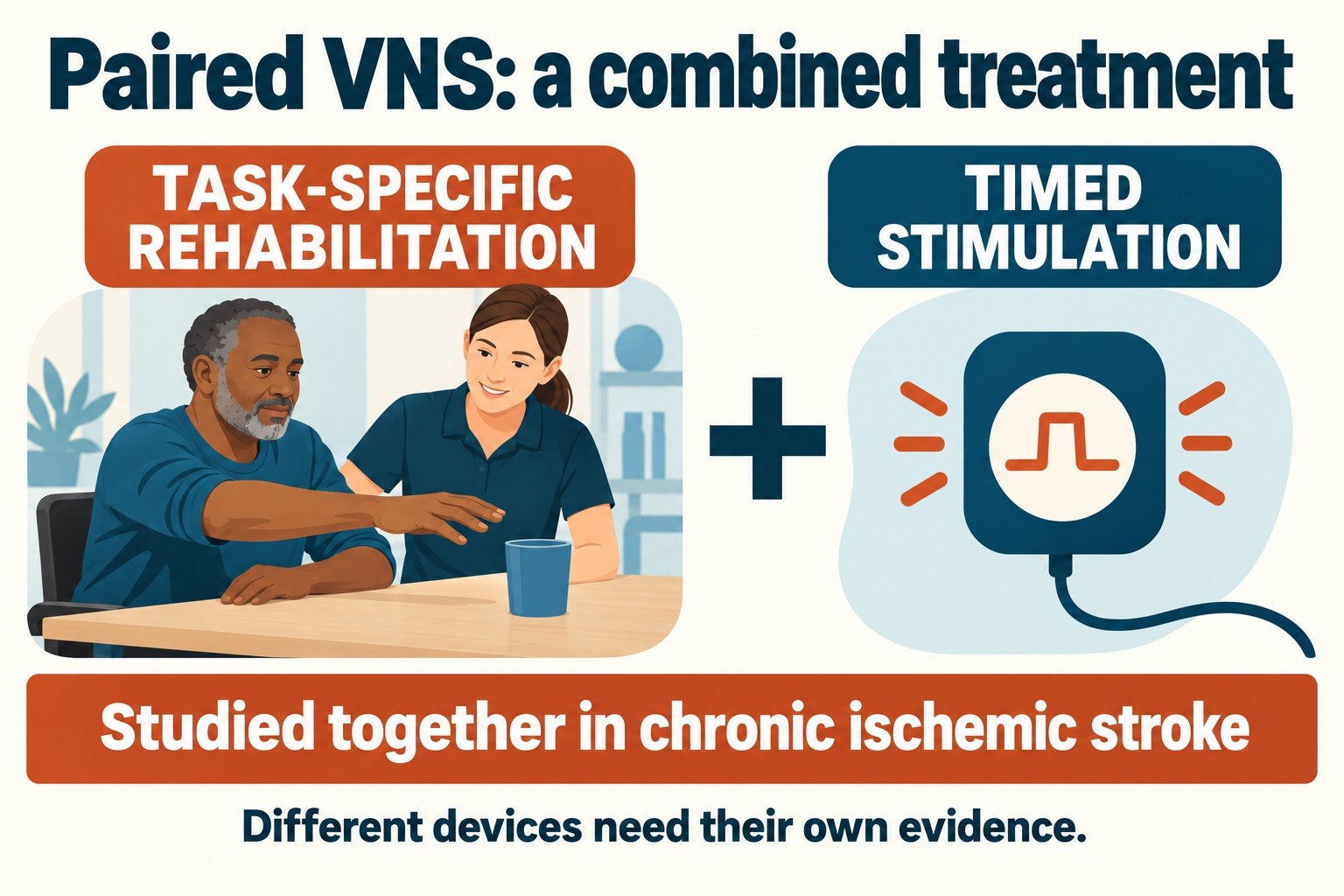
Paired vagus nerve stimulation, or paired VNS, links stimulation with rehabilitation activity. The intervention studied after stroke used an implanted system. It was not a trial of sitting quietly with a consumer device or stimulating the nerve independently of task practice.
The pairing is part of the scientific rationale: stimulation is delivered in relation to an activity that the rehabilitation program is trying to improve. A description that focuses only on the nerve leaves out a major part of what participants did.
This also changes the practical decision. The person is considering surgery, a device and a rehabilitation commitment together. The treatment cannot be assessed as if it were simply an accessory added to an unchanged daily routine.
What the pivotal trial compared
The 2021 VNS-REHAB trial randomized 108 participants at 19 services in the United States and United Kingdom. They had moderate-to-severe arm weakness at least nine months after ischemic stroke. Both groups received rehabilitation; the comparison was active versus sham stimulation.
After the in-clinic therapy, the mean upper-extremity Fugl-Meyer score improved by 5.0 points with active stimulation and 2.4 with sham, a between-group difference of 2.6 points. The trial also reported a higher proportion meeting its meaningful-response threshold at 90 days in the active group.
These findings support an added benefit from the paired intervention in that population. They do not establish complete recovery for everyone. One serious surgery-related event, vocal cord paresis, occurred in the control group, illustrating that implantation risks are relevant even when stimulation is sham.
Read the outcome before interpreting the benefit
The Fugl-Meyer upper-extremity assessment measures aspects of motor impairment. It is not identical to every activity a person wants to perform at home. A meaningful improvement on the scale can be valuable while still requiring discussion of daily use and remaining limitations.
The between-group difference matters because rehabilitation itself can produce improvement. Comparing only the active group’s score with its own baseline would leave out what happened in the sham-and-rehabilitation group. The randomized comparison is what supports the added-treatment claim.
Ask whether a reported benefit is a mean score change or the proportion crossing a responder threshold. Those numbers answer different questions. Neither should be presented as the probability of full restoration without explaining the actual endpoint.
What the longer-term report can and cannot establish
A 2025 one-year analysis followed participants from VNS-REHAB. After the initial controlled phase, control participants crossed over to active paired treatment. The report pooled unblinded outcomes, and 74 participants completed the one-year follow-up.
The investigators reported maintained improvements in impairment, activity and patient-reported measures compared with baseline. That adds useful information about the treated participants. It is not a new one-year randomized comparison between continuing active and continuing sham treatment.
Attrition and crossover belong in the interpretation. The findings should not be described as an independent replication in 108 new patients or as proof that all participants maintained the same benefit. A careful account distinguishes the original comparison from the subsequent follow-up design.
What the FDA approval actually addressed
The FDA’s 2021 approval record for the Vivistim system describes stimulation during rehabilitation to reduce upper-extremity motor deficits and improve motor function in chronic ischemic stroke with moderate-to-severe arm impairment. The indication is specific to that combined use and patient group.
The original patient labeling states that the system is not established as a cure and that individual benefit can vary. It also identifies surgical and clinical considerations that belong in an assessment. Current device details and suitability should be reviewed with the treating team.
An approval for this purpose cannot be used as evidence that all vagus-related products treat stroke. Nor does it establish the same result for hemorrhagic stroke, an acute stroke episode, a different degree of impairment or a different condition. Those are separate evidence questions.
Why consumer products cannot borrow the result
A product may claim to influence vagal activity through sound, vibration or stimulation at the ear. Even if a proposed pathway is plausible, the delivered exposure differs from an implanted device paired with specific rehabilitation tasks. Evidence must match the actual intervention.
Ask whether the product was tested in people with the relevant impairment, alongside the relevant therapy, using a suitable comparison and meaningful motor outcomes. A general relaxation score cannot establish upper-limb recovery after stroke.
Our vagus nerve and inflammation article covers another part of the field. An inflammation experiment, a stroke trial and a stress-management study should remain distinct, even when they involve the same named nerve.
| Feature | Paired stroke intervention | Question for a different product |
|---|---|---|
| Delivery | Implanted system used with rehabilitation | Does it deliver a comparable exposure? |
| Timing | Stimulation paired with activity | Was the timing relationship studied? |
| Participants | Selected chronic ischemic stroke group | Were similar patients enrolled? |
| Outcome | Upper-limb impairment and function | Was recovery actually measured? |
| Comparator | Sham stimulation plus rehabilitation | What did the control group receive? |
A stroke result does not establish a PTSD treatment
The vagus nerve appears in discussions of stress and trauma as well as rehabilitation. That does not allow results to move automatically between conditions. A motor-recovery trial did not test PTSD symptoms, and a change in stress physiology would not by itself establish recovery of arm function.
The useful question is whether a specific intervention has relevant controlled evidence for the intended condition. Phrases such as autonomic reset or nervous-system balance are too broad to substitute for a defined clinical outcome.
This distinction matters when a commercial page cites several unrelated VNS papers together. A long bibliography can create an impression of general validation while no single study tests the actual claim being sold. Ask which paper supports which sentence.
Consider the rehabilitation commitment alongside the device
Before making a decision, ask how the therapy program will be organized, who will deliver it and which activities will be targeted. The device is not a replacement for rehabilitation. The evidence concerns the combination, so the feasibility of the therapy is part of the treatment question.
Also discuss assessment of progress. A person may prioritize reaching, grasping or participation in a particular daily activity. The team can connect those goals with appropriate measurements and explain what degree of change would be useful.
Our relative and absolute risk guide helps distinguish types of treatment numbers. For this intervention, keep mean scale changes, responder rates and personally meaningful activity in separate parts of the discussion.
Questions for a specialist consultation
Ask whether the stroke type, time since stroke and pattern of impairment fit the evidence and current indication. Bring relevant medical history and a clear account of current arm use. A general description such as weak hand is only a starting point for assessment.
Discuss implantation, follow-up, device management and possible adverse effects. Ask how the team will handle nonresponse or a change in medical circumstances. A treatment plan should make those responsibilities clear rather than emphasizing only a success story.
The pivotal trial was funded by the device developer. Funding does not invalidate the randomized result, but it belongs in transparent reporting. Independent replication and longer-term comparative evidence remain useful when judging the strength and reach of any device claim.
Common questions about paired VNS after stroke
Does stimulation alone reproduce the trial?
No. Participants received stimulation paired with rehabilitation. The results do not establish the same benefit from stimulation without that program or from a different device and exposure.
Did the one-year report repeat the randomized comparison?
No. The later analysis was unblinded and pooled after control-group crossover, with 74 participants completing follow-up. It adds durability information while having different limits from the original controlled phase.
What is the most useful takeaway?
Paired implanted VNS is a specific rehabilitation option with controlled evidence for selected people after chronic ischemic stroke. Evaluate it as a combined clinical program, with realistic goals and specialist assessment, rather than extending the result to every vagus-related device or condition.
Sources and further reading
- Dawson et al., 2021: pivotal VNS-REHAB randomized trial
- Kimberley et al., 2025: unblinded pooled one-year follow-up
- FDA: original Vivistim approval record
- FDA: original Vivistim patient labeling
Continue reading
- Constraint-Induced Movement Therapy After Stroke: Who Was Studied and What Improved
- GLP-1 Drugs and Parkinson’s Disease: Promising Signals, Negative Trials and an Evidence Warning
- Relative and Absolute Risk: Read the Number Behind the Headline
- Lecanemab’s Traditional FDA Approval: Why Confirming Clinical Benefit Mattered