
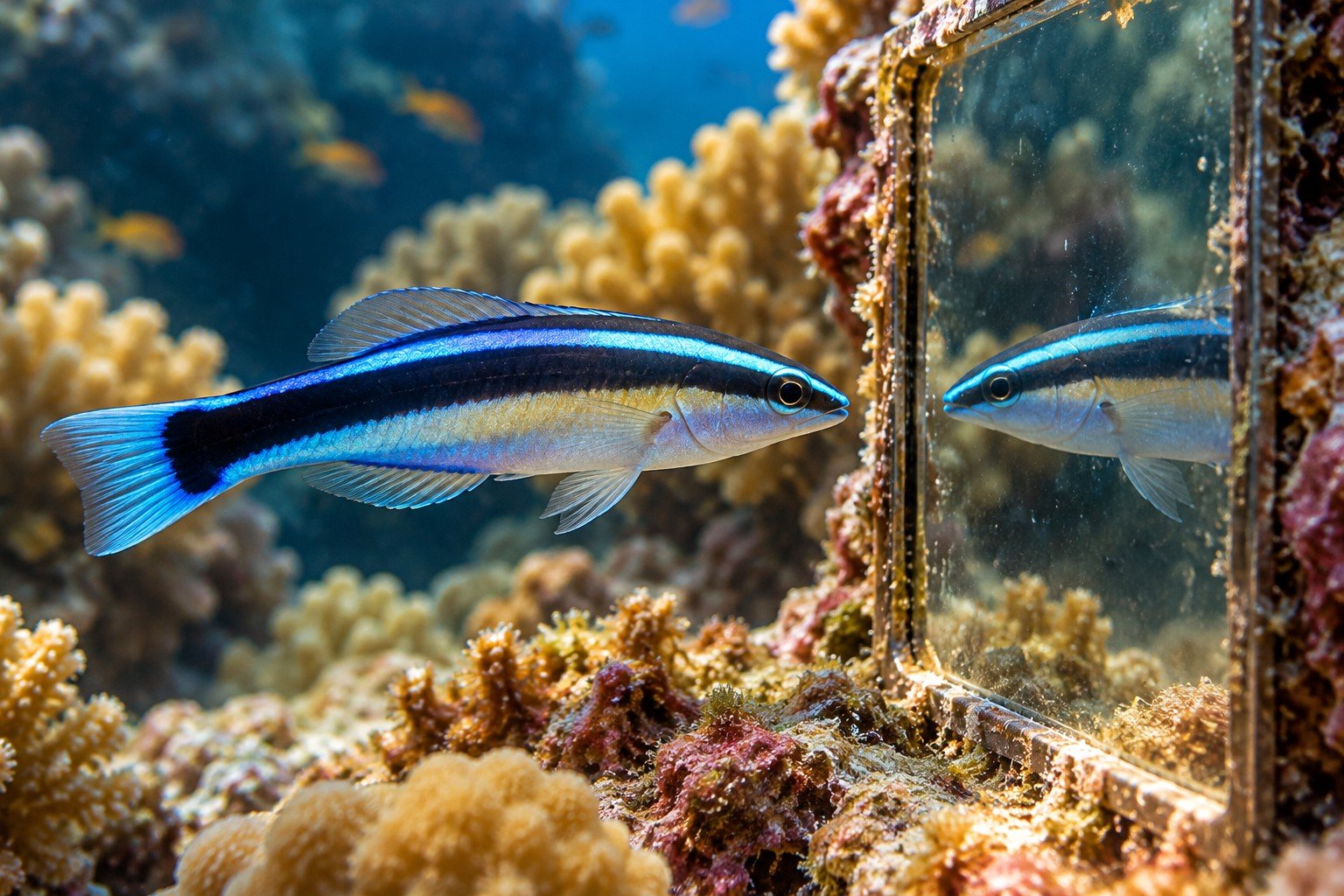
Cleaner Fish and the Mirror Test: What Self-Recognition Experiments Can Establish
Key takeaways
- A mirror response and a positive mark-test result are different observations.
- A 2022 study used mark-color and other controls to investigate competing explanations.
- Photograph experiments ask whether recognition extends beyond a moving reflection.
- Passing one visual task cannot measure every aspect of an animal’s subjective self.
A fish turns toward a mirror and later rubs part of its body against a surface. Whether that sequence indicates self-recognition depends on details that a short video cannot establish. Was there a visible mark? Could the fish feel it? Did the same behavior occur without the mirror?
The cleaner fish mirror test has become a useful case study in how scientists move from observable behavior to a claim about cognition. The experiments deserve attention because of their controls and follow-up questions, rather than because they provide an easy yes-or-no verdict on consciousness.
The species studied is the bluestreak cleaner wrasse, Labroides dimidiatus. Its results challenge assumptions about which animals should be investigated, while also exposing the limits of using one task as a universal measure of an internal mental state.
What the mirror mark test asks
The basic logic is to place a mark where an animal cannot directly see it. If the animal uses a mirror to guide behavior toward that body location, the response can support an inference about recognizing a relationship between the reflection and its own body.
Simply attacking a reflection does not meet that criterion. Neither does losing interest after repeated exposure. Those responses could concern an apparent social partner, novelty or familiarity rather than an understanding of the image as self.
The initial 2019 cleaner-fish study described changes from social responses toward unusual mirror-related behavior and inspection. It also reported responses to marks that the authors interpreted as meeting the mark-test criterion.
The distinction between stages is essential. A sequence of intriguing interactions helps describe the animal’s experience with the mirror. A successful mark test requires the additional connection among the mark, the reflected information and a response directed toward the animal’s own body.
Why the kind of mark matters
A mark might provide information through more than sight. If it creates an irritating sensation, a scraping response could have a different explanation from visually discovering an otherwise unnoticed feature. A suitable control asks what happens when the relevant visual information is unavailable.
The 2022 follow-up varied mark properties and mirror experience. Fourteen of fourteen new individuals scraped their throats after receiving a brown mark in the mirror condition. Blue and green marks did not produce the same scraping response.
The researchers also examined deeper injection, mirror-naive fish, marked companions and relocating the mirror. These comparisons were designed to challenge alternatives to the self-recognition account. The findings should be described together with the relevant conditions rather than compressed into fish know who they are.
Color dependence is itself informative, but it also makes interpretation more specific. A mark meaningful to one species may not be meaningful to another. That raises a measurement question: does a test compare the intended cognitive ability, the importance of the stimulus or both?
Fourteen fish do not establish a universal trait
A fourteen-of-fourteen result describes the reported cohort and condition. It does not imply that every cleaner fish in every setting would respond identically. Differences in experience, handling, motivation or the testing arrangement remain possible sources of variation.
Likewise, a sample of one species cannot be converted into a statement about all fish. Fish is a broad biological grouping, while the experiment concerns a particular species performing a particular task. Generalizing requires additional evidence rather than simply dropping the species name from the headline.
Repeated observations from each animal help establish the response pattern. They do not increase the number of independently sampled fish. Keeping individuals separate from observation periods is especially important when a study includes many sessions or several experimental phases.
These limits do not erase a consistent result. They define its reach. A fair account can describe the performance as striking while retaining the denominator and explaining why replication across groups would improve confidence.
What photographs add to the question
A reflection changes continuously with the animal’s movement. A photograph removes that immediate correspondence. Recognition of a still image therefore provides a different kind of test from responding to a perfectly synchronized reflection.
The 2023 paper used twenty-six fish across experiments. Ten that passed the mirror mark test then viewed composite face–body photographs. A different eight, exposed to mirrors but not previously marked, received a photograph mark test: six scraped their throats after seeing marked self-images. No scraping occurred for unmarked self-images or marked familiar-fish images. These are separate samples and conditions.
That interpretation extends the research question beyond simple movement matching. It does not establish every aspect of a reflective human self-concept. Recognizing a visual identity and reasoning about one’s beliefs, biography or future are different abilities.
The photograph result matters because the fish’s own throat was unmarked: local irritation cannot explain that particular response. Familiar-image controls also test whether seeing a mark on any known fish is sufficient. These comparisons support the authors’ self-image interpretation while leaving the broader nature of self-awareness open.
Self-recognition and self-awareness are not identical
Self-awareness can refer to bodily awareness, distinguishing oneself from another, monitoring knowledge or reflecting on personal identity. Without a definition, two people may appear to disagree about the same result while actually discussing different capacities.
A mark test focuses on a visual and bodily problem. It does not ask an animal to explain what it knows or how it understands its own history. Treating it as a complete test of all self-related cognition gives the apparatus more power than its design supports.
In a published methodological critique, Frans de Waal argued for a gradualist approach and questioned aspects of the original fish interpretation. That critique helps explain why researchers pursued stronger controls rather than treating the first result as the end of the discussion.
The critique should also be read in its chronology. A criticism of the 2019 design is not automatically a direct evaluation of every later experiment. Conversely, a later positive finding does not make every broader philosophical question disappear.
Compare observations with the claims they support
| Observation | Relevant interpretation | Further question |
|---|---|---|
| Social reaction to a reflection | The image is behaviorally important | Is it treated as another animal? |
| Body-directed response with a mirror | Reflected information may guide action | Could sensation explain the response? |
| Different responses to mark colors | Stimulus meaning affects behavior | What feature is necessary for the effect? |
| Recognition-related photograph responses | A moving reflection may not be required | What representation supports recognition? |
This framework avoids both automatic dismissal and automatic acceptance. The right question is whether the experiment rules out the alternatives relevant to its precise claim. A familiar label such as self-awareness cannot substitute for that work.
It also helps explain why failure is difficult to interpret. An animal might ignore a mark for reasons unrelated to self-recognition. A task that depends on vision, body access and motivation is not equally suited to every species. This is a design concern, not proof that every animal would pass a different test.
What the results mean for neuroscience
These studies investigate behavior. They do not directly identify a complete neural circuit for self-recognition, and they do not show that a fish’s brain reproduces a human brain’s organization.
A neural account would need to connect relevant activity or interventions to task performance while distinguishing sensory, motivational and movement effects. Similar outcomes across species can motivate that comparison, but they cannot provide it by themselves.
Our article on how dogs respond to human faces illustrates another route from behavior to neural evidence. Comparing studies is useful when the measurements remain distinct. A fish’s scraping response and a dog’s brain-scan response are not interchangeable indicators of understanding.
The broader value lies in asking better questions about capacities outside familiar mammalian models. That does not require ranking all animals on a single ladder or assuming that a human word names an identical experience in every nervous system.
Common questions about the cleaner fish mirror test
Does passing prove consciousness?
It provides evidence relevant to a specified self-recognition claim. Consciousness is a wider question that cannot be settled by one body-directed response. State the observed result before deciding how much theoretical meaning to assign it.
Do all fish recognize themselves?
The studies discussed here concern cleaner wrasse and particular testing histories. Extending their results to all fish would require evidence from other species and suitable methods.
Did the fish understand the mark as a parasite?
The ecological interpretation helps motivate mark choices, but a response does not supply a verbal explanation of what the animal believed. Keep the stimulus design separate from certainty about an internal concept.
Should an aquarium owner repeat the experiment?
The papers describe approved research procedures rather than a home demonstration. Applying marks, provoking scraping or repeatedly exposing an animal to a mirror is unnecessary for appreciating the finding. Reading the methods and comparison conditions is more informative than trying to obtain a dramatic reaction from a pet.
Sources and further reading
- Kohda et al., 2019: initial cleaner-fish mark-test study
- Kohda et al., 2022: follow-up experiments and mark controls
- Kohda et al., 2023: self-face photograph experiments
- de Waal, 2019: gradualist interpretation and methodological critique


