Transformers and the Brain: What Language Alignment Studies Can Actually Establish
Key takeaways
- Self-attention is a specified computational operation, not a synonym for conscious attention.
- Predicting a measured response can support a useful model without uniquely identifying the underlying mechanism.
- Next-word prediction and contextual representations have empirical links with language-processing signals in selected studies.
- Results from particular models and experiments are not a universal ranking of products or minds.
A language model predicts words, and a person listening to speech also anticipates what may come next. That resemblance has become a productive research question: can a model help explain the brain signals recorded during language comprehension?
Transformers and brain-language studies have produced striking results. Yet the word alignment can conceal different comparisons, from predicting a measured response to matching a pattern across experimental conditions. It should not be read as a claim that a model and a person are interchangeable.
The goal here is to explain the computational idea, the primary experiments and the limits that belong beside the headline. The useful question is which part of language processing a model helps researchers understand.
What self-attention means in a transformer
Vaswani and colleagues’ 2017 paper, Attention Is All You Need, introduced a transformer architecture for sequence processing. Self-attention relates positions within a sequence to help compute representations. The original work evaluated machine translation and parsing, not the biology of human attention.
In plain language, the operation lets a representation incorporate information from other positions according to a defined calculation. The technical name does not establish awareness, intention or a feeling of concentrating. Nor does a model’s use of the operation tell us where an equivalent process occurs in a brain.
A familiar word can be a useful entry point while still being a technical term. The same caution applies to memory, learning and understanding when they describe operations or measured performance in a computational system.
What is being aligned with the brain?
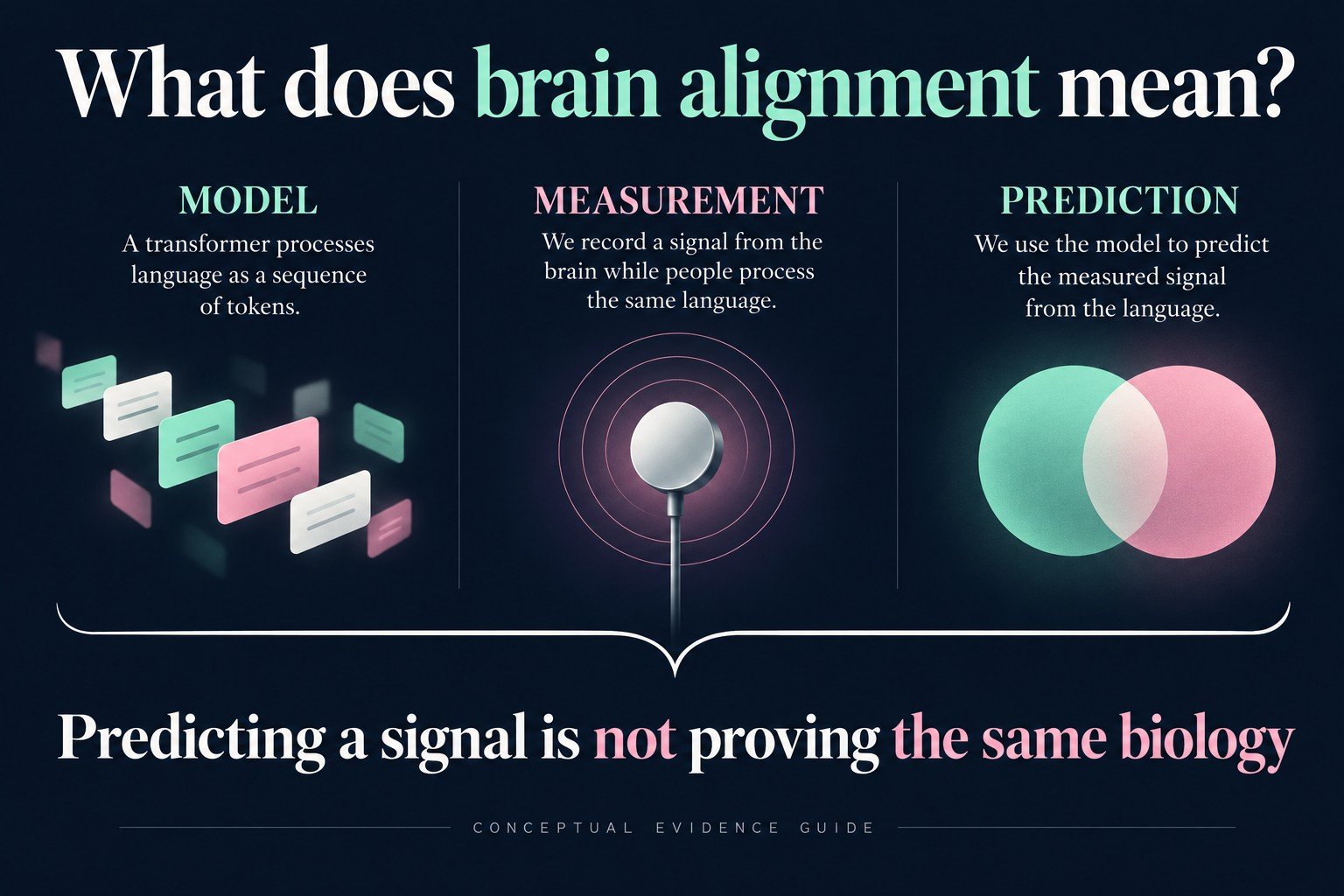
A researcher can present the same language to people and to a model, record human responses and examine whether model-derived features help predict those responses. This is the general comparison used in the language studies discussed below.
The prediction may involve a mapping from model features to measurements. That mapping matters. A good prediction is evidence that the features contain useful information about the measured outcome; it is not a direct observation that every model unit corresponds to one neuron.
Ask what counts as the target signal. Functional MRI and electrocorticography measure different aspects of brain activity. A result tied to one signal, stimulus and recording arrangement cannot be described as a complete match to everything the brain does during language.
What the 2021 integrative study found
Schrimpf and colleagues’ 2021 PNAS study compared computational language models with neural and behavioral datasets. Strong transformer models predicted a large share of explainable variation in neural responses to sentences. The work included functional MRI and electrocorticography datasets.
Model performance on next-word prediction was associated with neural and behavioral fit, while architecture also contributed. The authors interpreted the pattern as evidence supporting a predictive-processing account of language comprehension.
The phrase explainable variance is essential. It concerns the portion of variation available to explain under the study’s measurement and analysis conditions. It is not a percentage of the entire human mind that a model has reproduced.
Likewise, a relationship across models does not identify one component as the only causal explanation. The result helps constrain scientific models, while leaving questions about mechanisms and alternative accounts open.
A natural-story study examined prediction and context
In Goldstein and colleagues’ 2022 study, nine participants listened to a thirty-minute podcast while brain responses were recorded with electrocorticography. The investigators compared those responses with an autoregressive language model processing the narrative.
Their analyses supported shared computational principles involving prediction before a word arrived, surprise after it arrived and contextual representations. The findings provide a concrete connection between aspects of predictive language computation and measured neural activity.
They do not establish that the participants were running the model’s code or that a model has their broader experience of listening. The experiment used a particular narrative, recording setting and analysis. Those conditions belong in any description of its scope.
It is also useful to distinguish context-dependent representation from a fixed dictionary entry. The same word in different surroundings can carry different information for a model. The study investigated how such contextual features related to neural responses, rather than treating a word as one unchanging numerical label.
Why prediction does not uniquely establish mechanism
Imagine two hypothetical models that both predict a recorded signal accurately. One may use a different internal representation from the other. If the current experiment cannot distinguish their predictions, a good fit alone cannot tell us which internal explanation is correct.
A stronger next test would identify conditions under which the models disagree. This example illustrates scientific reasoning, not an additional result from the cited papers. It explains why successful prediction is valuable while remaining one part of a mechanistic argument.
Our correlation and causation guide offers a related distinction. Evidence that two patterns correspond should not silently become proof of the entire causal story proposed to connect them.
Four claims that need different evidence
| Claim | Appropriate question | What does not establish it alone? |
|---|---|---|
| A model predicts a neural response | How well does it generalize to held-out measurements? | A visually appealing network diagram |
| A computation is shared | Which specific operation and alternatives were tested? | Similar vocabulary |
| The biological mechanism is the same | What evidence distinguishes competing mechanisms? | A strong statistical fit |
| A system has conscious experience | What theory and evidence address that separate claim? | A language benchmark or brain score |
This table keeps the interpretation proportional to the measurement. The first result can be scientifically impressive without already demonstrating the last three. Treating every limitation as a failure would be as misleading as ignoring the limitations altogether.
Attention weights are not an all-purpose explanation
An attention pattern is an internal quantity in a defined architecture. It can be inspected, but its scientific meaning depends on the question being asked. A highlighted word in an interface should not automatically be treated as a map of human attention or a complete explanation of a model’s answer.
The original transformer paper specifies one computational design. The neural studies ask how features from selected language models relate to measured responses. Neither grants a general rule that any visible attention map explains either a person’s thought or every aspect of a product’s behavior.
When an illustration uses arrows between words, ask whether it is a conceptual explanation or an actual analysis. A simplified diagram can be helpful if it is labeled clearly. It should not be presented as experimental neural evidence.
Read a brain-score headline with five details
First, identify the exact model and version. A result about a research model is not automatically a result about a current subscription product. Second, identify the language task and stimuli. Third, identify the neural measurement.
Fourth, ask how the model features were connected to the data. Fifth, ask how performance was evaluated on information not used to fit that connection. These details help distinguish a meaningful prediction from an attractive resemblance selected after the fact.
The details also make updates interpretable. A later model can improve on one dataset and still leave the mechanistic question unresolved. Progress in prediction and progress in biological explanation are related, but they should be described separately.
What this means for learning and AI purchases
A paper showing a useful brain-language correspondence is not a trial showing that a chatbot improves your memory or teaches a subject effectively. Those practical claims require relevant learning outcomes in intended users.
If a course or app describes itself as aligned with the brain, ask which result supports that phrase. Does the service use the tested model, and does the advertised benefit match the outcome? A science reference cannot fill the gap between a neural comparison and a purchase promise.
Our article on AI study tools and memory retention focuses on that separate practical decision. This article does not provide a product ranking, a consciousness test or a record of our hands-on testing.
Common questions about transformers and brain language
Does self-attention mean a model pays attention like a person?
Not by definition. It names a computational operation. A claim about human attention needs an explicit comparison and relevant evidence, rather than inference from the shared word.
Did a model explain nearly all of language comprehension?
The strong result in the cited study concerned explainable variation in particular neural measurements. It did not establish a complete explanation of language, personal meaning or all human communication.
Why use a model if its biology is different?
A model can organize observations, produce quantitative predictions and suggest new experiments. Its value depends on the question it answers and the limits it makes explicit, not on being a literal duplicate of a brain.
Sources and further reading
- Vaswani et al., 2017: Attention Is All You Need
- Schrimpf et al., 2021: integrative modeling of the neural architecture of language
- Goldstein et al., 2022: shared computational principles during narrative processing