TMS for Depression: Evidence, Treatment Options and Questions to Ask a Clinic
Key takeaways
- rTMS is a clinical procedure, distinct from meditation headbands, consumer electrical stimulation and ketamine services.
- Randomized comparisons support benefit in selected patients, but not everyone responds or reaches remission.
- Theta burst protocols can shorten individual sessions, while the whole treatment plan still matters.
- Ask about eligibility, safety, the exact protocol, total cost, outcome tracking and follow-up.
When depression has not improved with earlier care, another treatment option can offer hope and a new set of decisions. The phrase brain stimulation may sound intimidating or attract overly simple claims about resetting mood. Neither reaction provides enough information for a good choice.
TMS for depression has a clinical evidence base. The decision is still individual: which condition is being treated, what has already been tried, which protocol is proposed and what benefits and burdens are realistic for this person?
This guide explains the evidence and provides questions for a qualified treatment team. It does not determine eligibility or recommend changing medication. A consultation should connect research findings with the person’s history and preferences.
What rTMS does
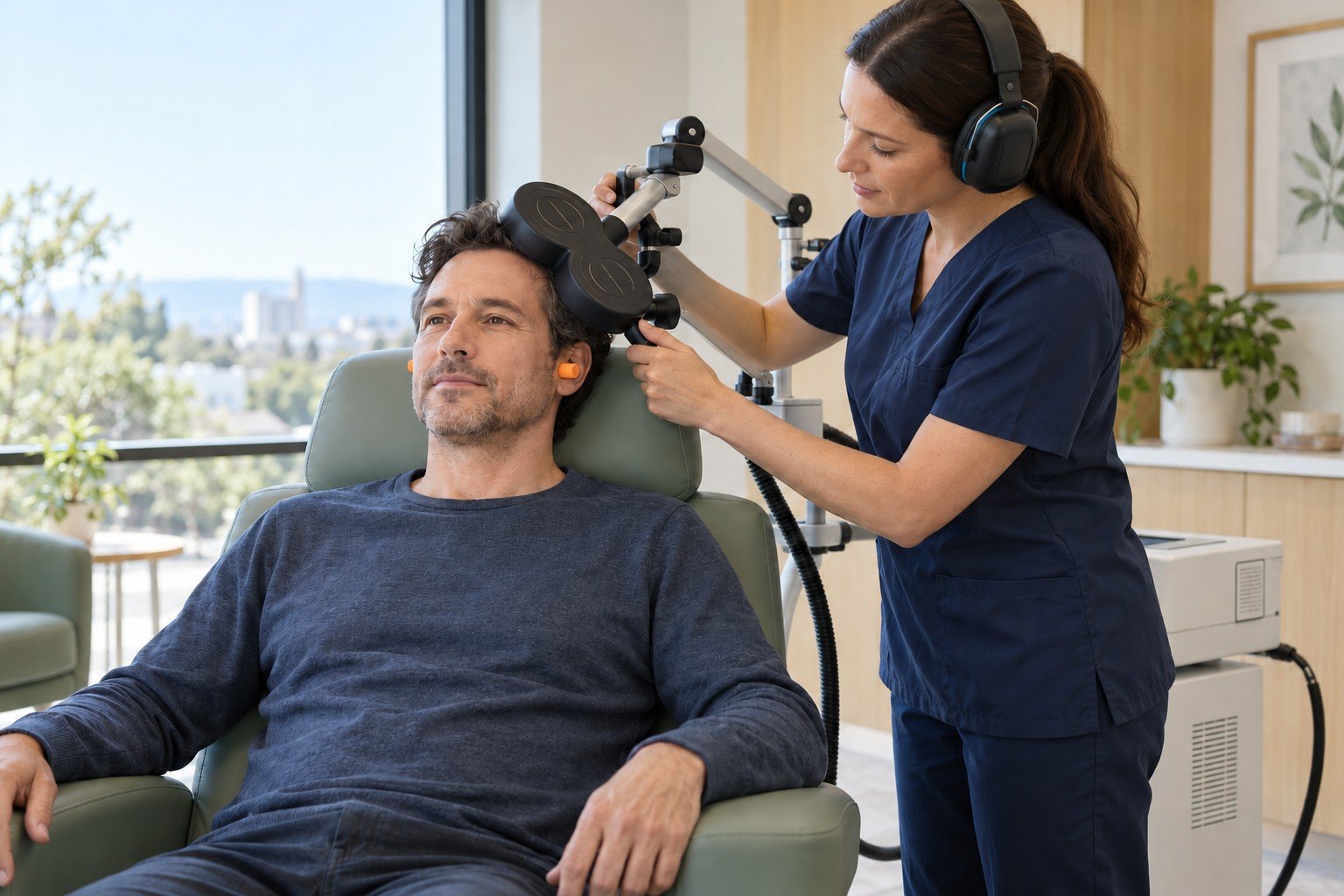
NIMH describes rTMS as a noninvasive procedure in which rapidly changing magnetic fields induce electrical currents that influence neural activity. A coil is held near a selected scalp location. Depression protocols commonly target prefrontal regions involved in relevant circuits.
The dorsolateral prefrontal cortex is often abbreviated DLPFC. Its involvement does not mean that one spot contains depression or that a treatment switches an entire network back to a factory setting. Target and stimulation parameters belong to a clinical protocol, not a general wellness recipe.
The phrase noninvasive refers to the absence of implanted electrodes or surgery in this procedure. It does not mean that medical screening, professional oversight or discussion of adverse effects can be omitted.
What treatment resistance means in practice
The term usually describes insufficient benefit from previous treatment, but exact criteria can differ across studies, clinical pathways and insurance policies. A clinic should explain the definition it uses and review whether earlier treatments were appropriate and adequately tried.
Prepare a history that includes medicines, psychotherapy, benefits, side effects and reasons something stopped. If records are incomplete, say so. An accurate account is more useful than assuming that a certain number of prescriptions automatically determines the best next treatment.
Assessment also considers the diagnosis, other symptoms and medical history. The question is not simply whether someone wants a technology-based option. It is whether the proposed procedure fits the clinical situation and how it compares with reasonable alternatives.
What a sham-controlled trial showed
In George and colleagues’ randomized trial, an intention-to-treat sample of 190 adults was used to compare active left-prefrontal rTMS with sham. Remission during the blinded phase was reported in 14.1% of active-treatment participants and 5.1% of sham participants.
That difference supports clinical benefit under the trial’s conditions. It also shows why an average result is not a guarantee: most participants did not reach remission in that phase. Later open-label treatment answers a different question from the initial blinded comparison.
Response and remission are also different endpoints. A person may improve substantially without meeting a remission threshold. Ask a clinic which outcome its advertised percentage describes, how it was measured and who was included in the denominator.
What theta burst evidence adds
The THREE-D trial compared intermittent theta burst stimulation, or iTBS, with a standard high-frequency rTMS protocol in 414 participants. It found the shorter iTBS protocol non-inferior for the primary depression outcome under the study’s conditions.
Non-inferior means the comparison met a predefined statistical standard against an active treatment. It does not mean every abbreviated schedule is identical or that the study compared both approaches with sham. In that trial, individual sessions differed substantially in duration.
The result can matter for access and scheduling, but a short session does not automatically mean a short total course. Ask about preparation, number of visits, total time at the clinic and the follow-up plan, as well as minutes of stimulation.
Accelerated schedules require their own evidence
An accelerated course may deliver several sessions in a day. That is a different scheduling approach from one brief session each weekday. Marketing sometimes combines the ideas, so request the actual protocol rather than relying on the word rapid.
Ask which study supports the device, target-selection method, schedule and population being proposed. If the clinic cites a protocol it does not deliver, ask what evidence justifies the substitution. A familiar acronym does not resolve those differences.
Travel and time away from home may change the practical comparison. An intensive schedule can reduce repeated journeys for some people while creating other burdens. The preferred option depends on clinical suitability and the person’s circumstances, not only speed.
Distinguish TMS from other services
| Approach | Key distinction | Question for the provider |
|---|---|---|
| rTMS or iTBS | Magnetic stimulation using a defined clinical protocol | Which device, target and course are proposed? |
| ECT | A different procedure involving anesthesia and a deliberately induced seizure | Why might this or another option fit the clinical situation? |
| Consumer EEG headband | Records signals for a device-specific purpose | What does it measure, and is a treatment claim supported? |
| Ketamine-based service | A medication-based intervention with separate evidence and oversight | What treatment is actually being offered? |
The NHS depression treatment overview describes brain-stimulation options within specialist care. Treatments should be compared in context. One person’s experience with ECT, a medication or a wearable does not establish what another person should expect from TMS.
Do not let a referral or affiliate link blur the distinction. A site discussing TMS should not send a reader to a different intervention while implying it is the same service. This article does not endorse or claim personal experience with a clinic or platform.
Safety screening is part of the treatment
The FDA’s rTMS special-controls guidance addresses risks including seizures, hearing effects, interactions with relevant implanted or metallic objects and clinical worsening. Screening and appropriate hearing protection are part of responsible delivery.
Give the team a complete account of implants, relevant medical history, medicines and changes in sleep or substance use. Ask how new symptoms or medication changes during the course should be reported. A previously completed questionnaire is not a reason to withhold a later change.
Common treatment experiences can include scalp discomfort and headache. The team should explain what is expected, what needs assessment and how concerns will be managed. A promise of no side effects is less useful than a clear monitoring and response plan.
If you are in crisis or thinking about harming yourself, call or text 988 in the US to reach the 988 Suicide and Crisis Lifeline, or contact local emergency services.
Ask how the clinic tracks improvement
Before treatment, agree on symptom measures and practical goals. These could include aspects of daily functioning that matter to the person, alongside standardized ratings. Record the starting point so later discussions are based on more than a general impression.
Ask when progress will be reviewed and what happens if improvement is limited. Does the plan allow reassessment? Who coordinates with the existing prescriber or therapist? What constitutes completing the course, and what follow-up is offered if symptoms return?
For a success rate, ask whether it includes everyone who began treatment or only those who finished. Ask whether outcomes come from a published trial, a clinic’s own records or testimonials. Those sources can be informative but should not be presented as interchangeable.
Understand the full practical commitment
Request the expected number of visits, appointment duration, transportation considerations and total price. Clarify what insurance authorization covers, what could produce extra charges and whether follow-up or maintenance is included. Get the proposed terms in writing before committing.
Also ask who performs each part of care and who is responsible for medical decisions. A welcoming room or an impressive device does not replace clinical qualifications, supervision and a clear communication plan.
Bring questions about continuing other treatment. Do not independently stop a medicine or therapy to prepare for TMS. The treating professionals should coordinate changes and explain their reasons. The goal is an integrated plan, not a competition between technologies.
Frequently asked questions
Is TMS a cure for every kind of depression?
No. Evidence supports particular uses, and outcomes vary. Suitability depends on assessment and the proposed protocol. Response, remission and long-term maintenance should be discussed separately.
Is TMS the same as ECT?
No. They use different procedures and have different practical and clinical considerations. A qualified specialist can explain why one option or another is appropriate rather than treating them as substitutes based only on the phrase brain stimulation.
Does a three-minute session mean treatment ends in one visit?
No. Session duration and total course are different. Ask for the complete schedule, including preparation, visits and follow-up.
Can I replace clinical TMS with a home headband?
Evidence for a specified clinical magnetic-stimulation protocol does not validate a consumer recording or electrical-stimulation device. Verify what the product actually does and what evidence supports its intended use.
Illustration of a clinician positioning a TMS coil beside an awake patient wearing hearing protection.
For help evaluating treatment claims, see how placebo comparisons work in clinical trials. Our mental health reading guide also distinguishes scientific evidence from broader explanations and advice.
Sources and further reading
- NIMH. Brain Stimulation Therapies.
- George et al. (2010). Daily left prefrontal transcranial magnetic stimulation therapy for major depressive disorder: a sham-controlled randomized trial. Archives of General Psychiatry, 67, 507-516.
- Blumberger et al. (2018). Effectiveness of theta burst versus high-frequency repetitive transcranial magnetic stimulation in patients with depression (THREE-D): a randomised non-inferiority trial. The Lancet, 391, 1683-1692.
- NHS. Depression in adults: Treatment.
- FDA. rTMS systems special-controls guidance.