
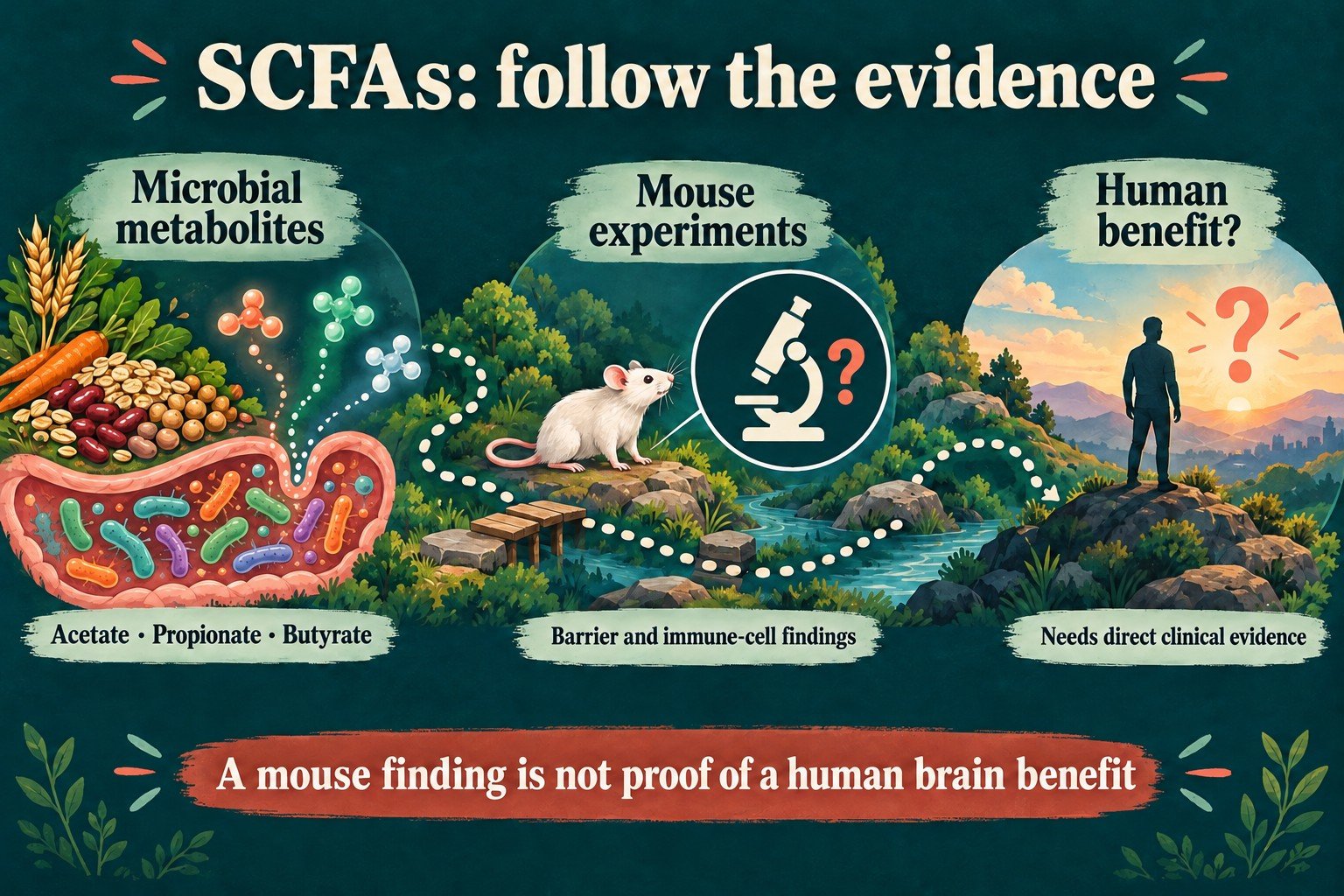
SCFAs and the Blood-Brain Barrier: What Mouse Studies Mean for Human Nutrition
Key takeaways
- Acetate, propionate and butyrate are related metabolites with different biological roles.
- The gut barrier and blood-brain barrier are separate structures.
- Germ-free mouse experiments are not trials of retail probiotics in people.
- A human prebiotic trial can investigate cognition without proving a barrier-repair mechanism.
A product that promises to protect the brain by feeding gut bacteria compresses several steps into one attractive story. Microbes must produce a relevant substance, the substance must affect the intended pathway, and the change must lead to a meaningful benefit. Evidence for one step cannot settle the others.
Short-chain fatty acids are an important part of this research. Our gut-brain axis guide covers the wider communication system. Here, the focus is the experiments behind blood-brain barrier claims and how carefully they translate to nutrition decisions.
What SCFAs are
SCFAs are small fatty-acid metabolites associated with microbial fermentation in the gut. Commonly discussed examples include acetate, propionate and butyrate. The term describes a chemical group, rather than a single ingredient with one uniform effect.
Dietary fiber, a prebiotic preparation, a probiotic organism and an SCFA supplement are different interventions. Fiber supplies substrates; a prebiotic is intended to be used by relevant microbes; a probiotic supplies specified microorganisms; a metabolite product supplies a chemical preparation. Evidence should follow the actual intervention.
This matters because a commercial label may move between these categories without explanation. A paper about a bacterial community does not automatically validate a capsule containing butyrate, just as a capsule study would not establish the effect of every fiber-rich meal.
The relevant questions include which compound was studied, how it was delivered and what was measured. Increasing a metabolite in one compartment is different from demonstrating that enough reaches another compartment to cause the proposed outcome.
Distinguish the two barriers
The intestinal barrier separates the gut contents from the body’s internal environment. The blood-brain barrier regulates exchange between the circulation and brain tissue. They are connected within a larger physiological system, but they are not the same wall in two locations.
For the brain barrier, researchers can examine permeability and proteins associated with tight junctions between endothelial cells. A change in those measures is a specific experimental result. It should not be casually translated into a complete diagnosis of a leaky brain.
Likewise, digestive symptoms do not identify blood-brain barrier damage. A person does not need to accept that explanation to discuss persistent symptoms with a clinician. The experience can deserve assessment even when the proposed mechanism has not been demonstrated.
The distinction also prevents misleading diagrams. An arrow running from the intestine to the brain may represent a hypothesis or communication route. It cannot show that a particular food directly seals human brain vessels unless that outcome was actually tested.
What the blood-brain barrier mouse study showed
In Braniste and colleagues’ 2014 study, germ-free mice showed greater blood-brain barrier permeability than mice raised with a normal microbiota. The finding was associated with lower expression of tight-junction proteins including occludin and claudin-5.
Introducing microbiota into germ-free adult mice reduced permeability and increased tight-junction protein expression. The experiments provided evidence that the microbial environment can influence barrier properties in this model.
Germ-free animals are a special experimental condition. They are not equivalent to a person who eats few vegetables or receives a low diversity score from a stool test. Moving from that model to an everyday dietary recommendation requires additional evidence.
The study also does not establish that a human brain-fog symptom reflects the same abnormality. Permeability measurements, protein expression and subjective cognitive complaints are different endpoints. A credible clinical claim would need a study connecting the specific intervention with the relevant human outcome.
What microglia experiments add
Erny and colleagues’ 2015 research examined microglia, immune cells within the central nervous system, in mice with different microbial conditions. Germ-free mice had altered microglial characteristics and impaired innate immune responses. Recolonization with a complex microbiota partially restored features.
The investigators identified SCFAs as regulators of microglial homeostasis in the model. Mice lacking the SCFA receptor FFAR2 also showed defects resembling those observed under germ-free conditions.
This is a mechanistic contribution about microbial influences on immune-cell biology. It does not mean that more microglial activity is always better, that every inflammatory condition needs more butyrate or that a supplement can normalize a person’s brain immune cells.
The important distinction is between restoring features in an experimental model and optimizing a healthy consumer’s cognition. Those are different starting points and goals. A useful article should preserve that distinction rather than turn an animal result into a universal performance protocol.
What a human prebiotic trial can tell us
The 2024 PROMOTe randomized trial included 36 twin pairs aged 60 or older. One twin in each pair received an inulin/fructo-oligosaccharide prebiotic, while the other received placebo for 12 weeks. Both groups received the same protein supplement and exercise advice.
The prebiotic changed aspects of the microbiome and improved a combined cognitive measure, a secondary outcome. The primary muscle-function outcome, chair-rise time, did not improve significantly. The authors noted uncertainty about the clinical meaning of the cognitive change.
This is encouraging human evidence for a specific intervention and outcome. It is not a direct test of whether SCFAs repaired the participants’ blood-brain barrier. The trial cannot establish that barrier repair caused the cognitive finding.
It also should not become a recommendation to copy a dose or replace clinical care. The intervention, population and study duration belong to the result. An unrelated probiotic blend or metabolite capsule cannot inherit the trial’s findings through a shared gut-health label.
Follow each claim to its measurement
| Claim | Relevant measurement | Missing inference to avoid |
|---|---|---|
| Changes gut bacteria | A defined microbiome analysis | Therefore repairs brain vessels |
| Alters barrier permeability | A validated barrier measure in the studied model | Therefore improves daily cognition |
| Changes a cognitive test | A specified human task or composite | Therefore prevents dementia |
| Supplies butyrate | Ingredient identity and delivered exposure | Therefore reproduces microbial signaling |
The table is a reading guide, not a ranking system. A study can be valuable even if it answers only one question. The problem arises when a marketer quietly replaces its actual endpoint with a more attractive promise.
For example, a favorable stool-test result may be presented next to a claim about concentration. Ask where concentration was tested and how it changed relative to a comparison group. The first result does not supply the missing second result.
Make practical food decisions without a brain-barrier target
A useful nutrition decision can begin with your meals, preferences and tolerance. Our dietary fiber guide explains how to compare foods and supplement labels. You do not need to pursue a claimed optimal butyrate score to make an ordinary food comparison.
Choose a concrete change you can sustain, such as including a familiar fiber-containing food more regularly if appropriate for your circumstances. Describe the change as a dietary choice rather than a proven neurological treatment. If a gastrointestinal condition complicates food choices, ask for individualized guidance.
Pay attention to tolerability when considering concentrated prebiotics. The fact that a substrate feeds microbes does not establish that every person should take more of it. Discuss persistent digestive symptoms rather than escalating a product because discomfort is described as evidence that it is working.
Questions before paying for a test or supplement
Ask what the test measures directly. A stool sample represents material leaving the gut; it is not a direct sample of brain tissue or a measurement of blood-brain barrier permeability. A recommendation derived from the result needs its own validation.
For a supplement, identify the precise ingredient, formulation and claim. Then ask whether a randomized human trial tested that product for that outcome. A list of animal papers can explain the rationale without establishing clinical effectiveness.
Consider what would count as a reason to stop or reconsider. A plan should not depend on buying more tests indefinitely or interpreting every symptom as proof of a hidden barrier problem. Cost and burden matter even when the mechanism sounds plausible.
Frequently asked questions
Are SCFAs always beneficial?
The evidence does not support one universal effect across compounds, tissues, exposures and conditions. Specify the biological setting and measured outcome rather than assuming that a higher level is always the goal.
Does low microbial diversity diagnose a leaky brain?
The studies reviewed here do not validate that diagnosis. A microbiome measure cannot, by itself, establish damage to a particular brain barrier or explain an individual’s symptoms.
Does the twin trial prove dementia prevention?
No. It examined a short intervention and measured cognitive performance among other outcomes. It did not establish prevention of dementia or identify barrier repair as the cause of improvement.
Should I take butyrate for brain fog?
These studies do not establish that treatment. Persistent cognitive concerns deserve an appropriate clinical assessment. Bring the product label and the specific claim to the conversation rather than assuming the mechanism is already confirmed.
Sources and further reading
- Braniste et al. (2014): microbiota and mouse blood-brain barrier
- Erny et al. (2015): microbiota, SCFAs and microglia in mice
- PROMOTe trial (2024): prebiotic intervention in older twins