
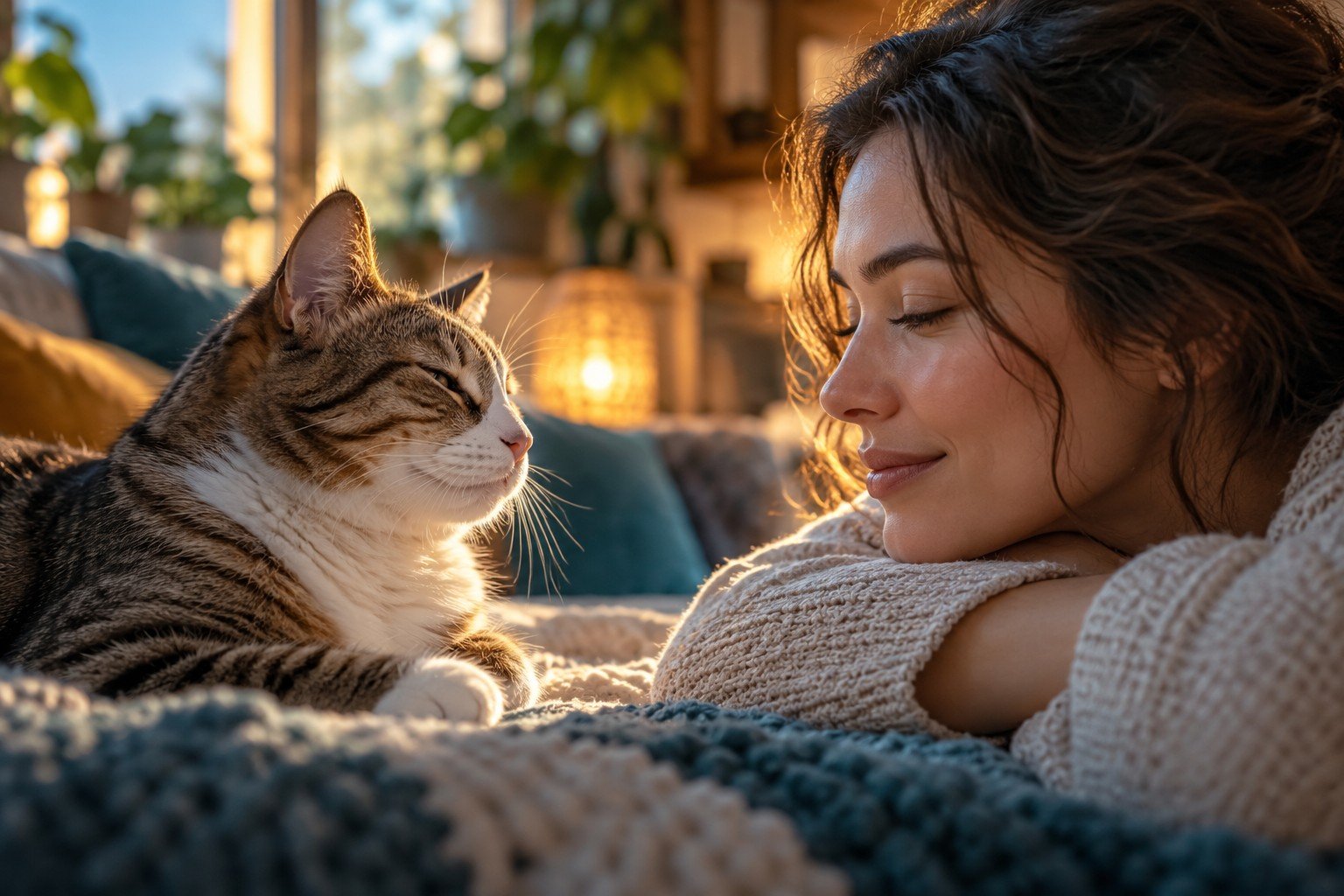
Cat Slow Blinking: What Eye-Narrowing Studies Reveal About Communication
Key takeaways
- Slow-blink sequences differ from ordinary reflexive blinking.
- The study recruited twenty-one and twenty-four cats; eighteen remained in each experiment’s final analysis.
- Approach to an offered hand was a measured choice, not a complete assessment of trust.
- Read eye movements alongside posture and the cat’s opportunity to disengage.
A cat watches you, partly closes its eyes and opens them again. The moment can feel reassuring. Explaining it scientifically means asking whether that movement changes during particular interactions, not assuming that every narrowed eye carries the same message.
Cat slow blinking is an approachable example of research on communication between species. The movements are small, but researchers can define and count them. They can also compare a slow-blink interaction with a condition in which the person behaves differently.
The findings support taking this behavior seriously as part of positive communication. They also give a reason to be specific: an eye movement, an approach and willingness to be touched are different observations. A careful account lets each retain its own meaning.
What researchers mean by cat slow blinking
A slow-blink sequence can include partial blinks, sustained narrowing and eye closure. It is not simply any moment when an eyelid moves. Clear definitions matter because a response category that includes everything would be difficult to interpret.
The 2020 communication study used anatomically informed facial-action coding. Researchers distinguished different eye movements and compared them across conditions. Ordinary reflexive blinking was not interchangeable with the slow-blink-related actions.
That approach improves on judging an interaction solely by whether it looks friendly to a person. A defined movement can be coded by more than one observer and related to a specified period. The inference about its communicative role comes after the observation has been made clear.
At home, you do not need to assign a technical code. The useful distinction is between a description, such as the eyes narrowed briefly, and an explanation, such as the cat felt safe. The second may be plausible while still requiring more context.
What the two cat slow blinking experiments compared
The first experiment recruited twenty-one cats from fourteen households and compared owner slow blinking with no owner–cat interaction. After three outlying dyads were excluded, eighteen remained in the final analysis. Cats showed more relevant eye movements in the slow-blink condition.
The second recruited twenty-four different cats and compared an unfamiliar experimenter’s slow blinking with a neutral face without direct eye contact. Six exclusions left eighteen cats. Following the slow-blink condition, cats had higher approach scores toward the experimenter’s offered hand.
The design therefore supplied two related outcomes: a change in the cat’s own eye movements and a change in approach. The second was defined through movement toward, away from or neither toward nor away from the hand. It was not a test of permission for unlimited handling.
Both experiments used the same cats in their respective comparison conditions, with condition order counterbalanced. Each cat therefore provided its own comparison. The final samples of eighteen remain small, and excluding unusually high or low responses limits how confidently the pattern can be generalized to all cats.
Why the comparison face matters
A neutral face without direct eye contact is a particular control. It does not represent every possible alternative interaction, such as a direct stare, an averted body or a person speaking softly. The experiment’s conclusion should travel with the condition it used.
That point is easy to overlook when coverage says slow blinking makes cats like strangers. Liking is a broad interpretation, whereas a brief approach score is a specified outcome. Higher scores indicate a greater tendency to move toward the offered hand during the test, rather than a complete assessment of how the cat felt about the person.
Likewise, a response following a human expression does not necessarily establish conscious imitation. A cat could adjust its behavior to a social cue without representing the person’s intention in a human-like way. The study did not require the animal to explain why it responded.
Shelter research adds a different kind of evidence on cat slow blinking
A separate shelter study investigated slow blinking in eighteen cats and its relationship with rehoming. It reported an association between components of the eye-closure response and quicker adoption, alongside evidence of eye narrowing during human slow-blink interactions.
The adoption finding is an association. It does not establish that training a cat to blink will cause an earlier adoption, or that people consciously select cats on that basis. Several features of animals, visitors and shelter routines could contribute to rehoming time.
The shelter paper also reported a tendency for cats identified as nervous around people to spend longer producing slow-blink sequences. The authors suggested that these movements may occur in both friendly and submissive contexts. That makes the surrounding interaction especially important when interpreting an individual cat.
The distinction matters practically. A shelter cat’s adoption suitability should not be judged from one expression. An observation about response patterns is not a complete assessment of the animal’s needs, history or fit with a household.
Choice and control put the expression in context
Research on broader interactions offers a useful complement. A 2021 handling-guidelines study filmed one hundred shelter cats interacting with one hundred and twenty members of the public. Guidelines emphasized choice and control, attention to body language and appropriate limits on touch.
Interactions following the guidelines showed more affiliative behavior and fewer aggressive or conflict-related responses. The study concerns a package of interaction changes in a rehoming setting. It does not isolate a slow blink as the sole effective component.
The practical implication is to give the cat options rather than demand a particular response. A relaxed expression is one piece of information. What the animal does when it can approach, stay or leave provides another.
For example, a cat that remains at a distance after an interaction has made a different choice from one that approaches an offered hand. There is no need to reinterpret distance as a failed performance. The aim of a social interaction need not be to obtain contact every time.
Read several observations together
A single visible feature can be ambiguous. An eye movement becomes easier to interpret when accompanied by a description of the whole interaction: where the cat was, what the person did and whether the animal could disengage.
| Observation | A careful description | What it does not settle alone |
|---|---|---|
| Brief eye narrowing | A slow-blink-related movement occurred | The cat’s exact emotion |
| Movement toward an offered hand | The cat approached in that moment | Consent to every kind of touch |
| Remaining nearby without approaching | The animal stayed at its chosen distance | A diagnosis of fear or dislike |
| An association with rehoming time | Two measurements varied together | A guaranteed method to speed adoption |
This table is an interpretation aid, not a body-language dictionary. It helps separate observable events from conclusions that require additional evidence. Several descriptions together are usually more useful than a confident translation of one signal.
The same caution applies across species. Our article on how dogs read human faces concerns another experimental design and another animal. A visually similar expression does not make two communication systems interchangeable.
How to keep cat slow blinking low pressure in everyday interaction
If you notice a calm cat watching you, there is no need to lean close or insist on a response. You can keep your posture relaxed, allow distance and see whether the interaction continues. Treat that as an ordinary social exchange, not a diagnostic test.
Avoid turning the research into a requirement that every cat must slow blink back. The studies describe group patterns under defined conditions. An individual can be interested in something else, have a different history with people or simply choose not to engage.
A brief, gentle eye narrowing followed by looking away can be part of a quiet exchange. If the cat looks elsewhere or leaves, let the moment end. The research supports offering an opportunity to interact, rather than expecting a particular performance.
For handling decisions, the cat’s continued participation matters more than getting a photograph of a blink. A person can pause, allow space and respond to the animal’s actual behavior. The research supports attentive interaction without promising a universal shortcut to trust.
What the studies of cat slow blinking leave open
The findings do not directly measure affection, attachment strength or conscious intention. They also do not identify the neural circuit that connects a human facial action with the cat’s response. Those are additional research questions.
Sample composition matters too. Household and shelter settings bring different histories and opportunities for interaction. A result in one setting can motivate research in another without guaranteeing the same size of effect.
The term positive communication is therefore best understood as an interpretation supported by changes in behavior. It is more precise than translating a slow blink into an exact human sentence.
Common questions about cat slow blinking
Is a slow blink a cat kiss?
That is a popular metaphor. The experiments support a role in positive interaction, not an exact equivalence to a human kiss or a direct readout of love.
Should I touch a cat after it slow blinks?
The expression alone does not settle that decision. Allow the cat to choose whether to approach and whether an interaction continues. The hand-approach result is narrower than permission for handling.
Why did my cat not blink back?
The studies do not establish a universal response. An absence in one interaction cannot identify the reason or measure the quality of your relationship.
Does slow blinking help every shelter cat get adopted?
No. The shelter finding was an association in a small sample, not a guaranteed intervention for rehoming. Adoption depends on many circumstances beyond a single behavior.
Sources and further reading
- Humphrey et al., 2020: eye narrowing in cat–human communication
- Humphrey et al., 2020: shelter slow blinking and adoption
- Haywood et al., 2021: handling guidelines, choice and control