
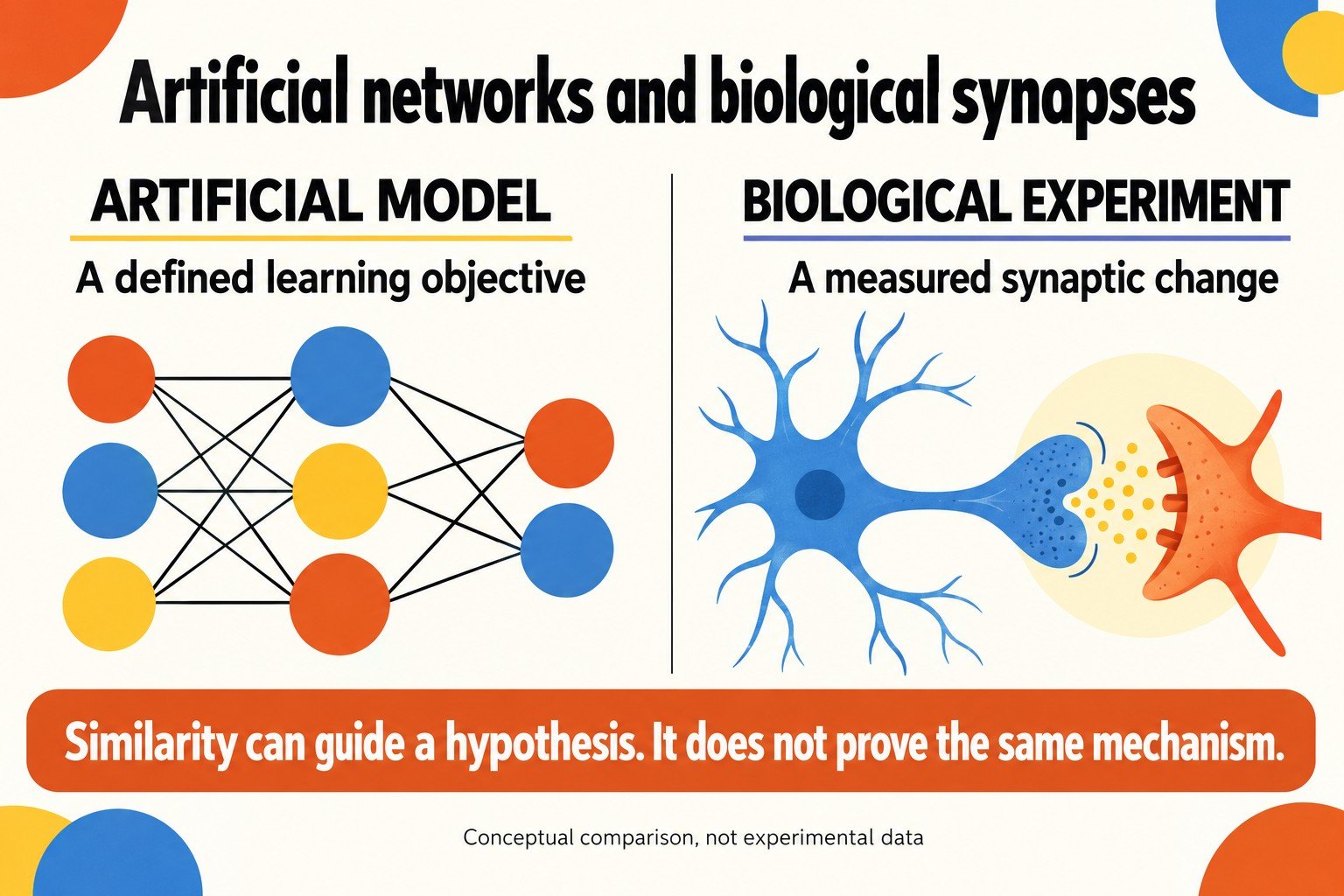
Artificial Neural Networks and Biological Synapses: Similar Ideas, Different Evidence
Key takeaways
- The term neural describes an inspiration and model structure, not a claim of biological identity.
- Backpropagation is a method for assigning how parameters contribute to an error.
- Spike-timing-dependent plasticity was measured in particular preparations and is not a universal learning recipe.
- Compare the learning rule, task, measurements and hardware before accepting a brain-like claim.
A diagram of connected circles looks a little like a diagram of connected neurons. That visual resemblance has helped artificial neural networks become familiar, but it can also encourage an overly literal story about how machines learn.
The comparison between artificial neural networks and biological synapses is useful when it generates a precise question. It becomes misleading when shared vocabulary is treated as evidence that a model reproduces a living nervous system.
To make the comparison concrete, distinguish the unit being modeled, the rule used to change it and the evidence used to judge the result. Those distinctions explain why computational neuroscience can learn from AI without assuming that an effective AI system is a digital brain.
A weight is a parameter in a specified model
In a simple artificial network, weighted connections help transform input values into outputs. Changing a weight changes the model’s computation. The meaning of that change depends on the surrounding architecture and task.
A biological synapse is a connection studied in living tissue, with changes measured through particular experimental methods. Calling both a weight and a synapse a connection does not make their internal processes identical. A mathematical abstraction deliberately leaves out details that may be important for another question.
That omission is not automatically a defect. A map can be useful without reproducing every feature of a landscape. The question is which features the model must preserve to answer its intended scientific or engineering problem.
What backpropagation does
Rumelhart, Hinton and Williams’ 1986 paper described a learning procedure that repeatedly adjusts connection weights to reduce differences between a network’s output and a desired output. Hidden units could thereby acquire representations useful for the task.
Backpropagation addresses a credit-assignment problem: when the output is wrong, how should earlier parameters change? The method computes how changes in parameters affect an objective and provides information used in updating those parameters.
The important distinction is between explaining an algorithm and explaining a brain. Demonstrating that this procedure learns a useful representation establishes something about the model under its training conditions. It does not identify the cellular mechanism by which a person learns to read or a bird remembers a picture.
Nor does the algorithm require the metaphor that a machine experiences disappointment when its answer is wrong. Error is a technical quantity in the computation. Its presence does not establish a feeling or a motive.
A biological experiment asks a different question
In Bi and Poo’s 1998 experiments, researchers studied cultured rat hippocampal neurons. The relative timing of presynaptic and postsynaptic spikes influenced the direction and extent of lasting changes at glutamatergic synapses. Initial synaptic strength and postsynaptic cell type also mattered.
This is concrete evidence that timing can shape plasticity under those experimental conditions. It is not a demonstration that every synapse in every brain follows one simple timing rule, nor that repeating information at a particular millisecond interval is a general human study technique.
The preparation and outcome matter. A measured change in synaptic response in cultured cells is different from an improvement in a person’s daily memory. Connecting those levels requires further evidence rather than a familiar phrase such as neurons that fire together wire together.
Our adult neuroplasticity article discusses the broader problem of turning biological plasticity into practical claims. A mechanism can be real without validating every product built around its name.
Why biologically plausible credit assignment is difficult
The problem is not simply whether a brain can change connections. It is how a distributed network might obtain the information needed to change particular connections appropriately. A successful output involves many interacting components.
Lillicrap and colleagues’ 2016 computational study examined a constraint associated with standard backpropagation: its use of a precisely related backward weight pattern. Their feedback-alignment approach used fixed random feedback weights to transmit useful teaching signals in model networks.
The work showed that effective learning in those simulations did not require that exact symmetry. This broadened the set of possible mechanisms worth considering. It did not record a human brain using feedback alignment, or establish the approach as a complete account of biological learning.
This difference between possibility and demonstration is central. A model can show that a proposed solution is computationally feasible. Determining whether a living circuit uses it is a separate empirical task.
Learning objective and learning mechanism are separate
Two systems can be evaluated on the same task while arriving at their outputs differently. Conversely, related learning procedures can produce different results when the data, architecture or objective changes.
Consider a hypothetical image-labeling exercise. A model may minimize classification error on labeled images, while a person encounters objects through varied activities. That comparison illustrates why a shared final label is insufficient to establish a shared learning history. It is not a claim that the cited papers tested this exact scenario.
For scientific comparison, ask what information each system receives and what counts as success. Does the evaluation concern recognizing an object, predicting a neural signal or explaining a cellular change? A strong result on one of these questions does not automatically answer the others.
A practical comparison table
| Feature | Artificial network question | Biological evidence question |
|---|---|---|
| Connection | Which parameter influences the output? | What is measured at the synapse? |
| Learning | Which rule updates the parameters? | Which process changes the observed response? |
| Success | Does the model meet its defined objective? | Does the proposed mechanism fit the experiment? |
| Generalization | Does performance hold on new inputs? | Does the finding extend to another preparation or task? |
This table is a reading aid, not an assertion that the fields are unrelated. The productive connection is to make each comparison specific enough to test. A claim that a model is brain-like should name the dimension on which that judgment is based.
A similar output can still be scientifically useful
Suppose two models predict the same observed response. That agreement can motivate better experiments, but it does not uniquely identify which internal explanation is correct. A useful next question is where their predictions diverge.
For example, an investigator could seek a new condition in which the candidate models make different predictions. This is a general illustration of model comparison, not a report of an experiment performed by Science Chronicle.
Our correlation and causation explainer provides related reasoning. A model’s ability to track observations can be evidence for its usefulness while remaining insufficient to prove every proposed causal detail.
Avoid an unsupported energy comparison
Claims that a brain uses a small number of watts while AI requires a data center often mix different system boundaries. Before treating the ratio as meaningful, ask what workload, time interval and hardware are included.
Training and using a trained model are different activities. A comparison that counts one system’s entire training process and another system’s brief task performance does not establish an efficiency ratio for the same job. A responsible estimate needs a defined denominator and comparable conditions.
This article does not provide a universal watts-per-intelligence figure. Such a number would need a clear task and measurement method, rather than a repeated slogan about biological efficiency.
Evaluate a brain-inspired course or product claim
When a service invokes neural networks or synaptic rewiring, ask what it actually delivers. Is it teaching an algorithm, testing a scientific model or claiming to improve a person’s abilities? These are different promises.
Request evidence for the promised outcome in intended users. A computer model that learns a benchmark task cannot establish that a course improves human attention, and a cellular plasticity experiment cannot demonstrate the benefit of a particular subscription.
None of the primary studies here is a product ranking or a record of our hands-on testing. Their value is in clarifying the evidence, not supplying an endorsement through scientific vocabulary.
Common questions about artificial and biological networks
Does biological inspiration make an algorithm a brain simulation?
No. A simulation needs a defined target and level of detail. Borrowing a concept is different from reproducing the relevant mechanisms of a living circuit.
Does the brain definitely not use backpropagation?
The papers discussed here do not settle that broad question. They distinguish a known machine-learning algorithm, experimental plasticity findings and computational proposals that may inform biological hypotheses.
What makes the comparison useful?
Specify which property is shared, which prediction follows and what evidence would test it. That turns a loose analogy into a question that engineering or neuroscience can investigate.
Sources and further reading
- Rumelhart et al., 1986: learning representations by back-propagating errors
- Bi and Poo, 1998: spike timing and synaptic modification in cultured neurons
- Lillicrap et al., 2016: random feedback and computational credit assignment
Continue reading
- Transformers and the Brain: What Language Alignment Studies Can Actually Establish
- AlphaFold and the Chemistry Nobel: Prediction, Design and the Next Experiment
- AI Study Tools for Memory Retention: How to Choose Beyond Summaries
- AI Note-Taking Apps and Your Memory: When Recording Helps and When Recall Matters