
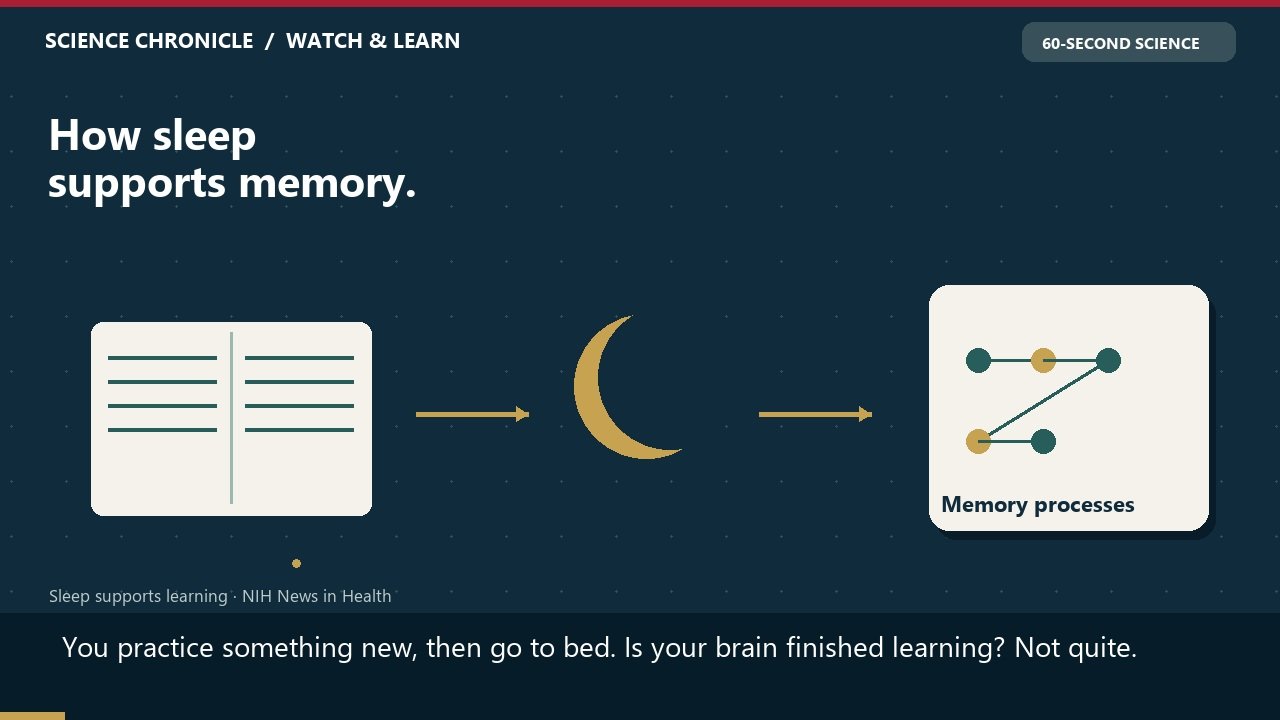
How sleep supports memory
60 seconds · Captions included
How sleep supports learning before and after practice, and why it is not a perfect save button.
Transcript & sources
You practice something new, then go to bed. Is your brain finished learning? Not quite. Sleep helps support memory both before and after you learn. Before learning, being rested helps you pay attention and take in new information. If you’re exhausted, the problem can start with what you manage to learn in the first place. After learning, sleep can support consolidation: the process of stabilizing and reorganizing memories over time. Researchers study how patterns of brain activity are reactivated during sleep, helping explain part of that process. But sleep isn’t a perfect save button. It doesn’t preserve every detail, and different tasks can show different benefits. Both non-REM and REM sleep are involved in memory research. There’s no single magic stage for everything. So practice while you’re awake, and leave room for sleep instead of relying on an all-nighter. Try recalling the material again the next day. Sleep complements learning; it doesn’t replace it. The takeaway? Learn, sleep, and revisit. Give your brain a chance to work with what you’ve practiced.
Research: Sleep and learning — NIH · Memory-consolidation research.
Further reading: explore encoding, storage and retrieval in our full memory explainer.