
Heartbeat Timing and Emotional Perception: Why the Task Matters
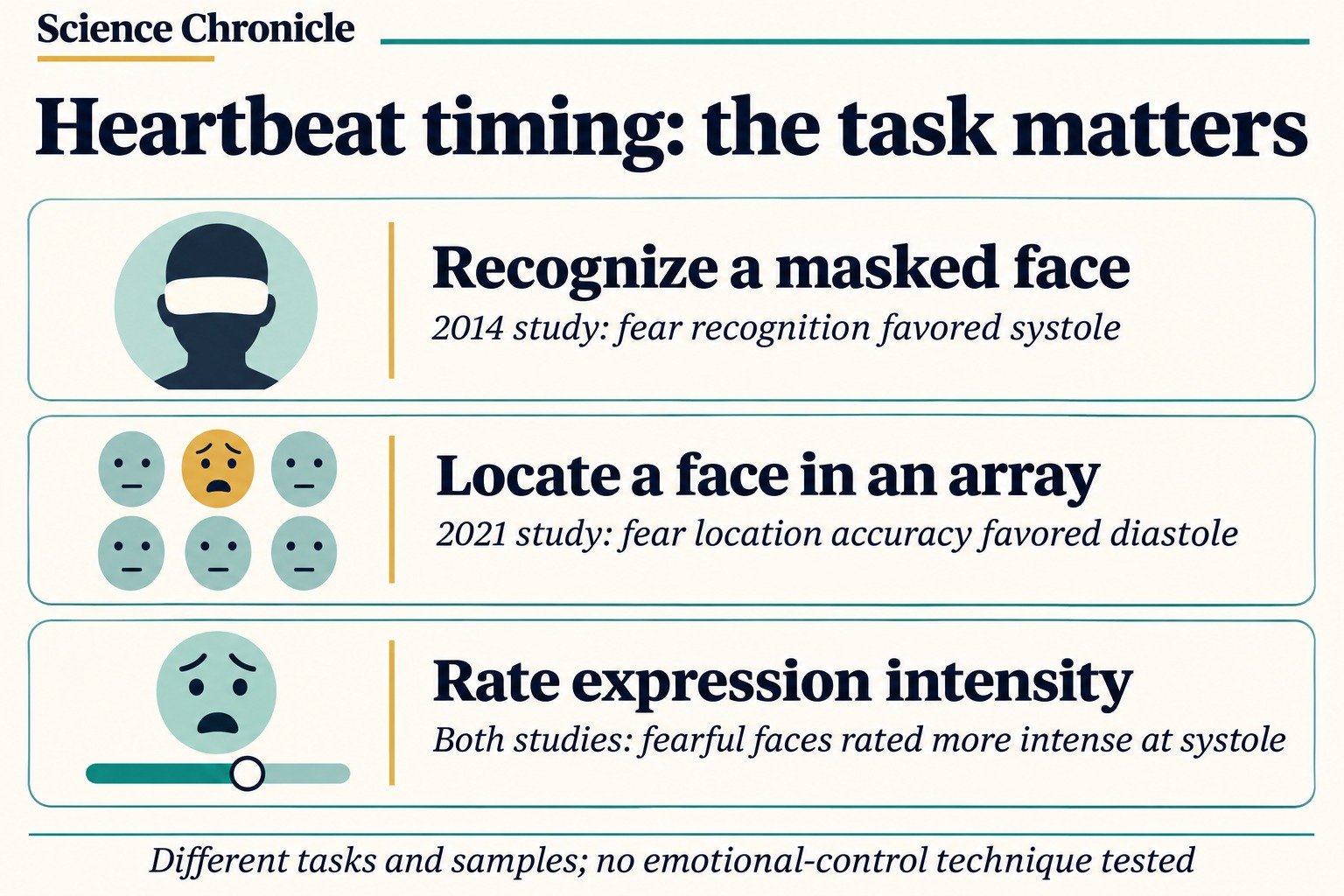
A face can appear at different points within a single heartbeat. Carefully timed experiments suggest that this small difference can influence how people process its expression. But the reported pattern differs across tasks: recognizing a briefly masked face, locating an emotional face among distractors, identifying its emotion or rating its intensity. These are different operations, and the results do not move together. Comparing the studies raises a task-dependence hypothesis; it does not isolate task design as the cause of their differences. [1][2]
This research treats the heartbeat as a repeating context for perception. It differs from asking whether someone can count their heartbeats or accurately describe bodily sensations. The manipulation concerns when a picture appears relative to cardiac activity, not whether participants possess exceptional awareness of their bodies. That distinction keeps an experiment about momentary perception from becoming an unsupported claim about emotional self-control.
A repeating bodily signal becomes an experimental clock
During the cardiac cycle, ventricular contraction and blood ejection create a changing pattern of arterial pressure. Stretch-sensitive baroreceptors help convey information about these changes toward the brain. Researchers use physiological timing to present stimuli around phases expected to differ in baroreceptor signaling. The key comparison is between stimulus presentations associated with systole and diastole, rather than between people with faster and slower average heart rates. [1]
Those labels summarize a measurement procedure. In these studies, investigators timed stimuli relative to an electrical or pulse-derived cardiac marker, using a delay to approximate the systolic signaling period. They did not directly count impulses in every participant's arterial sensory nerves. The timing method provides an experimentally useful estimate, while pulse transit, signal detection and equipment synchronization remain important parts of interpreting that estimate. [1][2]
A within-person design is especially useful here. The same participant sees stimuli in both timing conditions, so the comparison does not simply pit an anxious group against a calm group or one person's visual ability against another's. It asks whether performance changes across repeated trials under different timing conditions. Repetition improves the comparison, but many trials from one person do not become many independent participants.
A face that breaks through a crowded stream
Sarah Garfinkel and colleagues reported two experiments in 2014. In the first, 23 people took part, but synchronization failures excluded three and resting tachycardia excluded one, leaving 19 for analysis. Participants watched a rapid stream containing scrambled images and two targets: a house and a face. Afterward they selected which targets had appeared. The face could show fear, disgust, happiness or a neutral expression. [1]
The stream created an attentional bottleneck. Detecting one target can make another nearby target harder to recognize, allowing researchers to ask which emotional stimuli break through under constrained conditions. Face presentation was timed to systole or diastole. Fearful faces were recognized more successfully at systole in this task, whereas the other tested expressions did not show a significant cardiac-phase difference. House-target performance provided an additional comparison. [1]
This result concerns recognition of a briefly presented target within a particular stream. It does not mean that a fearful face becomes objectively more dangerous during systole. Nor does it show that participants became fearful themselves every time they identified the expression. Recognizing fear on someone else's face, judging the strength of that expression and experiencing one's own fear are related concepts that require different measurements.
The distinction between an interaction and an overall effect also matters. The investigators did not find that systole generally improved recognition across all expressions. Instead, the timing effect differed by emotion. Describing only the fearful-face result as a universal perceptual boost would discard the comparison that made the finding specific in the first place. [1]
Intensity ratings add a different outcome
The second experiment used a separate sample of 19 healthy participants and included functional brain imaging. Participants saw fearful or neutral faces briefly, then rated their emotional intensity. Fearful faces received higher intensity ratings when shown at systole than at diastole. The imaging results also implicated differing amygdala responses to fearful faces across cardiac phases. This was a separate experiment, not an additional measurement from the first sample. [1]
An intensity scale has no correct answer in the same sense as selecting a face that actually appeared. It records an evaluation. A phase-related change on that scale can therefore coexist with unchanged performance on another task. Imaging adds information about measured brain responses, but it does not convert a rating difference into proof that a single region caused it or that all components of emotional processing changed together.
Taken together, the two experiments supported the possibility that cardiac timing influences both access to a briefly masked fearful face and its evaluated intensity. Their relatively small samples and specific stimuli still constrain the claim. They did not establish a timing rule for daily conversations, a treatment for anxiety or a way to infer someone's emotional state from the phase of a heartbeat.
Searching an array changes the question
Mateo Leganes-Fonteneau and colleagues later studied 71 young adults using a visual-search task and an intensity-rating task. Their report appeared online in 2020 and in a 2021 journal issue. In the search task, a briefly displayed array contained six faces of the same actor. One expressed fear, happiness, disgust or sadness; the other five were neutral. Participants indicated both the target's location and its emotion. [2]
The experimental logic differed from the rapid-stream task. Here participants had to select a location among simultaneous distractors, then classify the expression. Stimuli were presented in randomized cardiac-timing conditions, with timing estimated using a finger-pulse system and a correction for pulse transit. Practice trials adjusted the distance of faces from the center to avoid making performance too easy for some participants. [2]
Fearful-face location accuracy was higher at diastole, the opposite direction from the fearful-face recognition advantage in the earlier stream task. Happy and disgust faces showed higher location accuracy at systole; sadness did not show a significant phase effect on that measure. There was no overall cardiac-phase benefit for search accuracy across emotions. The pattern depended on the expression as well as the task. [2]
The emotion-identification response produced a different pattern: participants named fearful and sad expressions more accurately at diastole, while happy and disgust expressions showed no significant phase difference on that measure. Correctly locating the unusual face and correctly naming its expression were therefore separate outcomes. Combining them into a single claim of improved emotion detection would obscure what changed. [2]
Stronger-looking does not mean easier to locate
In the later intensity task, participants rated a single face rather than searching among distractors. Fearful and happy expressions were judged more intense at systole. Disgust showed the opposite phase relationship, while sadness showed no significant phase difference. Thus the same report contained a diastolic advantage for locating fearful faces and a systolic increase in their rated intensity. [2]
There is no logical requirement for these outcomes to agree. Imagine a difficult display in which a target feels striking once noticed but is still hard to locate among similar shapes. That example is an illustration, not an additional experimental finding. Its purpose is to show why perceptual selection and subjective evaluation need separate definitions before either can be described as enhanced emotional processing.
The later study therefore qualifies a simple fear-specific story. It suggests that cardiac-phase effects can extend beyond fearful expressions and can depend on the demands of a task. It does not establish that task format is the sole reason the studies differed. Their participants, displays and timing systems also differed. A direct comparison holding those features constant would be needed to isolate the contribution of task design.
Such a comparison would be most informative if it specified the primary outcome in advance. Otherwise, several accuracy measures, response times, expression categories and intensity ratings offer many opportunities to emphasize whichever result looks clearest. Defining the question first helps distinguish a planned test from an interesting pattern that needs confirmation.
What the measurements do not establish
Both studies used controlled displays and limited samples of healthy participants. The later sample consisted of university students with a mean age around twenty. Such designs help isolate a short-lived association under laboratory conditions, but they do not tell us how the effect behaves across childhood, older age, cardiovascular illness or different clinical conditions. Those are new empirical questions rather than automatic extensions. [1][2]
Measurement quality also deserves attention. Exclusions for synchronization failures in the earlier experiment show why timing is part of the evidence, not merely a technical footnote. A study about fractions of a heartbeat depends on aligning the intended event with the recorded physiology. Readers should ask what signal was recorded, how the phase was estimated and whether failures were handled before interpreting an apparently precise timing claim.
There is also a difference between manipulating stimulus timing and manipulating the body's signaling mechanism. These experiments changed when pictures appeared relative to cardiac activity. That supports a phase-dependent perceptual comparison. It does not, by itself, isolate every neural pathway linking the cardiovascular cycle to perception. Baroreceptor signaling is a biologically motivated explanation, not a direct recording of the complete causal chain in each trial.
The practical scientific lesson is to ask a more specific question whenever a headline says the heart changes emotion. Which emotion, which task, which response and which timing procedure? In these experiments, a fearful expression could be rated more intensely at one phase while being located more accurately at another. That complexity is the discovery: bodily signals participate in perception without supplying a universal heartbeat-based instruction for how to feel or act.