AI in Brain-Drug Discovery: From AlphaFold Predictions to Experiments That Matter
Key takeaways
- Structure prediction, docking and experimental assays perform different jobs.
- A reported screening hit rate describes selected tested compounds, not all virtual molecules.
- A molecule affecting a receptor is not automatically an effective brain treatment.
- Human benefit requires evidence beyond a model score or animal experiment.
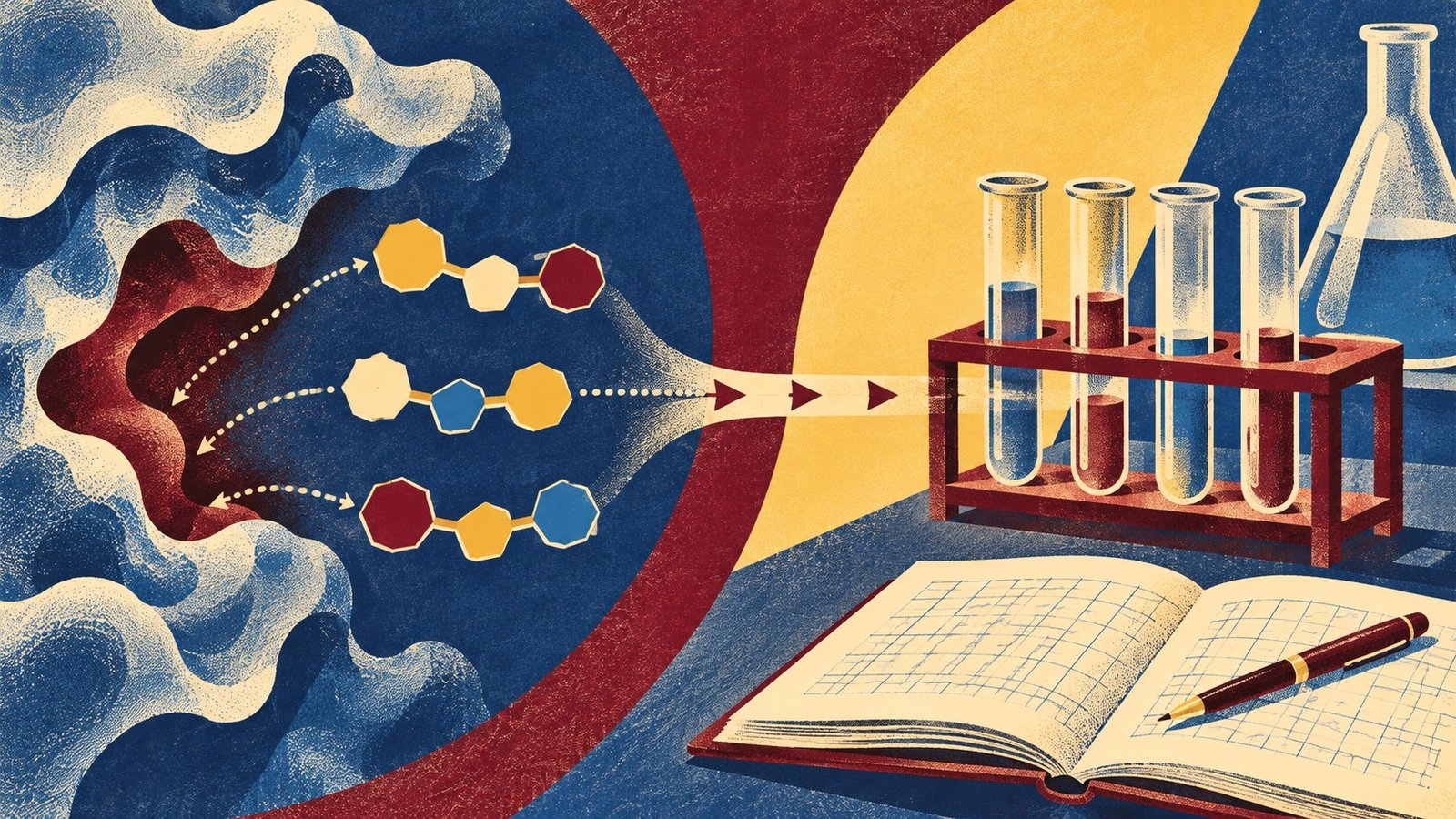
An image of a protein pocket with a molecule fitted inside it can look like the end of a scientific puzzle. In drug discovery, it is often the beginning of a more demanding sequence. The model helps decide what to test; the experiments determine which parts of the idea survive contact with biology.
This guide follows that sequence for brain-related targets. Our AlphaFold and the Chemistry Nobel explainer covers the distinction between protein design and structure prediction. Here, the question is how a predicted structure contributes to finding compounds and what remains before anyone can call one a useful medicine.
First identify what the AI actually does
AI is not one operation. A project may predict a protein structure, estimate molecular properties, propose a new chemical design or rank candidates. The same headline can include several methods with different training data and limitations.
Docking is another distinct operation: it evaluates possible ways a molecule might fit and interact with a target model. A workflow can combine AI-derived structures with docking without every calculation being deep learning. Precise reporting names the contribution instead of giving AI credit for the entire pipeline.
For a reader, start with the output. Is it a predicted shape, a ranked list, an estimated property or an experimentally measured effect? The answer tells you what kind of evidence you have and which questions remain open.
What the TAAR1 study demonstrated
Díaz-Holguín and colleagues' 2024 primary study compared virtual screens using AlphaFold-generated and homology models of trace amine-associated receptor 1, or TAAR1. More than 16 million virtual compounds were docked. The AlphaFold-based screen yielded a reported 60% hit rate among selected tested compounds, more than twice the homology model’s rate.
The relevant achievement was a comparison of discovery workflows followed by experiments, not the approval of a medicine. The hit rate should not be read as 60% of the entire virtual library being effective, or as a 60% chance of clinical success for a patient.
The study also investigated compounds experimentally beyond the initial ranking. Those steps make the work more informative than a structure image alone. They do not remove the distinction between receptor activity, preclinical findings and demonstrated treatment benefit in humans.
What a docking score can and cannot establish
A docking score is a model-based ranking under particular assumptions. It helps choose candidates for follow-up. It is not a laboratory measurement of clinical benefit, and a favorable score does not by itself show that a compound will reach the intended tissue or act selectively there.
Imagine an original hypothetical project selecting twenty candidates from a virtual library. If six show the specified activity in an assay, the useful result concerns those tested candidates and that assay. It does not establish what every untested molecule would do or which candidate would become a treatment.
The selection procedure is therefore part of the evidence. Ask how compounds were chosen, what was experimentally available and what counted as a hit. A high rate can be meaningful while still requiring its denominator and decision rule to be stated.
Binding and functional activity are different
A molecule can interact with a target without producing the desired functional effect. For receptor research, the relevant experiments need to characterize what the interaction does under tested conditions. A picture suggesting fit is not equivalent to that functional measurement.
Lyu and colleagues' 2019 ultra-large docking study examined targets including the dopamine D4 receptor and experimentally followed selected candidates. It illustrates a structure-based discovery approach that predates the particular AlphaFold workflow. Large virtual screening and AI protein prediction should not be treated as identical inventions.
For interpretation, keep the measured property attached to the result. Affinity, potency and selectivity answer different questions. A single strong number should not silently stand in for all three, and none alone describes a complete clinical profile.
Why brain-related applications add questions
An intended brain treatment must be evaluated in the biological context relevant to its use. A receptor assay does not directly establish exposure at the intended site, a suitable duration of action or tolerability at an effective dose. These are experimental questions, not details supplied by a visually convincing model.
The practical reading discipline is to identify which of those questions the paper actually tested. If exposure was not measured, leave it unknown. If an effect was observed in an animal model, identify that model rather than replacing it with a claim about patients.
Avoid the phrase brain-ready unless it has a defined meaning and appropriate evidence. A target associated with the nervous system does not make every molecule affecting that target a suitable therapy. Intended action and demonstrated application need to remain connected through measurements.
A second example: nonopioid analgesic discovery
A 2022 structure-based discovery study docked more than 301 million virtual molecules against the alpha-2A adrenergic receptor. Selected compounds and analogs were tested, including experiments in animal pain models. The work reported analgesic activity without the sedation observed with known drugs under its tested conditions.
This example is useful because it follows predictions with biological experiments. It is not a claim that docking alone proved a safe pain medicine for people, and it should not be relabeled as an AlphaFold or deep-learning result merely because it used computation.
The lesson is about the workflow: computational selection can help locate candidates, while successive experiments test the properties that matter. Each result should retain its species, model and conditions when translated for a general audience.
A discovery-stage evidence ladder
| Stage | Typical output | What still needs a separate test |
|---|---|---|
| Structure prediction | Candidate target geometry | Suitability for the intended discovery task |
| Virtual screening | Ranked molecules | Actual interaction or activity |
| Functional assays | Effects in a defined experimental system | Exposure, selectivity and wider safety |
| Preclinical evaluation | Results in specified models | Benefit and risk in people |
| Clinical research | Human outcomes under a protocol | Generalization to other uses or populations |
This is a reading framework rather than a claim that every program follows one rigid sequence. It helps locate the reported achievement and avoid skipping from an early-stage output to a treatment promise.
How to read an AI-discovery headline
Identify the compound, target and evidence stage. Then look for the comparison. Did the study compare with a different model, a conventional screen or no meaningful baseline? An improvement should be tied to a stated task rather than described as a general acceleration of medicine.
Next, check how many candidates were predicted, selected and actually tested. These numbers describe different populations. A library containing millions of virtual compounds is not a trial containing millions of experimental observations, and a handful of tested hits does not establish the success rate of all candidates.
Finally, find the unsuccessful or uncertain results. A paper that reports both can help readers understand where the workflow breaks down. A press image or demonstration restricted to a successful molecule cannot supply that missing context.
What validation should mean for a software claim
If a platform claims to improve discovery, ask what outcome was validated. Faster ranking, more experimentally active hits and better clinical success are different outcomes. Evidence for one should not be used as an automatic substitute for another.
An original hypothetical benchmark could compare two methods on the same target, candidate pool and testing budget. It would state selection rules before the assays and report all tested candidates. That would make a screening comparison easier to interpret, without proving a finished medicine.
For training courses or research software, request examples that explain the method’s limits and reproducibility. Check access requirements, licensing, computing costs and the actual task taught. A course that produces attractive protein images is not necessarily training in experimental drug discovery.
What this means for patients and readers
A promising discovery paper can be worth following without becoming a reason to buy an unapproved compound or alter treatment. The study may have answered an early scientific question while leaving the clinical question entirely open.
Our guide to GLP-1 observational dementia research illustrates another important boundary: even evidence involving people needs interpretation matched to its design. A computational result lies at a different stage and should be described accordingly.
If a commercial claim invokes AI, request the actual evidence for the product and intended use. Do not assume that a publication about a related target validates a seller’s formulation. A legitimate uncertainty is a reason to ask a better question, not a gap to fill with a purchase promise.
Where the useful optimism belongs
AI can contribute to a more efficient search for testable ideas. The meaningful achievement is not that experiments disappear, but that researchers may arrive at better experiments or candidates through a defined workflow. That contribution deserves a precise description.
The strongest next claim is therefore specific: this method improved this discovery task under these conditions. Following that claim through assays, preclinical work and human research makes progress understandable without confusing a promising molecule with a proven treatment.
Frequently asked questions
Does AlphaFold predict whether a medicine works?
Protein structure prediction does not by itself establish clinical efficacy. A discovery workflow may use a predicted structure, but activity, exposure, safety and human outcomes require additional evidence.
Does a 60% hit rate mean 60% treatment success?
No. The TAAR1 result concerns selected experimentally tested compounds and a defined screening outcome. It is not a patient’s chance of improvement or a measure of clinical approval.
Is all virtual screening deep learning?
No. Methods can be combined, but docking and AI-based structure prediction are different operations. A clear article identifies which method contributed which part of the result.