
Early-Childhood Screen Time and the Brain: What Studies Show and Leave Uncertain
Key takeaways
- White-matter diffusion measures and cortical thickness are different outcomes.
- Following children over time helps examine direction but does not equal random assignment.
- A learning experiment does not validate every educational app.
- Use age-appropriate guidance while protecting sleep, play, conversation and privacy.
A headline says that screens alter young children’s brains. A parent may reasonably ask whether one video, a tablet session or a call with a grandparent has harmed a child. The headline usually cannot answer that question.
Early-childhood screen time covers many activities. Watching an autoplay feed alone, sharing a story and responding to a relative on a video call differ in content and interaction. A single total can be useful to record, but it does not describe everything relevant.
This article compares the kinds of evidence and their limits. For concerns about a particular child’s development, our milestone-chart guide explains how observations can support an appropriate professional conversation.
Identify what the brain study actually measured
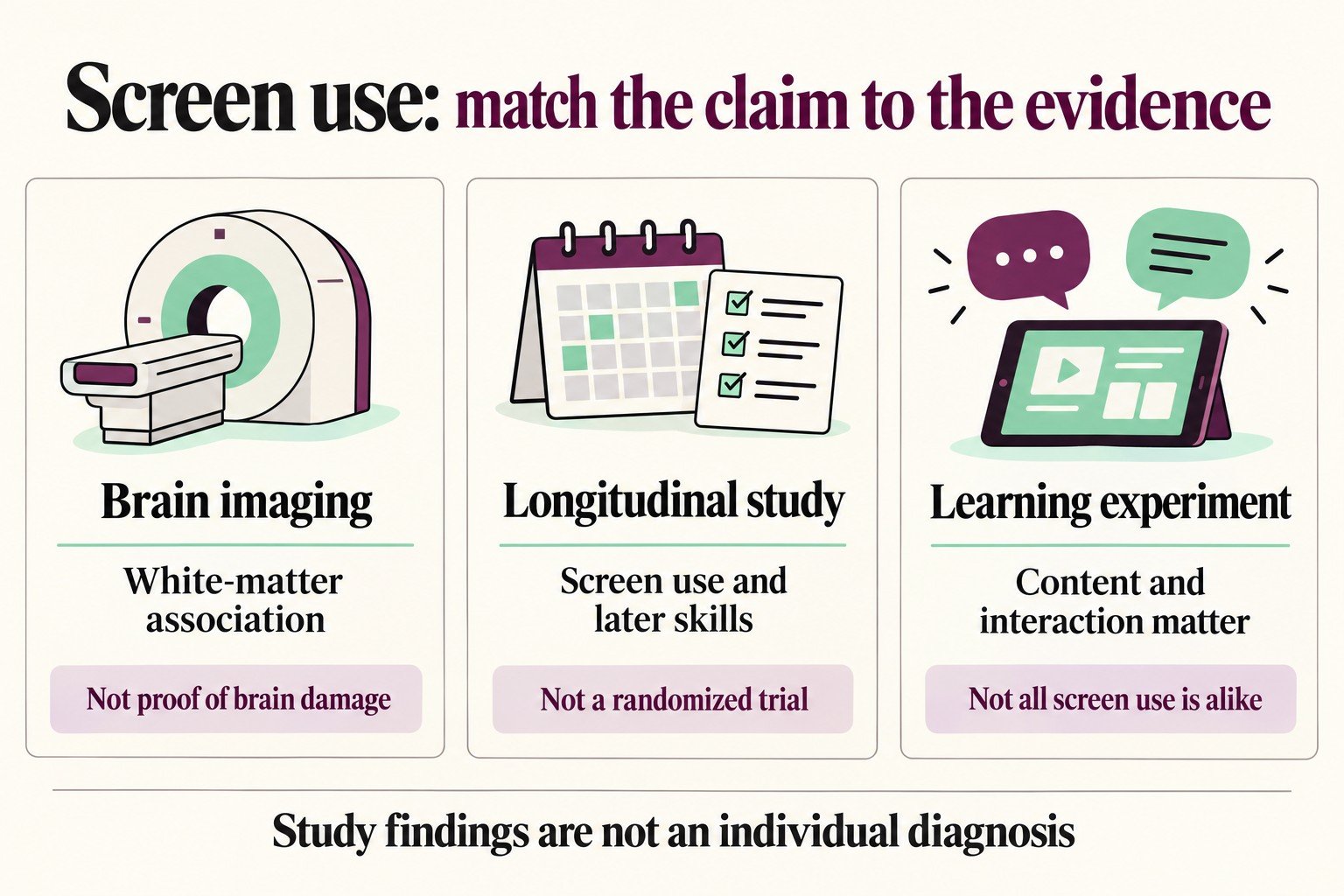
One influential study by Hutton and colleagues examined 47 children aged three to five who completed diffusion tensor imaging. Parents completed ScreenQ, a survey covering several aspects of media use.
Higher scores were associated with lower fractional anisotropy and higher radial diffusivity in certain white-matter tracts, with relevant adjustments in the analysis. The study also assessed language and emergent-literacy skills. It was a cross-sectional association, not an experiment assigning screen exposure.
This is different from demonstrating that a toddler’s cortex became thinner. Diffusion measures concern properties of water movement used to investigate tissue organization. They are not a direct count of damaged cells, and cortical thickness was not the headline outcome of this study.
The distinction matters because a result can become more alarming as it moves from paper to headline. Report the age group, design and measurement before drawing a conclusion about harm.
Why a cross-sectional association cannot settle cause
A cross-sectional design examines variables at a point in time. If screen-use measures and imaging measures differ together, several explanations may remain. Family circumstances, other activities and characteristics of the child can be relevant.
Statistical adjustment can address measured differences, but it cannot guarantee that every alternative explanation has been removed. A small sample also limits the precision and generalizability of a result.
That does not make the association meaningless. It identifies a question worth investigating with stronger or complementary designs. The accurate conclusion is narrower than proof that a device caused brain damage.
It is also different from reassurance that any amount of media is harmless. Uncertainty about a causal claim does not eliminate the value of age-appropriate guidance or attention to what media use replaces.
What following children over time adds
Madigan and colleagues’ 2019 study followed 2,441 mothers and children, using reports at ages 24, 36 and 60 months. It examined screen time and performance on a developmental screening questionnaire.
Higher screen time at earlier assessments was associated with poorer screening performance at later assessments in the model. This adds temporal information that a one-time comparison cannot provide.
The study remained observational, and both exposure and developmental outcomes were reported by mothers. It did not randomly assign children to different media environments or diagnose a particular child from the reported association.
The practical distinction is between a screening result, a diagnosis and an imaging measure. They are different outcomes. One study should not be described as though it directly measured all three.
Why interaction and content deserve attention
Roseberry and colleagues’ language-learning experiment compared socially contingent video-chat interactions with other learning conditions. Under the study’s conditions, toddlers learned novel words through video chat and live interaction.
This is evidence that the social features of a media experience can matter. It does not establish that every video call teaches language, that unlimited use is beneficial or that any product labeled interactive produces the same result.
The experiment also answers a different question from a broad developmental cohort. Learning particular words in a task is not a complete assessment of long-term development, sleep or family routines.
When an app cites a learning study, check whether its content, age group, interaction and outcome match. A button that responds to tapping is not automatically equivalent to a person responding meaningfully to the child.
| Study design | What it can examine | What it cannot establish alone |
|---|---|---|
| Cross-sectional imaging | Relationships between media measures and brain signals | The direction of causation |
| Longitudinal observation | How earlier exposure relates to later outcomes | A randomized treatment effect |
| Learning experiment | Performance under defined learning conditions | Every long-term effect of media use |
| Clinical assessment | An individual concern using suitable methods | A conclusion from a headline alone |
Use current media guidance without reducing it to one number
The AAP’s 2026 policy statement on digital ecosystems considers the child, caregivers, product design and wider conditions. It emphasizes that engagement-focused design can prolong use and displace other activities.
Time boundaries remain relevant, but duration is not the only question. The activity’s purpose, content and place in the day need attention too. A limit should support a feasible routine rather than become an isolated number disconnected from sleep or family needs.
The policy is professional guidance informed by evidence. It is not itself a randomized experiment showing that every recommendation produces the same outcome in every household. Keep the guidance and the underlying study designs distinct.
For a family deciding what to change, the useful next step is to identify the current pattern and the activity that needs protecting. That is more actionable than trying to infer a child’s brain structure from a weekly total.
Ask concrete questions about a media session
The AAP’s 5 C’s guide for toddlers and preschoolers prompts families to consider the child, content, calming, crowding out and communication. It offers a broader discussion than a timer alone.
An original way to prepare for that discussion is to record one ordinary session. What was watched or used? Was someone available to respond? What happened before and afterward? What activity would otherwise have occupied that time?
Avoid turning the record into a score of parenting quality. Its purpose is to reveal a manageable decision. Perhaps autoplay extends a session beyond the intended stopping point, or background media makes a shared activity harder to follow.
A change can then be specific: choose the content in advance, make a stopping point visible or protect an existing shared routine. These examples illustrate planning choices, not proven treatments for a developmental concern.
Make one feasible change and observe the result
Suppose a family wants a less disrupted shared meal. They can agree to put devices away for that routine and observe whether the meal becomes easier to share. The outcome is the routine, not an assumed improvement in white matter.
If the first plan is impractical, revise it. Work schedules, disability, caregiving demands and access to safe alternatives can affect what is feasible. Advice that ignores those conditions may be difficult to use even when its goal is reasonable.
Include adults’ device use in the discussion where relevant. A family arrangement can be clearer when expectations are understandable to everyone. It should not require a child to infer why the rule changes without explanation.
Avoid promising that removing a screen reverses a specific brain finding. The studies above do not establish that individual outcome or provide a timetable for it. Evaluate the change through the behavior and routine it was intended to support.
Do not let a headline delay developmental care
If there is concern about language, interaction or another skill, describe what has been observed and discuss it with the child’s healthcare professional. Do not assume screen use is the only possible explanation.
The CDC milestone resource advises acting when milestones are not met, skills are lost or concerns arise. Its checklists support monitoring and do not replace validated screening or individual assessment.
A media change can be discussed alongside appropriate care. It should not become a requirement that a family must complete before being allowed to ask for assessment, nor a reason to stop an existing professional plan.
Evaluate educational products and privacy separately
Ask what a product means by educational. Does it identify a skill, age group and directly measured outcome? A study of another program or a testimonial cannot establish the same benefit for the product being sold.
Inspect settings that affect use, including autoplay, advertising, purchases and the ease of stopping. Review what information is collected about a child and whether sharing it is necessary for the stated function.
There is no need to submit identifiable child videos to obtain a general explanation of a paper. Keep personal developmental information within appropriate care and support channels rather than public comments or unverified assessment services.
Frequently asked questions
Did the preschool study prove that screens thin the cortex?
No. The study discussed here examined white-matter diffusion measures and associations with media use. That is different from cortical thickness and does not establish causation.
Does an observational result mean the concern can be ignored?
No. Observational evidence can identify meaningful concerns and inform guidance. Its limits should shape the strength of the claim, not be used to dismiss every practical recommendation.
Is video chatting the same as passive viewing?
They can differ in responsiveness and purpose. A specific experiment demonstrates learning under particular conditions, but it does not establish a universal benefit for every use.
Can an app tell whether my child’s brain was affected?
The research reviewed here does not validate that claim. Individual concerns require an appropriate assessment rather than a media-use score presented as a brain diagnosis.
The most useful reading of screen research keeps the design and outcome visible. That allows families to make practical media decisions without accepting either alarmist brain-damage claims or blanket reassurance.
Sources and further reading
- Hutton et al.: preschool media use and white-matter diffusion measures
- Madigan et al. (2019): longitudinal screen use and developmental screening
- Roseberry et al. (2014): socially contingent video-chat learning
- AAP (2026): Digital Ecosystems, Children, and Adolescents
- AAP: 5 C’s for toddlers and preschoolers
- CDC: developmental milestones