Brain-to-Text Decoding: Why EEG and fMRI Results Are Not Mind Reading
Key takeaways
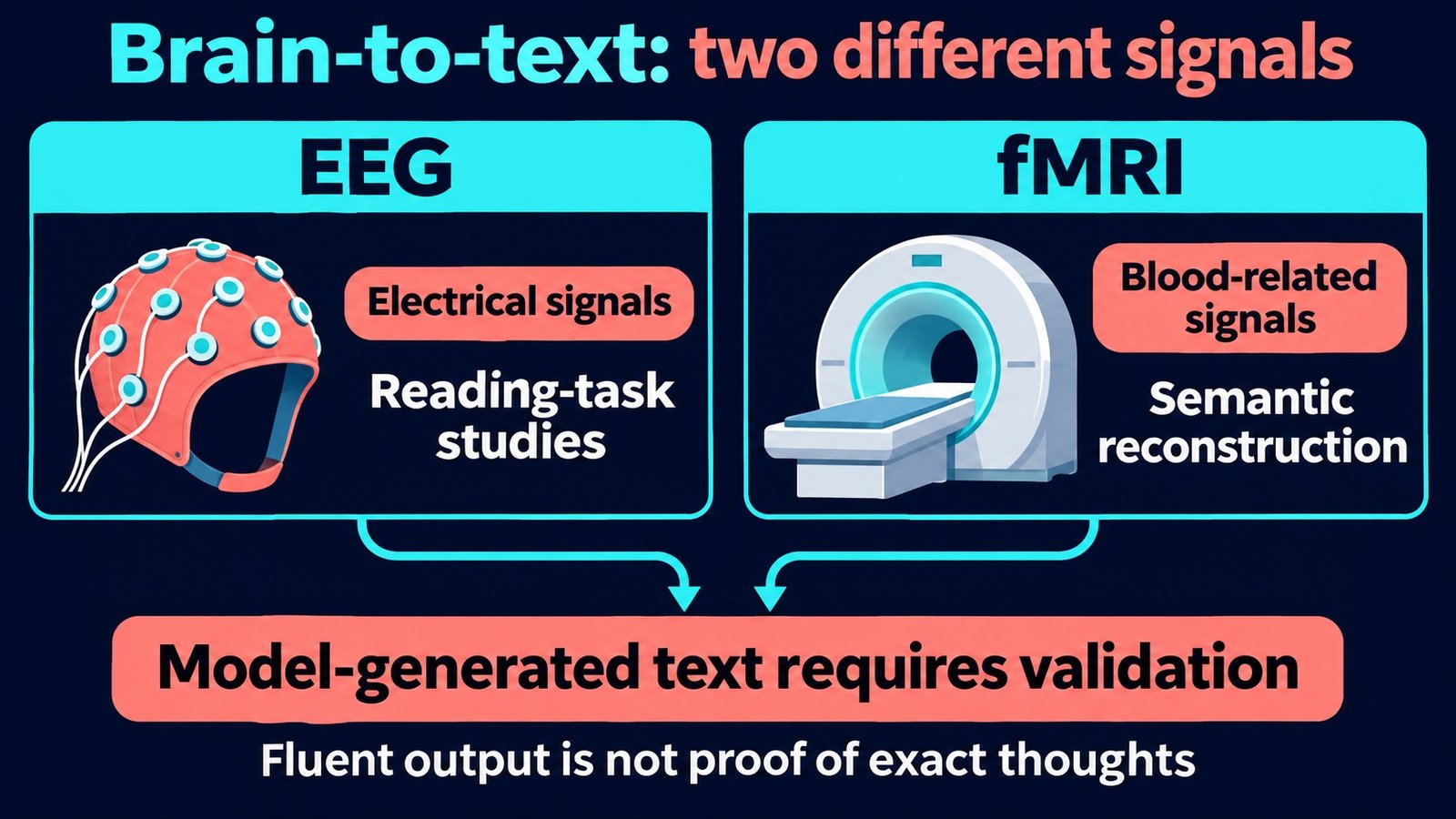
- EEG records electrical signals; fMRI measures blood-related responses.
- A 2023 continuous-language reconstruction study used fMRI in three participants.
- Reading displayed text is different from freely composing an intended message.
- Brain recordings, language-model output and a user’s confirmed meaning are distinct.
An impressive sentence on a screen can make a brain-decoding demonstration appear self-explanatory. The important questions begin before that sentence: what was recorded, what the person was doing, what the model already knew and how success was measured.
Those questions help separate scientific progress from an exaggerated claim of mind reading. This guide compares two non-invasive research directions, EEG-to-text during reading and semantic reconstruction from fMRI. It does not evaluate an implanted communication device or claim that a consumer headset can silently transcribe arbitrary thoughts.
EEG and fMRI begin with different measurements
EEG uses electrodes to record electrical potential differences. fMRI commonly measures a blood-oxygenation-related signal associated with brain activity. Neither measurement arrives as a sentence. Researchers need a task, processing choices and a model connecting the measurement with a defined target.
Our explanation of what EEG measures provides the measurement background. The distinction matters here because the label non-invasive includes different technologies. A result obtained in an MRI scanner does not establish the same capability in a wearable EEG system.
Read the equipment and task before the headline. If an article moves from fMRI research to a promise about a low-cost headset without a matching experiment, it has crossed an evidential gap. Convenience is an engineering goal, not evidence that two signals are interchangeable.
What the EEG reading-task paper tested
Wang and Ji's 2022 AAAI paper studied open-vocabulary EEG-to-text decoding on natural reading tasks, using a framework with a pretrained language model. It reported a BLEU-1 score of 40.1% for its decoding evaluation and also examined sentiment classification.
BLEU-1 concerns word overlap under a defined evaluation. It does not mean that 40.1% of arbitrary private thoughts were read, nor that a sentence was fully correct that often. The reported task involved reading language, rather than unconstrained spontaneous conversation.
That scope still supports a legitimate research question: can recordings contribute useful information to a language-related prediction? It should be evaluated at that level, with the dataset, preprocessing, baselines and train-test separation visible. An open vocabulary does not remove every constraint on the experiment.
What the fMRI semantic decoder demonstrated
Tang and colleagues' 2023 study trained individual decoders for three participants. The method combined fMRI responses with a language model and generated sequences that often captured aspects of meaning from novel stories. The study also explored imagined speech and silent-video conditions.
Semantic reconstruction differs from exact transcription. An output may preserve a general idea while changing words or making errors. The study’s small, intensively studied sample and particular recording setup constrain broader claims about users and everyday communication.
The researchers also tested cooperation and resistance. Those experiments are relevant to privacy, but they are not a universal guarantee about every future decoder. Describe the tested system and conditions rather than concluding either that all thoughts are exposed or that all future neural data are harmless.
Why a language model changes the interpretation
A language model can make a candidate output grammatically plausible. That is useful for generating readable text, but readability and fidelity to the intended content are different properties. A sentence can be fluent even when its factual meaning is wrong.
Consider an original hypothetical example. The intended message is that a visitor did not arrive. A reconstruction saying that the visitor arrived contains related vocabulary but reverses the event. A reader judging only whether the output sounds natural could miss the most consequential error.
The evaluation should therefore ask what the brain signal adds beyond linguistic expectations. A strong comparison might test the full system against a suitable condition without informative recordings. The exact control depends on the task, but the question is essential: where did the useful information come from?
Four tasks that should remain separate
| Task | What the participant does | What the result cannot automatically establish |
|---|---|---|
| Reading-task decoding | Reads presented language | Free composition of an unprompted message |
| Perceived-speech reconstruction | Listens to a stimulus | Exact transcription of all inner speech |
| Imagined-speech experiment | Performs a specified imagery task | Reliable everyday communication for new users |
| User-controlled communication | Intends and confirms a message | Accuracy in every person and environment |
These are different uses, not four interchangeable demonstrations of one capability. A carefully controlled reading experiment can be valuable without meeting the requirements of an assistive communication tool. The intended application determines what further evidence is needed.
How to judge a decoding metric
Begin with the target being scored. Does the metric count shared words, compare meaning, rank alternatives or assess an actual communication task? A single number cannot be interpreted independently of its denominator and comparison condition.
Ask whether errors in names, quantities or negation are visible. An output that resembles a reference overall may still change the part that matters to its user. A useful report should show unsuccessful examples as well as striking successes and should explain how examples were selected.
Also distinguish selecting from candidates from generating a new sequence. Both can be legitimate research problems, but the difficulty and interpretation differ. The evaluation needs to disclose what alternatives were possible rather than leaving a reader to imagine unlimited freedom.
Training data and personal calibration
A decoder can be tailored to an individual or evaluated across people. Those are different generalization questions. Good performance after extensive person-specific data collection does not establish immediate operation on an unfamiliar person with no calibration.
The researchers' semantic-decoding repository makes the published project’s code available for inspection. Access to code helps clarify an implementation, but downloading code does not reproduce the study’s recordings, participants or results. Reproducibility requires the relevant procedure and evidence, not merely a successful installation.
For a product claim, ask how much calibration is required, what happens after a poor recording and whether performance was tested in intended users. A demonstration in cooperative research volunteers does not answer every question about a clinical communication setting.
Privacy needs a specific threat model
Avoid treating neural privacy as an all-or-nothing debate about whether present systems can read minds. Even a recording that cannot transcribe arbitrary thoughts can carry information, attract secondary analysis or be combined with other data. The intended use and access arrangements matter.
Ask what raw signals, derived features and generated outputs are stored. Who can access them? Can they be used to train later models? What happens when consent is withdrawn? These are practical questions that remain relevant even when decoding is inaccurate.
Distinguish a laboratory finding about cooperation from a contractual promise about data handling. One concerns technical performance under tested conditions. The other concerns how an organization collects, retains and uses information. A provider needs to address both rather than substituting one for the other.
Before buying a brain-to-text promise
Request an identifiable study of the exact device and intended task. Check whether it used EEG, fMRI or an invasive recording. Then compare the participants, output method, calibration requirements and error reporting with the advertised use.
Ask whether users can correct or reject output before anyone treats it as their message. A generated sentence should not automatically become a statement attributed to a person. The relevant design question is how the person retains control when a system produces plausible but incorrect language.
This article does not rank or personally test products. A consumer purchase should not rest on an unrelated scanner experiment or a video showing only a successful sentence. If the seller cannot identify the validation for its claim, the uncertainty belongs in the decision.
What useful progress would look like
For an intended communication application, useful evidence would describe the users, tasks, time required, failures and correction process. It would show whether the person can reliably convey intended information, rather than whether a model can produce attractive sentences.
For a scientific language study, a useful advance might instead clarify which information can be recovered under controlled conditions. That is a worthwhile result with a different goal. Keeping the goals distinct lets research progress remain impressive without promising an application the experiment did not test.
The most practical reading habit is to follow the information path: stimulus or intention, recorded signal, model, output and user confirmation. Every step can introduce a constraint or uncertainty. The final sentence becomes understandable only when those steps are visible.
Frequently asked questions
Was the well-known continuous-language study an EEG experiment?
No. Tang and colleagues used fMRI. EEG-to-text work exists, but the technologies and experimental tasks should be described separately rather than merged under one headline.
Does a fluent output prove the model recovered an exact thought?
No. Fluency can come partly from the language model. Fidelity requires an appropriate evaluation of meaning, errors and the information contributed by the recorded signal.
Does non-invasive mean the system works without cooperation?
No. Non-invasive describes how recordings are obtained. It does not establish calibration requirements, consent conditions or decoding performance in an uncooperative person.