
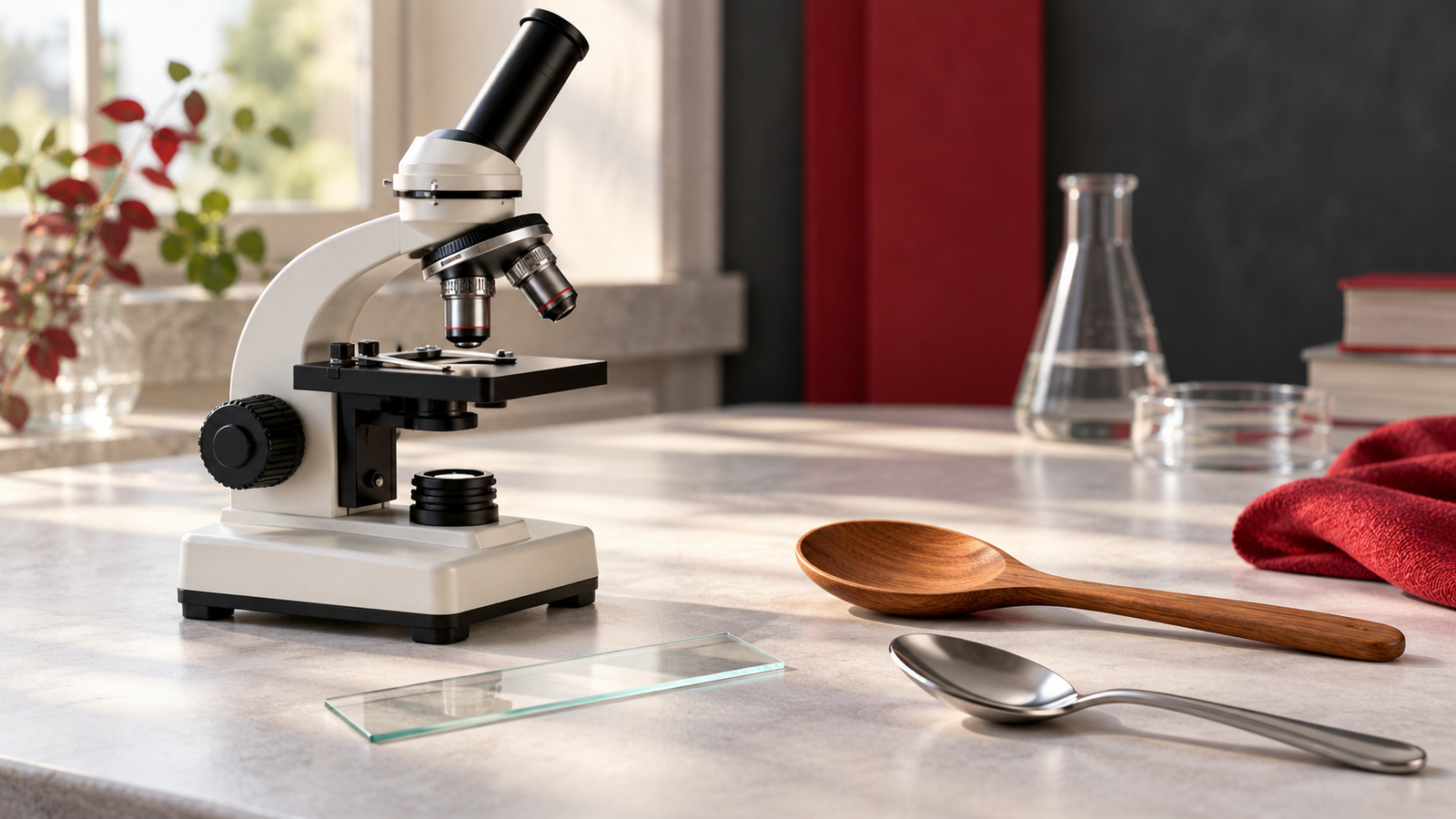
Why a Metal Spoon Feels Colder Than a Wooden One
Key Points:
- Materials at the same room temperature can feel different because heat transfers differently.
- Touch is an observation about the interaction with your skin, not a reliable temperature measurement.
- Use ordinary room-temperature objects for the suggested observation; avoid hot, cold or hazardous materials.
- Keep the observation, explanation and any actual measurement separate in your notes.
Touch a room-temperature metal spoon and a wooden utensil that have been sitting in the same room. The metal will often feel colder. That sensation does not necessarily mean that the metal started at a lower temperature.
Your skin notices a change
When your hand is warmer than an object, thermal energy can move from your hand into the object. Materials differ in how readily they conduct that energy. OpenStax College Physics explains conduction and thermal conductivity: metals generally conduct heat more readily than materials such as wood.
The result is a faster cooling of the skin in contact with a typical metal object. The sensation is about an interaction between your hand and the material. It is not a reliable thermometer reading of the material itself.
An original room-temperature observation
- Choose a clean metal spoon and a clean wooden utensil. Leave both in the same indoor location long enough to settle near room temperature.
- Briefly touch each with a dry hand. Use only ordinary room-temperature objects. Do not heat, chill, taste, or press them against sensitive skin.
- Write down which feels colder and what other differences you notice, such as the contact area or surface texture.
This is a qualitative observation, not a measurement of thermal conductivity. Different shapes, finishes, moisture, and starting temperatures can influence the result. If the objects were stored in different places, you have not controlled their starting conditions.
Temperature and heat are not interchangeable
Temperature describes a thermal state. Heat describes energy transferred because of a temperature difference. Two objects can begin at approximately the same temperature yet exchange energy with your hand at different rates.
An everyday analogy is two routes out of a parking lot: the starting location may be similar while the rate of movement differs. The analogy only illustrates rate; energy transfer is not literally traffic, and the material does not contain a substance called cold.
Why the explanation matters
Do not infer that a surface is safe to touch just because its material usually feels comfortable at room temperature. The same material that readily draws energy from your warmer hand can transfer energy toward your skin when it is hotter. This article is not a method for checking cookware or other potentially hot surfaces.
No special equipment is needed for this question. The useful lesson is to separate the sensation you observe from the physical quantity you want to measure. That distinction returns in our guide to magnification and detail.
Separate the sensation from the temperature claim
Touch gives information about heat exchange at the skin, but it does not function as a complete thermometer reading. A material can feel colder because of how heat moves between it and your hand, even when another material has been in the same room. This is why the observation needs a physical explanation rather than a simple conclusion that the colder-feeling object must have a lower temperature. The OpenStax conduction chapter cited above provides the relevant foundation for heat transfer through materials.
An original observation should stay within safe, ordinary room conditions. Use clean objects that have been resting in the same environment, and avoid anything heated, chilled, sharp or connected to electricity. Do not use touch to judge whether a surface is safe. The educational question is why familiar materials can feel different, not how much heat or cold a person can tolerate. If an activity cannot be performed safely and comfortably, use a written thought experiment instead.
| Keep track of | Reason | Limit |
|---|---|---|
| Where objects rested | Different surroundings can affect their temperatures | Shared room location does not guarantee identical conditions |
| Material and shape | The contact and heat-transfer situation can differ | One spoon does not represent every object of that material |
| Contact description | Sensation is the observation being discussed | Do not convert a feeling into an exact temperature |
| Measurement method, if used | An instrument answers a more specific question | Its own limits and setup still matter |
Think in terms of a system
The relevant system includes your skin, the object and the surrounding environment. The experience is not a permanent property called coldness stored in one material. Heat exchange depends on the conditions and the materials involved. A useful explanation therefore identifies the direction of heat flow and the initial situation. If an example changes from a cool room to a hot surface, do not assume the same sensation or practical conclusion follows merely because the material name remains the same.
For a conceptual example, compare a material that transfers heat readily with one that transfers it less readily under otherwise similar conditions. The difference can influence how quickly energy moves at the contact. That explanation does not mean every metal object always feels colder than every wooden object. Initial temperatures, geometry and contact matter. The original observation is a way to introduce conduction, not a universal ranking that ignores the rest of the physical situation.
Why an analogy needs a boundary
People sometimes describe a material as pulling cold into the hand. That phrasing can feel intuitive, but it can obscure the direction of heat transfer. A clearer account describes energy moving between objects at different temperatures. The word cold is useful in everyday experience; it is less precise as an explanation of the mechanism. Rewriting the sentence in terms of heat flow can reveal whether the physical account is actually consistent.
Try a short explanation exercise. Write what you observed in one sentence, then write a separate sentence about the proposed mechanism. The first might say that one object felt cooler at contact. The second should explain the heat-transfer situation without claiming an exact temperature that was not measured. Keeping observation and explanation separate makes it easier to correct a mistaken mechanism while preserving the genuine experience that prompted the question.
Measurement introduces its own questions
If an appropriate thermometer is used, read its instructions and understand what quantity and location it measures. A room-air reading is not automatically the surface temperature of every object in the room. An instrument with an unsuitable method or setup may not answer the intended question. This article does not test thermometers or provide a calibration procedure. The useful lesson is to match the measurement method to the question rather than assume any digital reading settles the entire comparison.
Record the unit, instrument, location and time if you make a safe measurement. Avoid adding decimal places through calculations that imply more certainty than the observations support. A table can show the observations without turning them into a claim about universal material properties. If you have not controlled or measured an important factor, identify it as a limitation. That is part of a sound learning exercise, not a reason to invent a more conclusive result.
Connect the concept to everyday design
Objects are designed with different materials for different functions. A handle, cooking surface and insulating layer may serve different purposes, so a material’s ability to transfer heat can be helpful in one place and undesirable in another. This is a conceptual application of heat transfer, not a tested recommendation for a particular product. A buying decision also needs current manufacturer information, intended use, durability and safety instructions rather than a single material label.
For an original shopping question, ask what part of an object must exchange heat and what part should limit contact with it. Then read how the manufacturer describes the design and use conditions. Do not infer that a wooden component makes an entire product safe at any temperature, or that a metal component is necessarily unsuitable. The full design and instructions matter. Scientific concepts help formulate better questions; they do not replace product-specific evidence or precautions.
What a useful explanation should retain
The core distinction is between temperature and the sensation produced during heat exchange. A clear account names the materials, initial conditions and limits of the observation. It does not claim that the experiment measured a material constant or that touch can certify safety. The educational value comes from noticing an apparent puzzle and using a physical concept to explain it more precisely, with uncertainty left visible where the setup does not settle the question.
You can extend the learning by explaining the same idea in your own words and checking it against the OpenStax source. Avoid copying the textbook’s examples or diagrams into a public article without considering their terms and attribution. An original explanation and a clearly labeled observation plan can stand on their own while linking readers to the authoritative educational foundation. The result should be a better understanding of heat transfer, not an exaggerated claim about what a spoon can prove.
Sources and further reading
- Rice University OpenStax. College Physics 2e: Conduction.