Choosing Your First Microscope: Start With What You Want to See
Key Points:
- Start with the specimen and question, then choose a viewing setup that fits them.
- Distinguish surface viewing from tasks involving prepared teaching slides.
- Include the stand, illumination, accessories, compatibility and return conditions in the comparison.
- These are selection criteria, not endorsements or results from testing named models.
Guide method: This is a selection framework, not a tested product ranking. There are no affiliate links in this guide. Check current manufacturer documentation before buying.
The best starting question is not how powerful a microscope is. It is what you want to examine and how you want to use the image. Write down three likely specimens before looking at product bundles.
Match the arrangement to the job
OpenStax Biology introduces light microscopy and the importance of resolution. Building on that distinction, use the following as a shopping framework. The exact capabilities of a candidate instrument must come from its manual.
| Your goal | A type to investigate | Check before buying |
|---|---|---|
| Inspect larger objects and their surfaces | Stereo or dissecting microscope | Working space, top lighting, focus range, and whether both eyepieces work for you |
| Study suitable teaching slides | Compound light microscope | Objectives, transmitted illumination, stage controls, and slide compatibility |
| Share or save an image on a screen | A microscope with an appropriate camera, or a digital instrument | Supported software, captured resolution, export formats, and stand stability |
Digital describes an imaging arrangement; it does not guarantee a particular optical quality. A camera can be part of more than one microscope type. Avoid treating these descriptions as rigid, mutually exclusive product categories.
Price the complete setup
List the instrument, lighting, power supply, suitable teaching specimens, any camera adapter, software, and storage. Compare the complete cost rather than the headline price. A bundle is useful only when its extras serve your intended activities.
Check usability before extra features
Can the user comfortably reach and turn the focus control? Is the specimen held steadily? Does the manual explain setup and maintenance in a language the user understands? Are replacement parts and support available? For a child, an adult should assess the complete activity, not just the age printed on the instrument.
The American Chemical Society safety guidance emphasizes reading instructions and following activity-specific precautions. A microscope purchase does not make every possible specimen safe to collect or handle. Start with appropriate prepared teaching materials, and avoid bodily samples and unknown cultures.
When to postpone a purchase
If you cannot name the objects you want to examine, borrow an instrument or explore a supervised class first. If the goal is simply to inspect a large surface, a basic magnifier may already answer the question.
We have not used this framework to award product scores. It is designed to help you ask better questions of a seller and avoid paying for a large magnification claim that does not serve your purpose.
Make a specimen-and-use brief
Write a short brief with three likely objects or teaching materials, who will use the instrument and what output is needed. Include whether the goal is direct viewing, group discussion, photographs or a saved observation record. This prevents the purchase from being driven by a large magnification claim before the actual task is understood. A brief can also reveal that access to a borrowed instrument or a supervised class would answer the initial question without immediate ownership.
For an original example, a household may want to explore suitable prepared slides occasionally, while a teacher may need a stable image on a shared screen. The same bundle may not fit both purposes. These examples are planning scenarios, not product tests. A useful guide should explain how requirements differ and direct readers to current manuals and appropriate demonstrations rather than award one universal best-beginner label without documenting the needs and evidence behind it.
| Requirement | What to specify | Evidence to request |
|---|---|---|
| Specimen | Object size and desired feature | Documented suitability and relevant sample images |
| User | Viewing comfort and control needs | Manual, supervised demonstration or return option |
| Output | Direct view, still image or video | Actual supported capture and export information |
| Setup | Workspace, lighting and power | Complete included-parts list |
| Ownership | Storage, cleaning and support | Maintenance instructions and current service terms |
Distinguish essential parts from attractive extras
A bundle may contain many accessories while omitting something important for the intended task. Read the included-parts list and compare it with the complete setup described in the manual. Identify which extras are useful, which are consumable and which require additional preparation or supervision. Counting accessories is not a quality measure. A smaller, clearly documented setup may be more useful than a large kit whose contents do not support the activities you actually plan.
For a hypothetical budgeting exercise, list the instrument, suitable prepared materials, any required adapter, lighting, power and storage. Add current prices only after checking them directly. A lower checkout price can become a higher complete cost if essential parts are separate. The calculation should be labeled as a budget, not a tested value score. It does not establish optical quality, durability or educational benefit, all of which require different evidence and a clear statement of the intended use.
Read sample images as evidence with conditions
Ask which instrument configuration produced a sample image and whether processing was applied. A photograph from an unrelated or upgraded setup cannot automatically validate the entry-level bundle. Equally, a poor image taken with an unsuitable specimen or setup may not fairly describe the instrument’s capabilities. Context matters in both directions. A good comparison identifies the method and limitations rather than treating an attractive gallery or one disappointing photograph as a complete evaluation.
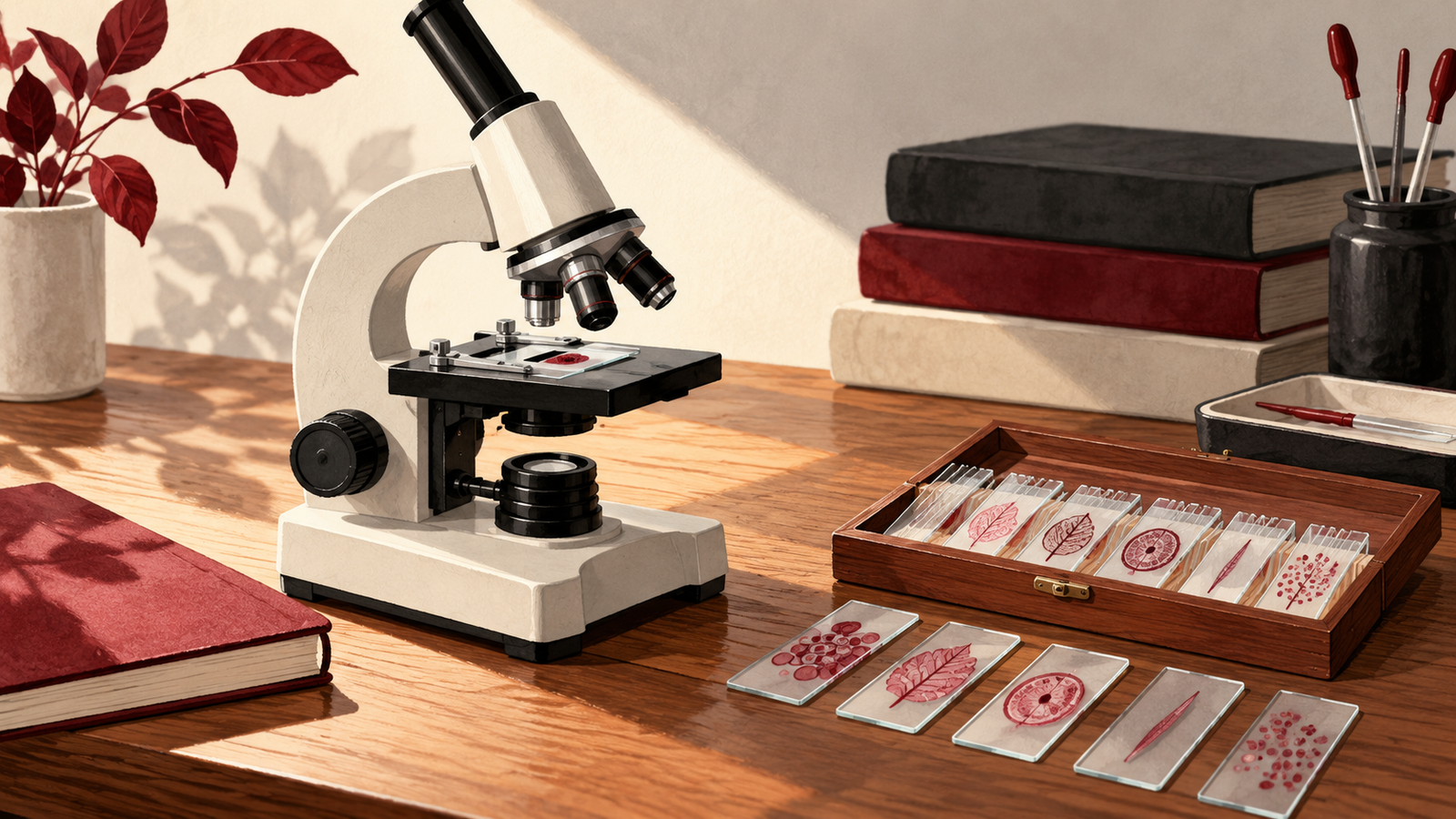
Our editorial illustrations are not observations from instruments tested by Science Chronicle. They should not be used as product evidence. A future hands-on review would need to document the exact equipment, specimens, setup and results, including problems. Until such work is performed, the appropriate label is research-based selection guidance. That distinction allows the guide to be useful without inventing ownership, laboratory experience or an independent test that has not actually occurred.
Evaluate the controls and viewing arrangement
Think about whether the user can reach and operate the focus controls, position the specimen and view comfortably. A screen can help with sharing but also introduces compatibility, capture and privacy questions. Eyepiece viewing has different practical considerations. The right arrangement depends on the task and user. These are requirements to investigate rather than assumptions that a particular age label or product category guarantees comfort for every person.
If a demonstration or legitimate trial is available, choose an appropriate prepared material and check whether the user can complete a simple intended activity. Do not begin with a difficult or unsafe specimen to make the test look impressive. An informal demonstration can reveal usability issues, but it is not a complete optical evaluation. Record what was actually tried and avoid extending the conclusion to every objective, specimen or accessory the instrument can theoretically support.
Plan care and storage before purchase
An instrument needs a suitable place to be stored and used according to its instructions. Check cleaning guidance, replacement parts and support availability. Do not improvise lens-cleaning methods or chemical substitutions from an unrelated online tip. The manufacturer’s current manual is the starting point for product-specific care. A buying guide should help readers locate and understand that information, not replace it with one generic maintenance rule applied to every instrument.
An original ownership checklist can ask where the instrument will stay, who can supervise activities when needed and how materials will be stored safely. If those questions are unresolved, postponing the purchase may be sensible. Owning equipment is not the only route to learning science. A library, school, museum or supervised educational program may offer an introduction with support and appropriate materials, although local access and conditions need to be checked directly.
Use a decision rule rather than a popularity contest
Choose essential requirements that must be met before considering optional features. For example, a documented viewing arrangement and suitable teaching-material support may matter more than an advertised maximum multiplier. If a seller cannot provide the information needed to assess an essential requirement, mark it unverified. Do not compensate for missing evidence by adding points for an unrelated extra. A clear stopping rule makes the comparison easier to review and less vulnerable to a persuasive product photograph.
The best first microscope is therefore a question about fit, evidence and complete ownership, not a single universal model. This guide does not name a tested winner or imply that a purchase is required. Start with the specimen and task, understand the viewing arrangement, price the full setup and preserve safety and usability needs. Those steps give you a concrete basis for a decision that can remain useful even if the most appropriate outcome is to borrow, learn more or wait.
Sources and further reading
- Rice University OpenStax. Biology 2e: Studying Cells.
- American Chemical Society. Science Safety Tips.