
Accuracy, Precision and Uncertainty: How to Read a Sensor Specification
Key Points:
- Accuracy, precision and uncertainty describe different aspects of measurement.
- A repeatable number can still be systematically off target.
- Check the measurement range, conditions, reference and uncertainty before comparing specifications.
- Choose a sensor for the decision it must support, not the number of digits on its display.
A digital display can show several decimal places without measuring a quantity equally well. The display tells you how a result is presented; it does not by itself tell you how close that result is to the quantity being measured. Understanding accuracy, precision and uncertainty helps you read specifications for thermometers, air sensors, scales and other instruments without confusing a detailed-looking number with a dependable measurement. Start with the purpose of the measurement, then examine what the specification actually promises.
Three terms that should not be swapped
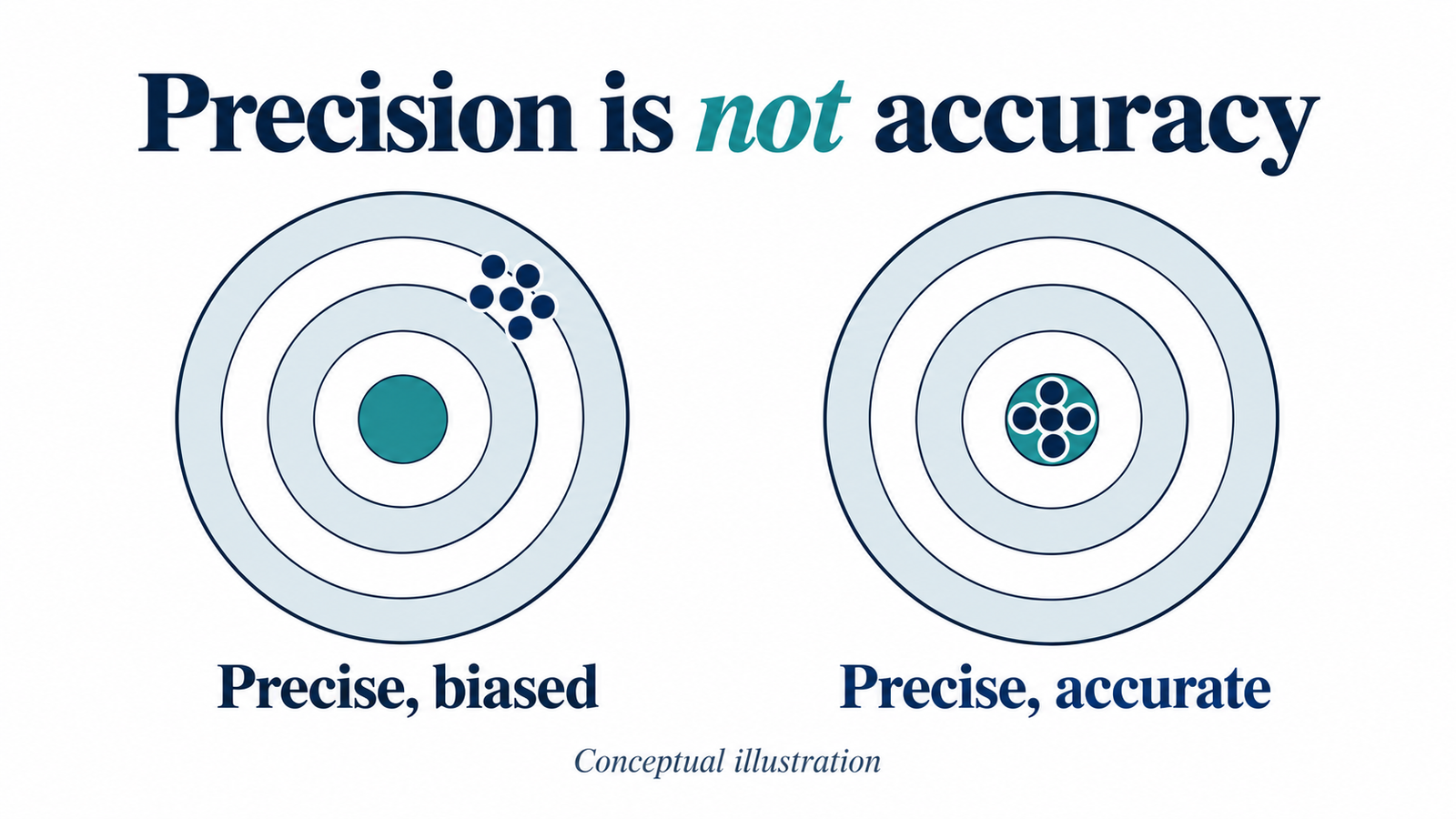
NIST Technical Note 1297's terminology appendix distinguishes accuracy from precision and discusses repeatability, systematic effects and uncertainty. Accuracy concerns agreement with the value being measured. Precision concerns agreement among repeated results under stated conditions. Uncertainty describes the doubt associated with a measurement result, using an evaluated range or other specified expression. These concepts work together, but a claim about one cannot simply substitute for evidence about the others.
Imagine a hypothetical scale that gives almost the same reading each time you place the same reference object on it. The readings are consistent, but the scale might consistently read too high. Repeating the measurement would reveal little scatter without revealing that offset. This is why a demonstration of repeatability should not be described as a complete accuracy check. You need an appropriate reference and a suitable comparison method to investigate agreement with the quantity of interest.
| Instrument | Three displayed results | What the pattern suggests | What still needs checking |
|---|---|---|---|
| A | 104.0, 104.1, 104.0 g | Little variation, possible positive offset | Reference quality and comparison uncertainty |
| B | 99.0, 101.0, 100.0 g | More variation around the nominal value | Whether conditions explain the spread |
| C | 100.0, 100.0, 100.0 g | Identical displayed values | Display rounding and actual measurement performance |
The table is not a test of real products. It shows why patterns need interpretation. Instrument C looks ideal, but identical displayed numbers can partly reflect rounding. The nominal reference value also has its own uncertainty. A proper evaluation considers the whole comparison rather than treating the reference as magically exact. For a consumer purchase, the practical lesson is to ask how a performance claim was established, not to conduct an improvised calibration beyond your knowledge or equipment.
Resolution is about distinguishable steps
A display changing in tenths has finer displayed steps than one changing in whole units. That may be useful, but it does not establish that each tenth represents a meaningful difference in the measured quantity. A specification should explain the conditions under which its claims apply. If an advertisement emphasizes decimal places while giving little information about evaluation or limitations, the extra digits should not be treated as a substitute for that missing evidence.
For an original shopping example, suppose two room thermometers show 21.3 and 21.6 degrees. Without knowing their specifications, placement and response time, you cannot decide that one is more accurate from those readings alone. One might be closer to a warm surface or still adjusting after being moved. The useful first action is to understand the setup and intended use, rather than select the device with the more reassuring-looking number or average the readings without justification.
Conditions belong inside the claim
Performance can depend on the measurement method and conditions. NIST’s terminology distinguishes repeatability under the same conditions from reproducibility when conditions change. A result obtained by one operator in one setting over a short period answers a narrower question than one tested across operators, locations or times. When reading a specification, look for the stated range, environment and procedure. A number detached from those details can be difficult to apply meaningfully.
Record the conditions you expect to encounter before comparing devices. A monitor intended to track broad changes in a room has a different purpose from an instrument used for a regulated decision. The required performance should follow the decision, not the other way around. This prevents paying for impressive specifications that do not solve your problem, while also preventing a convenient consumer device from being used for a purpose its evidence does not support.
Uncertainty is not an admission of failure
A carefully reported measurement can include uncertainty because measurement is an evidence-based estimate, not access to a perfectly known truth. NIST explains that uncertainty can be evaluated even when the actual measurement error is unknown. Do not interpret an uncertainty statement as proof that an instrument is poor. Conversely, the absence of a visible uncertainty statement does not prove that a device has none. It may simply mean that the advertisement does not provide that information.
If you see a plus-or-minus value, ask what it represents. Is it a manufacturer’s limit under specified conditions, an observed spread, a standard uncertainty or an expanded uncertainty? Those descriptions are not automatically interchangeable. A consumer need not calculate a complete uncertainty budget to recognize the question. When the answer matters to a technical or safety decision, seek appropriate professional guidance and documentation rather than inventing an interpretation from the symbol alone.
Calibration is a comparison, not a permanent guarantee
A calibration record can provide evidence about an instrument’s relationship to a reference under stated conditions. It does not establish that every later reading in every environment will be correct. Read the date, range, method and relevant uncertainty. If a seller says calibrated without explaining what was compared or how the claim applies to the device being sold, ask for the documentation. A label is less informative than a traceable, interpretable record.
Our proposed purchase worksheet separates the specification from the evidence. In one column, copy the manufacturer’s exact claim and units. In another, identify the supporting test or document. In a third, record the limits and whether your intended conditions fall within them. Leave unanswered cells blank or mark them unverified. This is more useful than awarding an overall accuracy score that merges incompatible units, test methods or environmental conditions into a single ranking.
A practical example: air-quality sensors
The EPA Air Sensor Toolbox distinguishes lower-cost sensors from regulatory-grade monitoring and provides resources for evaluating performance, planning studies and comparing sensors with reference monitors. The distinction does not mean consumer sensors have no use. It means their results need to be interpreted for the intended purpose. A small device can help explore patterns without becoming a regulatory instrument or an all-purpose assurance that indoor air is safe.
Before buying, identify the pollutant or quantity the sensor measures. An instrument reporting one quantity should not be assumed to detect unrelated hazards. Then examine the supporting evaluation and installation requirements. The EPA resource offers a route to more detailed guidance; it does not endorse a particular consumer product through this article. We have not conducted hands-on comparisons, and our framework should not be read as a tested recommendation for a specific monitor.
Use measurements to answer a defined question
A useful measurement plan states the quantity, unit, method, conditions and decision it will inform. For a simple household observation, that might mean tracking relative changes consistently rather than claiming a definitive absolute value. For a consequential technical decision, it may require a more suitable instrument and expert interpretation. The correct level of rigor depends on the purpose, but the need to describe what was measured remains the same.
When sharing results, preserve the units and avoid adding decimal places through calculations that imply more certainty than the input supports. Explain whether a number is a direct reading, a calculated average or a model estimate. A clear table can show repeated values and conditions without pretending they are exact. These habits make measurement more useful because they connect the number to the evidence behind it, rather than asking the display to speak for itself.